Console History
Below, we've listed the dates of the introductions of various consoles, from 1972 to the present. Who can forget the often heated debates regarding the virtues of Atari 2600 vis-à-vis the upstart Mattel Intellivision? Those same debates are going on right now, but the focus has shifted to PS2, GameCube and Xbox.
| INTRODUCTION | MANUFACTURER | BRAND NAME |
|---|---|---|
| 1972 | Magnavox | Odyssey |
| 1976 | Fairchild | Channel F |
| 1977 | Atari | 2600 |
| 1979 | Mattel | Intellivision |
| 1983 | Coleco | Colecovision |
| 1983 | Atari | 5200 |
| 1985 | Nintendo | NES |
| 1986 | Sega | Master System |
| 1986 | Atari | 7800 |
| 1989 | NEC | Turbografx 16 |
| 1989 | Sega | Genesis |
| 1990 | SNK | Neo Geo |
| 1991 | Nintendo | SNES |
| 1993 | Atari | Jaguar |
| 1995 | Sega | Saturn |
| 1995 | Sony | Playstation |
| 1996 | Nintendo | N64 |
| 1999 | Sega | Dreamcast |
| 2000 | Sony | PS2 |
| Fall 2001 | Microsoft | Xbox |
| Fall 2001 | Nintendo | GameCube |
From 'Tennis For Two' To 'Oddworld': Even Computer Games Have Traditions
We discern there to be three rival gaming traditions: two of them, text adventure and arcade, merging to become the first person shooters of Max Payne; and the latter tradition of simulation leading to Microsoft Flight Simulator 2000, Gran Turismo and even Munch's Oddworld .
And it may be difficult to believe now, but the first video game was developed at the Brookhaven Laboratories in 1958 by William A. Higinbotham and Robert V. Dvorak, the former an alumnus of the Los Alamos Project, to enliven the dreadful open houses held there.
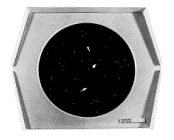
Much to the everlasting chagrin of Higinbotham and Dvorak, the games came free: it was the machine that cost. (The business model was like Gillette selling handles for the price of a Stealth Bomber and giving away the bombs, we mean, blades.)
The nerds of the MIT Rail Road Club, not to be outdone by the Geeks of Brookhaven, however, went on to invent a game called Space War . A whopping 9k in length, it debuted on the brand-new PDP1 and was the precursor to the arcade classic Asteroids. Space War , truly, was the first first-person shooter console game.
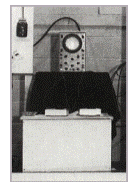
By 1979, widely distributed and collectively built, the game was over a megaByte. Commercial life called though, and the three designers formed their own company, called Infocomm. They were not happy being an entertainment company, however (that was for kids and kids had no money), and made the worst decision of their life, to go into business software. Their product was a natural language database called Cornerstone . It sank like a stone, and with it sank Infocomm.
Parallel to the efforts to market their business software, programmers started to deploy graphics on their machines, and text-based adventures lost their shine, though the idea of the immersive dungeon lived on.


