Killer App: Instant Messaging
Business users are increasingly turning to the same communications tool that individuals have employed for some time with great success: instant messaging (IM). IM describes a technology for exchanging text messages in real time, using networked software, usually over the Internet. IM programs can move messages among two or more users, to which they can respond as quickly as their fingers can fly across their keyboards. In fact, IM fills the communications gap between phone calls and e-mail quite nicely, in that it's less intrusive than a phone call, and more synchronous than e-mail.
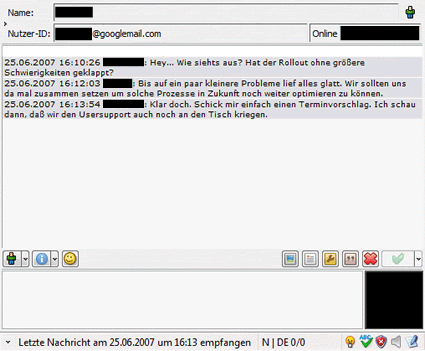
IM has gradually crept into the workplace, given its big advantage of real-time communication.
The software and messaging networks needed to make IM work are available for free from mega-sized service providers such as AOL, Yahoo, or Microsoft. The Israeli company Mirabilis was one of the first companies to offer IM software along with the necessary underlying messaging infrastructure. Released in 1996, many readers may recognize this program by its name: ICQ. Following its debut, its user base swelled dramatically because it outstripped any of the other alternatives available at the time.
An Embarrassment Of Options: AIM, ICQ, Live Messenger, And More
In 1998, AOL acquired Mirabilis. Because AOL already offered its own AOL Instant Messenger (AIM) service to its user base, it added support for the ICQ messaging protocols to AIM, and vice-versa, so that AIM and ICQ users could exchange messages freely. This gave birth to one of the largest worldwide IM networks, with nearly 400 million registered users and a 50-plus percent share of the instant messaging market.
Along with AOL, Microsoft and Yahoo have also marched into the IM marketplace. This has led to something of an IM war, as these major players seek to attract users, and each player stresses its features, functions, and advantages compared to the others. With its Windows Live Messenger - formerly known as MSN Messenger - Microsoft has parlayed its position into a user base of nearly 300 million, which makes Live Messenger the most frequently used IM program today. Compared to Microsoft and America Online, Yahoo has a modest user base in the tens of millions. At the end of September, 2006, Microsoft and Yahoo ended a two-month beta test where they interlinked their two IM networks.
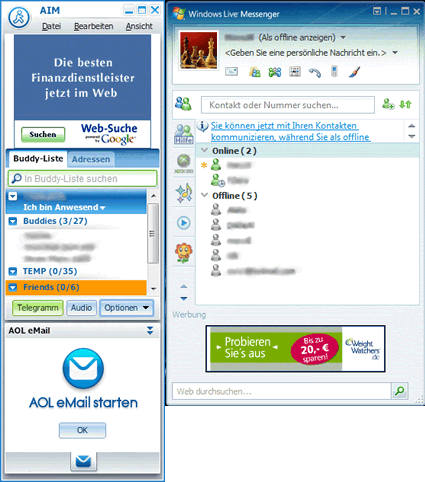
AOL Instant Messenger and Windows Live Messenger are the two IM services with the largest user bases. In addition to sending and receiving messages, clients for these services must also put up with lots of advertising.


