GeForce3's New Vertex Shader - A Poor Name For A Great Set Of Features
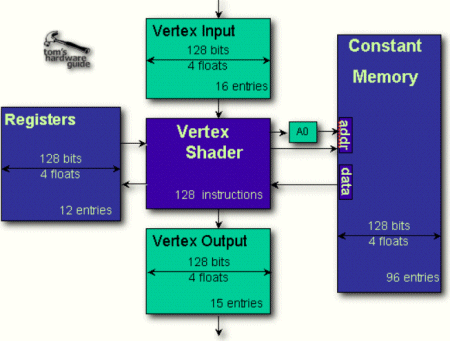
The new so-called 'Vertex Shaders', first part of GeForce3's 'nfiniteFX Engine' is one major, if not the most important new feature of GeForce3, using a major amount of the 32 million transistors that GeForce3 has over GeForce2. This unit with the rather badly chosen name is capable of a whole lot more than just 'shading vertices'. I would rather have called it 'Vertex Processor'. It enables developers of 3D applications to apply special programs to each vertex of an object or a complete scene (frame) that are executed within GeForce3, thus not requiring any CPU-resources.
To explain what that actually means I need to go back to the 3D-pipeline.
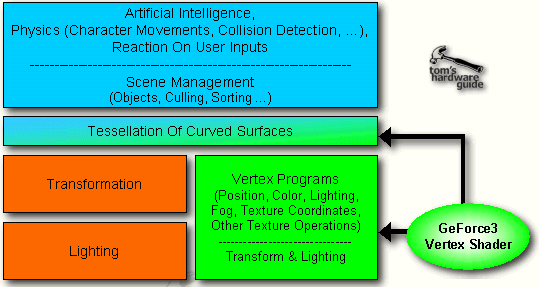
What you see up there is the first stages of the 3D-pipeline before the view port mapping and the triangle setup. The whole 3D-pipeline is executed for each rendered frame.
First of all the 3D-application, let's say a 3D-game, is providing the game AI, the game physics, responses to user inputs, scene management and more. The tessellation of curved surfaces means the conversion of curved areas (such as e.g. arches) into polygons or rather triangles. It is only done by a few current games. So far this was always done in software and thus executed by the CPU. GeForce3 is able to take over this job and I will get to that later.


