Yorkfield Overclocking
Most of us can't even afford the currently-available QX9650, let alone hope to find the QX9770 that's said to be around a month away from its release. Yet if past processors are any indication of future trends, today's fastest samples will provide a good indication of the overclocking capabilities of tomorrow's mainstream parts.

The only noticeable difference between the Core 2 Extreme QX9770 sample EU80569X088NL at this lab and the one our German colleagues used can be found on the LGA package, which is identified as "ID6" rather than "ID2". (Anyone who believes the "black" characters of its heat spreader markings are some sort of Photoshop trickery should note that flatbed scanners show reflective surfaces in black, whereas the markings would appear polished without the help of this technology.)

Four-core Yorkfield processors have been around for only a short time, so we've yet to collect enough data on them to determine a "good" maximum overclocking voltage that doesn't significantly decrease useful life. This author instead took an educated guess that 1.450 volts might be a good stopping point, a voltage that yielded only 4.20 GHz maximum stable speed. This represents only a mild improvement from the 4.00 GHz that this same processor is capable of using air cooling at 1.400 volts.
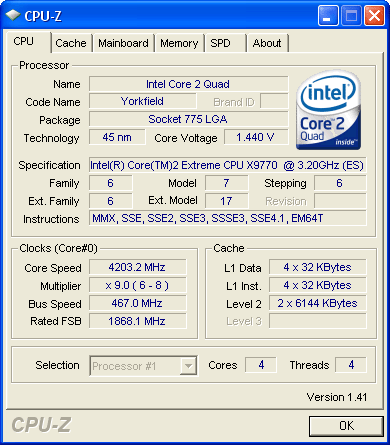
Another thing we noticed was that the QX9770 wasn't stable at 500 MHz FSB no matter what multiplier we selected. Like the Core 2 processors that went before it, this lack of high bus speed capability is probably limited to the four-core Yorkfield version, so we might yet reach higher bus speeds using a dual-core Wolfdale. At 4.20 GHz, our choices were either 10x 420 MHz or 9x 467 MHz, and the later provides a slightly higher FSB data rate. Had this not been an "Extreme Edition", the low 8x stock multiplier would have prevented us from reaching the highest possible core speed.
Of course, we really wanted to see what it would take to reach 5.0 GHz, but increasing the core voltage setting beyond 1.500 volts let the heat monster out of the box. Each tiny increase in voltage brought with it a huge increase in temperature that we simply couldn't remove fast enough. We could have tested the CPU at 4.30 GHz using 1.4875 V, but the difference of 100 MHz didn't seem worthy of the increased risk when taking our CPU beyond the cooler-running 1.450 V setting.