Join for quick access. Enter your email below and we'll send confirmation plus sign you up to our newsletter.
By submitting your information, you confirm you are aged 16 or over,
have read our
Privacy Policy
and agree to the
Terms & Conditions. Geographical rules apply.
Join for quick access. Enter your email below and we'll send confirmation plus sign you up to our newsletter.
By submitting your information, you confirm you are aged 16 or over,
have read our
Privacy Policy
and agree to the
Terms & Conditions. Geographical rules apply.
Stay On the Cutting Edge: Get the Tom's Hardware Newsletter
Get Tom's Hardware's best news and in-depth reviews, straight to your inbox.
You are now subscribed
Your newsletter sign-up was successful
Join the club
Get full access to premium articles, exclusive features and a growing list of member rewards.
An account already exists for this email address, please log in.
Researcher turns wi-fi smart lightbulb into a Banned Book Library — open source project makes digital books available via a server and open Wi-Fi access point hacked into an ESP32-powered bulb
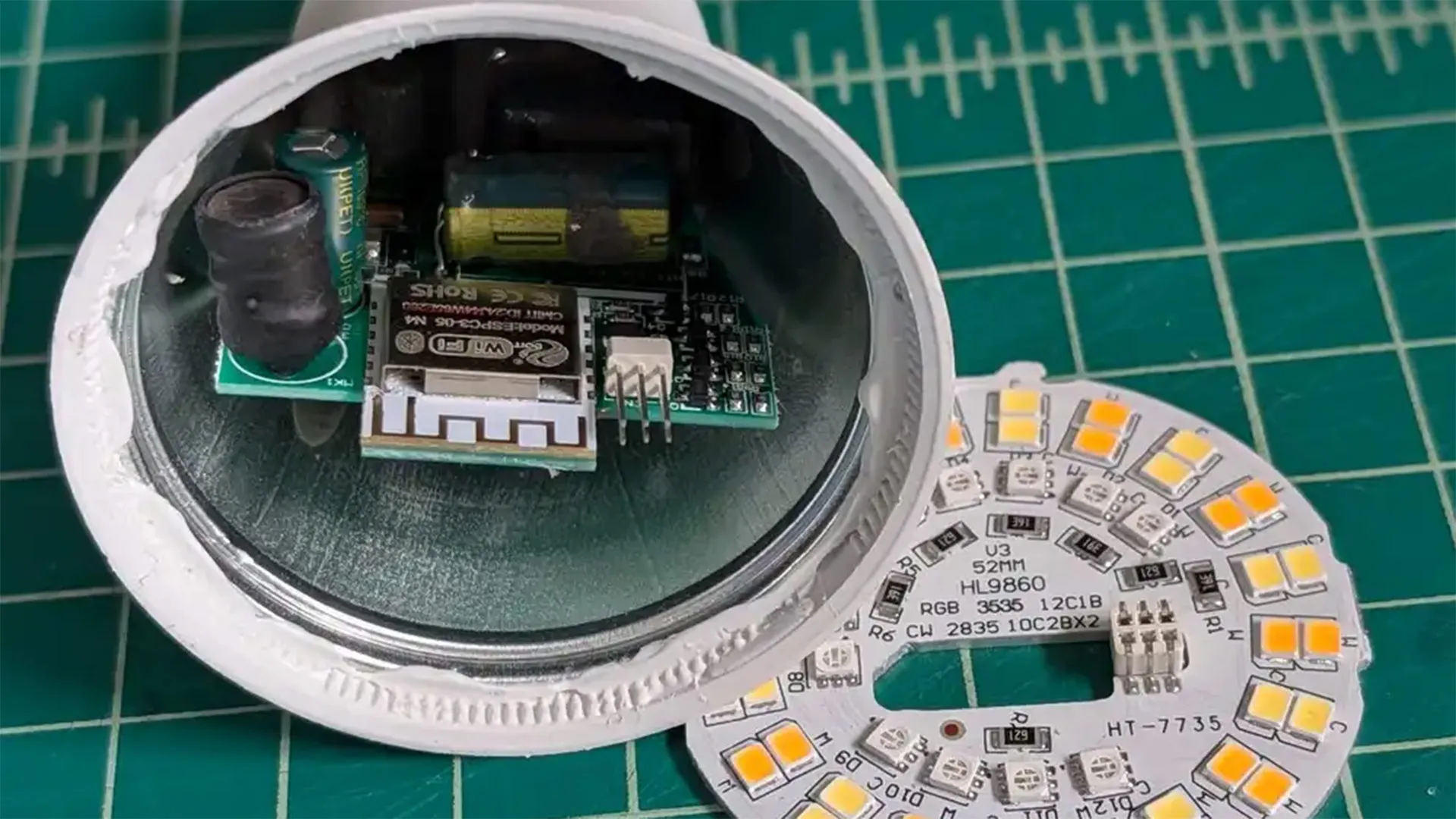
A security researcher has added another dimension to smart lightbulbs by using them to store a library of banned books, creating what they describe as a “cyberpunk digital dead drop.” Rick Osgood wrote about the idea behind the Banned Book Library on his personal blog, alongside a retelling of the process to create a working prototype. Meanwhile, all the code is open source and available via Codeberg. So, anyone interested can acquire some ESP32-powered smart lightbulbs and distribute stealthy banned book libraries of their own.
Osgood notes that he was pondering making smart lightbulbs more useful. As someone “interested in infosec, open-source software, making things, breaking things,” he found inspiration in Ben Brown’s short story of anti-corporate tech resistance, called ‘Library.’ After that lightbulb moment, Osgood knew he wanted to make a small, inexpensive, cyberpunk‑style digital dead drop, designed for resilience and stealth – by reprogramming smart lightbulbs.
The security researcher chose a Tasmota‑flashed ESP32C3 smart bulb as the starting point for the stealth library project. As this device only has 4MB on board in total for everything, including the OS, and not much spare capacity left over, Osgood spent a considerable amount of time and effort wrangling with adding a microSD reader. However, this expansion effort proved fruitless, and thus he decided to live with the total capacity 4MB limit for the sake of sanity, convenience, and stealth.
Once Osgood accepted the 4MB storage limitation, a key task was to expand the existing ~320KB of free space for the filesystem as much as possible. After some optimizations and tuning, he managed to reserve about half of the total storage space available for banned books. We also assume some kind of text compression is used to make the best use of the limited capacity.
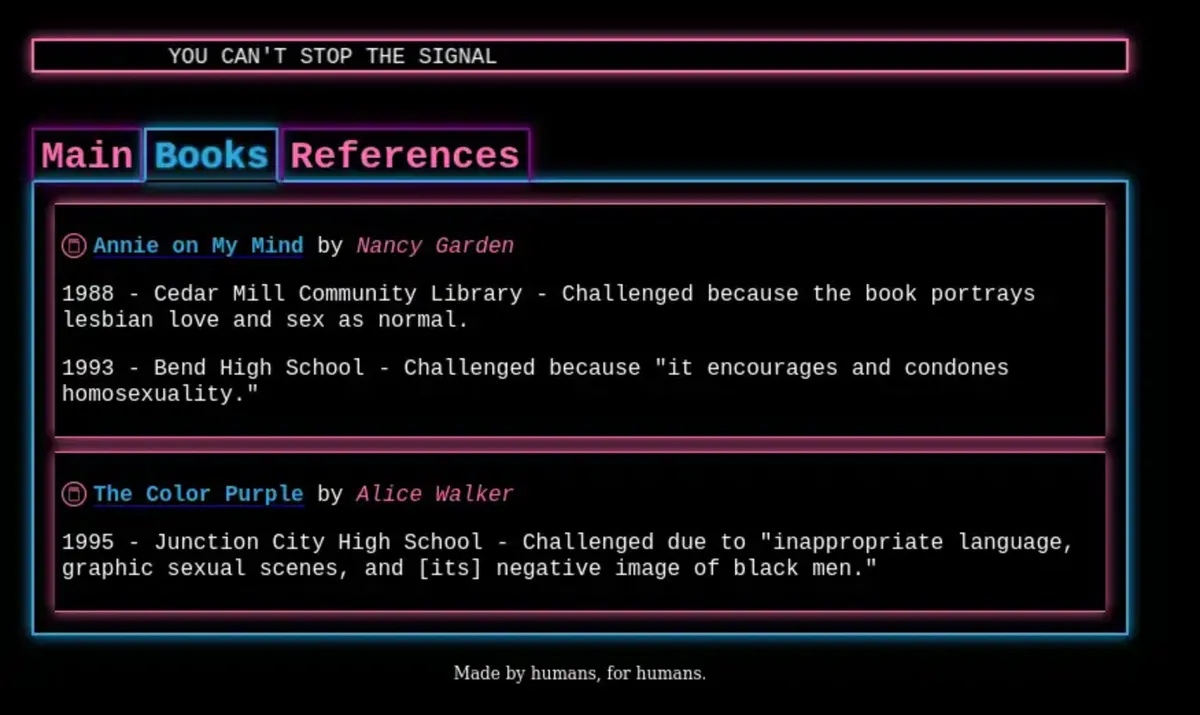
Thus, the current working prototype runs some custom ESP32 firmware, broadcasts an open Wi-Fi network, and hosts a server, with about half of the total capacity of the smart lightbulb left over. That means the all-important LittleFS library partition can be stuffed with almost 2MB of banned books. Osgood's example files use a selection of old public domain titles, presented in a CSS contents page. However, those who set up the lightbulbs will of course want to add their own digital tomes. Guidance for this, and for updating admin settings, and more is provided on the linked blog and Codeberg pages.
The Banned Book Library supports OTA updates. It is also worth mentioning that no cloud services are required, and no sensitive credentials need to be saved on the device. Please remember that modifying your smart lightbulb firmware could ‘brick’ it, so follow the linked guides at your own risk. Finally, also be careful carrying your banned book-stuffed smart lightbulbs when traveling internationally.
Mark Tyson is a news editor at Tom's Hardware. He enjoys covering the full breadth of PC tech; from business and semiconductor design to products approaching the edge of reason.
The small storage capacity might be too small to hold the books themselves, unless....
You could use the space as an index for content-based addresses that work regardless of the location of the data, meaning that you could the book metadata (title, author, etc) and the book's content ID. The actual content could be retrieved from anywhere else in the world based on its content. Much like file sharing protocols like napster.
Or you could go a step further and do erasure coding on the media to be stored, and spread it across a thousand devices - even if they're in separate locations or each behind separate consumer firewall devices. Basically forward error correction using reed Solomon or similar, and spread that across something like a bunch of iroh nodes with a lightweight service discovery mechanism.
All of the components needed exist as Rust crates that I think might be no-std friendly and therefore ought to be easily ported to the ESP32-C3....
Not wanting to be that guy that replies to their own post, I'm going to be that guy that replies to their own post. The iroh crate can't yet do no_std, but I'm sure that the general approach could still be made to work another way....