









Experiment shows liquid metal TIM doesn’t dry out; it turns solid — two-year electron microscope test finds gallium bonds with copper coolers, and nickel plating keeps the layer about 10 times thinner
Liquid metal’s hardened layer conducts heat about a quarter as well as the copper it replaces.

YouTuber hardware enthusiast and Thermal Grizzly boss der8auer tested a two-year-old liquid metal thermal interface material (TIM) application with an electron microscope in his new video, discovering that it doesn’t dry out. Instead, the gallium bonds with the copper in a reaction to form a solid compound. On copper, that layer’s heat conduction performance is about one-quarter of the bare metal’s, and nickel plating keeps it about 10 times thinner.
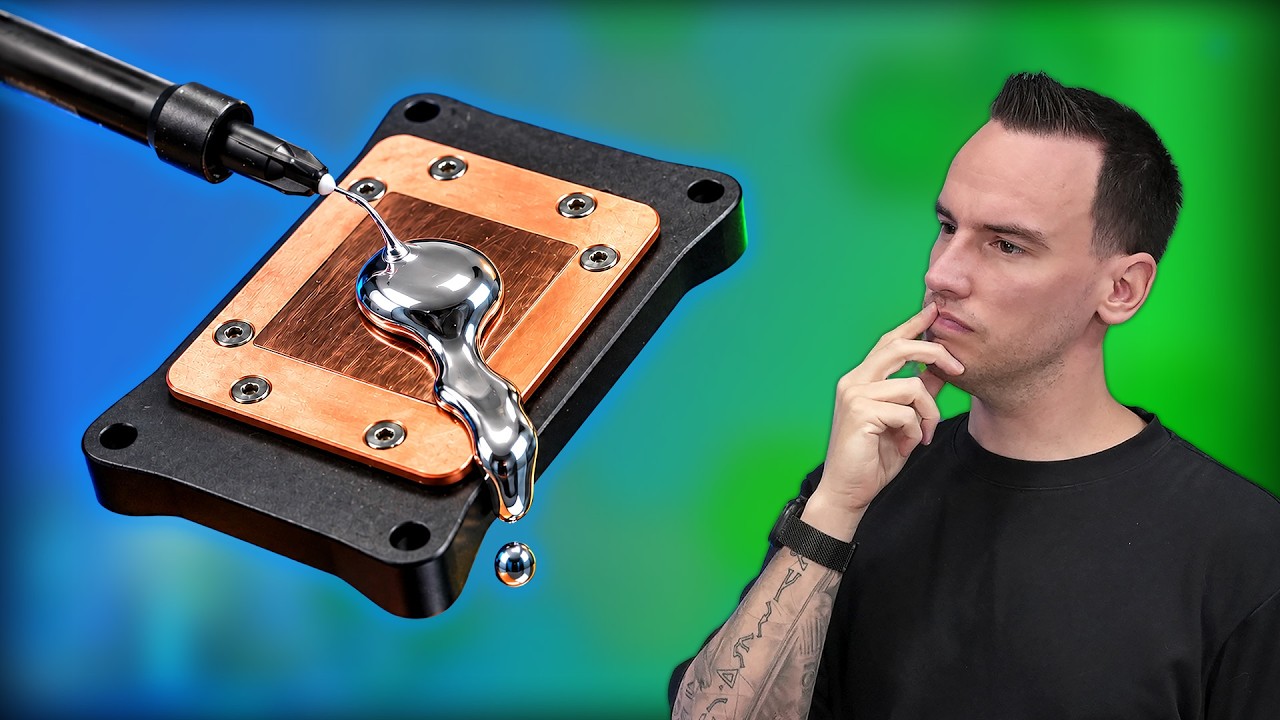
His test showed the TIM as liquid after one hour, no liquid visible with crystals everywhere at the two-month mark, and then unchanged after two years. “After a total of two years, this honestly did not change further,” he said. The test relied on storing the setup in a vacuum or a nitrogen-filled box between sessions to avoid oxidation.
The TIM in question is an alloy of gallium and indium, often including tin, which is liquid at room temperature (Thermal Grizzly sells its own as Conductonaut); gallium melts at about 30 degrees Celsius, with the gallium-indium-tin mix melting at only 11 degrees. Improving cooling at the interface bottleneck is becoming a real issue as heat per surface area continues to rise. His examples are the RTX 5090 and RTX 5080, which he says have “twice” and “three times” the power density of the 8800 GTX.
How the liquid metal reacts depends on the cooler material. With aluminum, the gallium travels along the grain boundaries once the oxide layer is broken, and this weakens the metal. His demo on a scrap 2 mm aluminum sheet showed surface swelling after about five minutes, and it became brittle within half an hour. This reaction has been “common knowledge for a very long time.”
With copper, the liquid metal on the cold plate of Thermal Grizzly’s new stainless steel water block can’t be wiped off with isopropyl alcohol or acetone after less than five minutes. The gallium bonds with copper to form CuGa2, one copper atom to two gallium atoms, with the leftover indium and tin forming other solid areas. This makes the film look like it is solidifying. CuGa2’s heat conductivity is rated at about 100 W/mK versus copper’s roughly 400. Since CuGa2 stays solid up to about 254 degrees Celsius, “you will not be able to melt it again.”
The layer grows about 1 micrometer a day until it reaches about 50 to 100 micrometers, depending on temperature and how much gallium is available; his example of pure gallium between copper plates at 70 degrees Celsius shows about 4 micrometers over 96 hours. The liquid metal “doesn’t really dry out”; it “reacted chemically and it formed a solid compound,” so the metal is still there in another form.
On nickel-plated coolers, the gallium forms NiGa5 instead, one nickel atom to five gallium atoms, which is also solid at room temperature. The nickel plating stops the layer at about 10 times thinner, at 1 to 5 micrometers, or 5 to 10 micrometers on his slide, but NiGa5 conducts heat worse than the copper-gallium compound. However, nickel is “most of the time superior” in his estimation because much less gallium gets absorbed into the surface, and it protects the copper underneath.
Get Tom's Hardware's best news and in-depth reviews, straight to your inbox.
Removing the residue is tricky, and he recommends Thermal Grizzly’s TG Metal Polish & Restore, with a chemical that lowers gallium’s surface tension. The company’s Sept. 30 blog post describes it as a surfactant that binds gallium to stop it from re-sticking. It costs $22.11 direct for 30 g of paste, a polishing pen, and microfiber cloths. His demo showed fresh film coming off bare copper. A PC Games Hardware forum user used it to clean an Aqua Computer block that had run liquid metal on a delidded Skylake-X since 2018, with removal taking about an hour.
This isn’t a TIM for the average user, and he recommends that it should “stay in the enthusiast bubble,” intended for very high power density components like a manually overclocked CPU. Thermal Grizzly aims to replace nickel with new coatings, “hopefully next year.” It also plans to release a new version of its KryoSheet graphene pad for bare dies shortly, which he says is maybe three or four degrees worse than liquid metal but worth a try, “especially if you look at the pricing.”
For cost, he points out that his company pays almost 10 times as much for gallium after five years, from €300 per kilogram to €2,500–3,000. Prices have more than doubled since the start of 2025. China supplies 99% of the world’s gallium, and its ban on gallium exports to the U.S. is suspended only until Nov. 27, 2026, with export licenses still required.

Follow Tom's Hardware on Google News, or add us as a preferred source, to get our latest news, analysis, & reviews in your feeds.

Shane Downing is a Contributing Writer for Tom’s Hardware, covering consumer storage, PC hardware, and AI.
-
MrN8 I have seen the tests and the charts and I am fully aware that liquid metal cooling compound beats traditional thermal compound by a large margin. I have also seen how easily it can destroy expensive hardware in seconds. It is too risky to use in my opinion. Even when it is applied correctly with good quality seals and dams damage often occurs. Thermal cycling of the system over time causes "pump out" where the liquid metal eventually gets squeezed out from behind the dam or seals and the second it contacts any metal conductive parts, your system fries often spectacularly. Too much risk. Just get a liquid cooling loop. Works very well and have much less risk of destroying your system. With hardware prices what they are now, it is an even bigger investment you risk for what?Reply -
EzzyB Reply
Yeah, I've looked at it in the past. It always came down to me asking, "do you really want to risk having to be absolutely perfect with this stuff?" The answer and always been "nope!"MrN8 said:I have seen the tests and the charts and I am fully aware that liquid metal cooling compound beats traditional thermal compound by a large margin. I have also seen how easily it can destroy expensive hardware in seconds. It is too risky to use in my opinion. Even when it is applied correctly with good quality seals and dams damage often occurs. Thermal cycling of the system over time causes "pump out" where the liquid metal eventually gets squeezed out from behind the dam or seals and the second it contacts any metal conductive parts, your system fries often spectacularly. Too much risk. Just get a liquid cooling loop. Works very well and have much less risk of destroying your system. With hardware prices what they are now, it is an even bigger investment you risk for what? -
Rand0m_Guy The answer are the Graphene sheets, these never dry out, easy to apply with no mess and perfect coverage, performs better than pastes. 2022 (COVID time) I used Kyronaut on my CPU, 5800X3D with an older EK-Quantum Velocity block from my previous CPU. In July I just replaced the TIM with a Kyrosheet, temps dropped 6C using OCCT. Peaks with Kyronaut were 86.1C, Kryosheet 80.3CReply -
leclod Does Tom's H really hide this subject, made by der8auer and accessible for free, behind a paywall ?Reply -
bit_user For removal, you could always use some 5000-grit sandpaper. It's usually sold for things like automotive detailing.Reply
I've lapped heatsinks and CPUs, which basically amounts to starting out with a coarse grit and then using successively finer grits of sandpaper on an extremely flat surface (e.g. a piece of high quality mirror glass). Wet sanding works best. The 5000-grit stuff is where you normally end, and it gives nearly a mirror finish to the metal. If you just started at like 2000 or 5000 grit, it probably wouldn't be enough to remove the nickle, but it'd probably work pretty well for removing the hardened metal TIM. -
bit_user Reply
I have Thermal Grizzly's Kryosheet in one of my machines. In my testing, it performed a little worse than fresh Arctic MX-6 (rev 2) paste , but I kept it because it was good enough for my (non-OC) needs and I liked the idea that its performance would never degrade.Rand0m_Guy said:The answer are the Graphene sheets, these never dry out, easy to apply with no mess and perfect coverage, performs better than pastes.
Thanks for the data points! Do you have any idea how much that TIM degraded over its life? I'm guessing that accounts for some, if not most of the improvement you saw. Kryonaut has a bad reputation for durability. Some people say it should be replaced after even 4-6 months of heavy usage!Rand0m_Guy said:2022 (COVID time) I used Kyronaut on my CPU, 5800X3D with an older EK-Quantum Velocity block from my previous CPU. In July I just replaced the TIM with a Kyrosheet, temps dropped 6C using OCCT. Peaks with Kyronaut were 86.1C, Kryosheet 80.3C
My testing was with a 5800X and Noctua NH-L12x77 air cooler. I upgraded the fan on the cooler and top-mounted it, before experimenting with different TIMs. My comparisons used a NF-A12x25 (gen 1). -
bit_user I had actually bought some Thermal Grizzly Conductonaut Extreme, thinking I might experiment with using it to enhance the performance of a TG Kryosheet by filling in the remaining gaps the sheet and the two metal surfaces. Haven't tried it yet, but I've got a 9600X and a couple sub-$50 air coolers that I might still be tempted to sacrifice.Reply -
Phaaze88 Reply
https://www.thermal-grizzly.com/en/kryonaut/s-tg-k-001-rs"Kryonaut uses a special structure, which halts the drying out process at temperatures of up to 80° Celsius. This carrier structure ensures that the nano-aluminum and zinc oxide components of the paste bond optimally, to compensate for unevenness of the component (i.e. the CPU) or the heat sink, thus achieving remarkable heat transfer."bit_user said:Do you have any idea how much that TIM degraded over its life? I'm guessing that accounts for some, if not most of the improvement you saw. Kryonaut has a bad reputation for durability. Some people say it should be replaced after even 4-6 months of heavy usage!
A bit contradictory that there's an advertised temperature range of -250°C to +350°C... -
bit_user Reply
Perhaps, but don't you think 80 C is rather low? GPU hot spots can definitely get hotter than that. Heavy CPU loads, on most coolers, can as well.Phaaze88 said:https://www.thermal-grizzly.com/en/kryonaut/s-tg-k-001-rs"Kryonaut uses a special structure, which halts the drying out process at temperatures of up to 80° Celsius. This carrier structure ensures that the nano-aluminum and zinc oxide components of the paste bond optimally, to compensate for unevenness of the component (i.e. the CPU) or the heat sink, thus achieving remarkable heat transfer."
Not sure if that's the reason my quick "web research" contradicted their info, but I tried to draw from real-world experience and not simply manufacturer claims.
https://www.reddit.com/r/watercooling/comments/yv3540/grizzly_kryonaut_thermal_paste_longevity/ https://www.overclock.net/threads/thermal-grizzly-kryonaut-goes-bad.1773937/