









AMD targets Nvidia with first official benchmarks for EPYC 'Venice' CPUs — company claims 256-core chip is more than twice as fast as Nvidia Vera, 96-core model 20% faster per-core
Mind the footnotes.
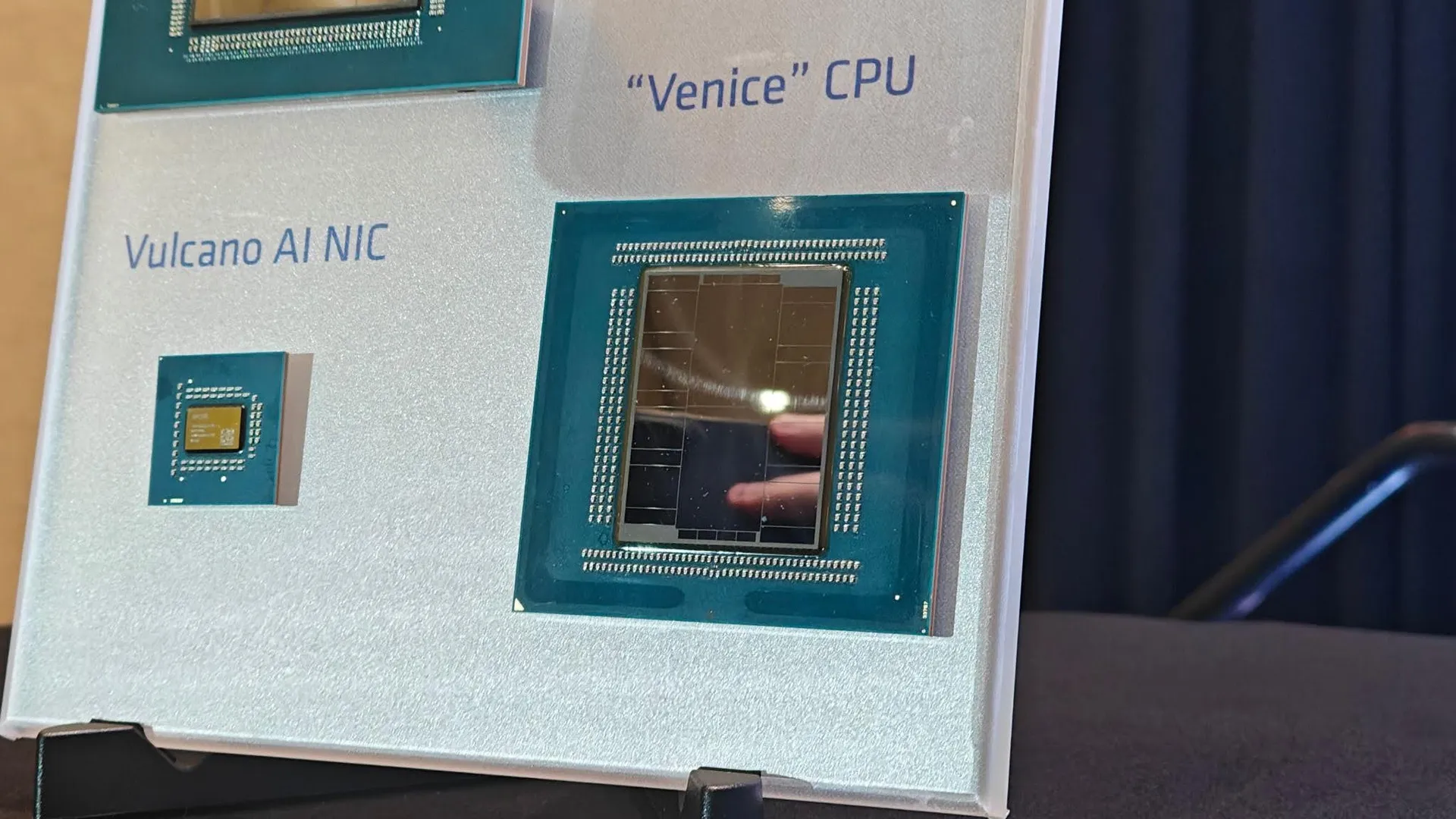
Following the launch of AMD's EPYC 'Venice' CPUs in July, AMD extended the performance claims for its upcoming generation of server chips on Friday. The high-level claim hasn't changed. AMD still says a 96-core, high-frequency Venice chip is around 20% faster than Nvidia's 88-core Vera in SPEC CPU 2026's Integer Rate test. However, the company went into far greater detail about the benchmarks in a new white paper.
There are several configuration differences depending on the benchmark throughout AMD's white paper, and although we'll call out those differences here to the best of our ability, we don't have all of the details. For the Vera comparison, in particular, AMD is mixing data from different sources, and in some cases, using different major releases of the GNU Compiler Collection (GCC). That can have a substantial impact on performance, so keep your salt shaker handy.

First up are results in SPEC CPU 2026 with the intrate test, looking at total throughput. These are older numbers, gathered in July with GCC 15.2. The intrate test runs multiple copies of an application on the same CPU, and the SOP is to run one copy per thread. Presumably, that's what AMD did here, but the white paper doesn't clarify, even in the footnotes.
The 256-core 9996 is 2.37x faster than the Intel Xeon 6980P and 2.24x faster than Vera according to the slide. The white paper clarifies the mystery 9006 CPU is the 256-core flagship. Perhaps most impressive is AMD's gen-on-gen comparison. According to these results, the 9996 is around 78% faster than last-gen's 192-core EPYC 9965.
Although the high-level results bring in data from Intel and AWS, much of the white paper focused squarely on the comparison between Venice and Vera. AMD broke down the individual subtests of SPEC CPU 2026 intrate in the white paper, which you can see below.

The comparison looks good for AMD, naturally, though there are a few wrinkles in the configuration. AMD is testing a down-cored EPYC 9996, dropping from 256 cores to 96 cores. It made no mention of power budget, but when AMD originally shared SPEC numbers, the 96-core model had access to the same 600W as the 256-core model — AMD's 96-core, high-frequency Venice SKU tops out at 500W. More consequential is the compiler, however. AMD is using GCC 16.1 and comparing the results to the ones Nvidia shared in its Vera white paper. Nvidia used GCC 15.2.
Michael Larabel over at Phoronix has a nice write-up about the difference between GCC 15 and 16, but the short story is that there are performance differences, not always for the better. GCC 16 takes longer to compile due to better optimizations, hence the lower scores on the GCC and LLVM compilations above. However, that leads to faster binaries. By how much depends on the flags, software, and a whole host of other factors. Regardless, it's not best practice to compare benchmarks using two different compiler versions. It makes sense that AMD used GCC 16.1 — it includes support for Zen 6 — but ideally Vera would also be on GCC 16.1.
Get Tom's Hardware's best news and in-depth reviews, straight to your inbox.

Speaking of Phoronix, AMD pulled some data for the publication's initial, controlled testing of Vera. Above, you can see the Stream, an industry-standard benchmark for measuring memory bandwidth. Again, AMD is using a down-cored 9996 from 256 cores to 96, and offering it a 600W power budget. Still, this is an impressive showing, as Vera absolutely clobbered the competition in the publication’s original Stream results. Here, AMD is ahead by about 18%, with per-core performance about 8% ahead.

Breaking out of Vera, AMD also showed performance in cloud workloads, including database, Java, and cryptography. Once again, the gen-on-gen comparison stands out, as AMD was already leading in these workloads with its last-gen chips. AMD ran these tests itself, rather than relying on third-party data, though the Graviton5 results came from an AWS cloud instance.

Similarly, in HPC workloads, AMD furthers its lead over Intel's flagship Granite Rapids-AP offering. Intel's next-gen data center CPUs, codenamed Diamond Rapids, are set to be released next year.

Finally, we have "agentic AI workload performance," which uses actual benchmarks for comparison, despite what the names in the chart above suggest. From left to right, AMD used NGINX, TPCx-AI kit, FAISS, TPC-H and TPC-C, and a replay of a multi-persona agent. For TPC-H and TPC-C, AMD says it derived workloads from those benchmarks, so the results here aren't comparable to published results.
Although looking at benchmark results is always interesting, it doesn't say much in the context of a server deployment, at least at the scale that AMD is targeting. Peak performance is only one of the major factors that go into server deployments, after all, and even then, performance can vary wildly depending on what software you're running and how it's built.
Still, Venice looks impressive, perhaps more so in the gen-on-gen comparison than any competitive comparison. Hopefully that bodes well for AMD's future Zen 6 rollout on consumer desktops, but we'll have to wait until Team Red has more to share before drawing any conclusions on that front.

Follow Tom's Hardware on Google News, or add us as a preferred source, to get our latest news, analysis, & reviews in your feeds.

Jake Roach is the Senior CPU Analyst at Tom’s Hardware, writing reviews, news, and features about the latest consumer and workstation processors.
-
Stomx This fat toy is for the future world "elite" and their personal AI datacenters.Reply
As for consumers — I honestly don't know who this processor is even for. Maybe it will end up in servers. Maybe it will run local AI on the CPU: with 2.5x the RDRAM bandwidth of AMD Turin, it could reach ~20 tokens per second on decent 4-bit quantized trillion-parameter models — though even 20 cores would be enough for that...
But there is one piece of bad news for consumers: the massive socket size and the larger RAM footprint will most probably kill dual-socket designs within the old extended-ATX form factor. A dual-socket motherboard, if one ever gets built, will look monstrous (just take a look at the first single-socket example, Gigabyte's MD25-CG0) and won't fit into any existing cases. That's fine by me — the design could go case-free — but I'm afraid motherboard manufacturers will be scared off by the smaller demand and simply stop even considering making them.
As a single-socket replacement for the previous dual-socket Turin, Venice
makes little to no sense (and it's still a C-core CPU, not a P-core one). To keep going single-socket, CPUs will have to push core counts (to 500 and beyond), the same way GPUs are doing.
Unfortunately, while GPU designers are bulking up at 2–2.5 kW per GPU, the CPU crowd is still in kindergarten, scared to touch 600 W.
If CEOs of AMD and Intel ever try to make their morning tea/coffee with 600W boiler instead of standard 1500W they'd probably finally understand that :)
With NVIDIA, you buy an 8-GPU motherboard and then populate it with 1, 2, 4, or all 8 GPUs (16 were possible before, too) — the 900 GB/s NVLink is already there. With CPUs all we ever had was a dual-socket design with a barely-there ~40 GB/s, and even that will most probably go extinct. -
usertests Reply
To the extent that "consumers" are using Epyc... single socket is cheaper and more accessible. AMD's "Siena" Epyc is single socket only, for example.Stomx said:But exist also one bad news for consumers: its massive socket size and larger RAM area most probably will kill dual socket designs within the previous extended ATX motherboard size. Dual socket motherboard if it will be build will look monstrous (take a look at the first single socket example like the MD25-CG0 from Gigabyte) and do not fit into any existing boxes. It is OK with me, the design could be box-free, but I afraid the manufacturers of motherboards will be scared of smaller demand and will stop making them.
As a single socket arrangement instead previous dual socket Turin, Venice has little to no sense (and it is is still C-core not a P-core CPU). To continue with single socket, CPUs have to rise core counts to 500 and beyond same as GPUs doing.
Venice SP8 doesn't support the full 256 cores, but it also cuts the memory channels down to 8 (16 DIMMs possible). A board could offer only 8 DIMMs for 8 channels, making it much smaller.
So I guess you got it right in your first sentence, the 256-core is not for plebeians at all. Not a really big surprise. We're long past the days of the $200 Threadripper special too. -
LordVile Doesn’t really matter how much better they are than Nvidia’s when Nvidia gives their products out for free, sorry for pinky promised payments and stock.Reply -
usertests Reply
Dang, I need to set up a fake company (fake former cryptominer backstory) so I can get some AI swag. Hook a brother up with a DGX Spark.LordVile said:Doesn’t really matter how much better they are than Nvidia’s when Nvidia gives their products out for free, sorry for pinky promised payments and stock. -
bit_user Thanks for the article, @JakeRoach . Here's my analysis, FWIW.Reply
On the one hand, it's pretty cool that Vera's 88-core/176-thread CPU can beat a 192-core Graviton 5. On the other hand, I'll bet Graviton 5 is clocked much more for efficiency, while Vera is clocked more for performance. That's at least how their previous generations were clocked, and those used the exact same cores (ARM Neoverse V2) as each other. It's also impressive Vera beat Intel's Granite Rapids.
Intel's current-gen Clearwater Forest is missing from the comparison, of course.
They more than doubled the memory bandwidth. I'm sure that's a big part of it.The article said:According to these results, the 9996 is around 78% faster than last-gen's 192-core EPYC 9965.
No, the GCC spec subscore is telling you how long it takes for the test system to run GCC 11.2.0 on an input file, with the output targeted for an x86-64 machine (i.e. even if you run the benchmark on an ARM CPU, the output of the compiler is still for the same target as if you run the benchmark on an x86-64 CPU). You can read more about it, here:The article said:GCC 16 takes longer to compile due to better optimizations, hence the lower scores on the GCC and LLVM compilations above.
https://www.spec.org/cpu2026/docs/benchmarks/721.gcc_r/721.gcc_r.html
Likewise, the LLVM subscore is running the optimizer of LLVM 14.0.0 on an intermediate representation (IR), irrespective of what AMD used to compile the rest of the benchmarks. You can read more about it, here:
https://www.spec.org/cpu2026/docs/benchmarks/723.llvm_r/723.llvm_r.html
Well, the way SPEC CPU traditionally works is that each vendor supplies their own hardware and software. It's common practice for vendors to make official submissions with a compiler that has custom tuning for their specific CPU.The article said:Regardless, it's not best practice to compare benchmarks using two different compiler versions. It makes sense that AMD used GCC 16.1 — it includes support for Zen 6 — but ideally Vera would also be on GCC 16.1.
This practice dates back to the old days, when some computers were only supported by the vendor-provided compiler. It's still common for supercomputers to compile their software with a vendor-provided compiler. This is why Intel and AMD have their own, even though AMD's (called AOCC) is based on LLVM/Clang and just has some custom tuning.
Intel's compiler is called ICC and used to be based on a backend by EDG (Edison Design Group). About 5 years ago, they also adopted LLVM.
This one looks good for AMD, unless you know what the raw bandwidth actually is for both systems: 1.23 TB/s and 1.64 TB/s. So, Nvidia's bandwidth efficiency is actually way better: 89.4% vs 79.2%. That has to do with the difference in memory coherency model between ARM and x86. I'm actually surprised AMD did that well. I'd have guessed it'd be no higher than 75%.
Anyway, one thing we can say for sure is that Nvidia's power efficiency is way better, since they're using LPDDR5X-based SOCAMM2 modules, while AMD is using power-hungry MRDIMMs.
The difference in raw bandwidth comes directly from Nvidia's use of LPDDR5X-9600 vs AMD's use of DDR5-12800. Both have the same data width of 1024 bits per CPU. In AMD's case, that works out to 16 DIMMs, while Nvidia uses 8 SOCAMM2 modules. SOCAMM2 have twice the data width, in part, because LPDDR5X multiplexes address and data over the same pins, whereas regular DDR5 has separate pins for each. This makes the practical bandwidth and latency of LPDDR5X a bit lower and longer, but it saves cost and power.The article said:Vera absolutely clobbered the competition in the publication’s original Stream results.
Customers will also be looking at perf/W and TCO (Total Cost of Ownership, where operating costs are combined with system purchase price).The article said:Although looking at benchmark results is always interesting, it doesn't say much in the context of a server deployment, at least at the scale that AMD is targeting. Peak performance is only one of the major factors that go into server deployments, after all, and even then, performance can vary wildly depending on what software you're running and how it's built.
I think the comparison with Nvidia's Vera is a little bit weird. It seems clear to me that Vera is primarily aimed at orchestration, while AMD's Venice is aimed much broader set of tasks, mostly consisting of general compute workloads. I think the comparison against Vera is more about bragging rights and trying to take wins over Nvidia anywhere that AMD can find them. -
bit_user Reply
The cores in this CPU will find their way into some AMD-powered desktops and laptops. Others will have cores derived from these. So, the way I look at it is as a taste of what's to come.Stomx said:This fat toy is for the future world "elite" and their personal AI datacenters.
I think the insane memory bandwidth is just to feed the insane core count + PCIe 6.0 I/O. Their current platform is bandwidth-starved in each domain and PCIe 6.0 doubles I/O bandwidth, while more cores at higher clockspeed also increases bandwidth demands from within the CPU.Stomx said:Maybe it will run local AI on the CPU: with 2.5x the RDRAM bandwidth of AMD Turin,
Oh, no question about that. Each CPU needs 16 DIMMs to achieve maximum memory bandwidth. So, there's no realistic way you're fitting 2 of those CPUs and 32 DIMM slots on an EATX board.Stomx said:the massive socket size and the larger RAM footprint will most probably kill dual-socket designs within the old extended-ATX form factor.
I thought Venice was supposed to go up to 700W. Intel's 256-core Diamond Rapids CPUs are supposedly going to use up to 650W, though I don't know if that's been officially announced.Stomx said:the CPU crowd is still in kindergarten, scared to touch 600 W.
That said, remember that customers don't want these CPUs to draw lots of power. Nvidia likes to point out that Vera and its memory run on a budget of only 500W.
Well, you're counting DRAM power for GPUs, but not CPUs. So, it's a mismatched comparison. I've heard that the cumulative power utilization of server memory can even surpass that of the CPU, although I doubt that will still hold true for CPUs burning 650W to 700W.Stomx said:If CEOs of AMD and Intel ever try to make their morning tea/coffee with 600W boiler instead of standard 1500W they'd probably finally understand that :)
Obviously, Nvidia's Vera is an exception, due to its use of LPDDR5X and lower total capacity.
Um, what? A PCIe 6.0 x16 slot is good for 128 GB/s per direction and each CPU has ~128 lanes (i.e. 1024 GB/s in each direction).Stomx said:With NVIDIA, you buy an 8-GPU motherboard and then populate it with 1, 2, 4, or all 8 GPUs (16 were possible before, too) — the 900 GB/s NVLink is already there. With CPUs all we ever had was a dual-socket design with a barely-there ~40 GB/s, and even that will most probably go extinct.
That said, you know about AMD's MIx00A series, right? They have infinity fabric links for running in a mesh, similar to NVLink. Some future version of Intel Xeons will have NVLink integrated directly. -
bit_user Reply
AMD does that, too.LordVile said:Doesn’t really matter how much better they are than Nvidia’s when Nvidia gives their products out for free, sorry for pinky promised payments and stock.
https://www.tomshardware.com/tech-industry/amd-to-supply-anthropic-with-2-gigawatts-of-instinct-mi450-gpus
They have different sorts of deals with OpenAI and Meta, however. Also, I'm not aware of them doing anything like the VC fund that Nvidia raised to finance their customers.
So, you're right that the scale on which Nvidia is financing the purchase of its products is unmatched.