Stay On the Cutting Edge: Get the Tom's Hardware Newsletter
Get Tom's Hardware's best news and in-depth reviews, straight to your inbox.
You are now subscribed
Your newsletter sign-up was successful
Join the club
Get full access to premium articles, exclusive features and a growing list of member rewards.
An account already exists for this email address, please log in.
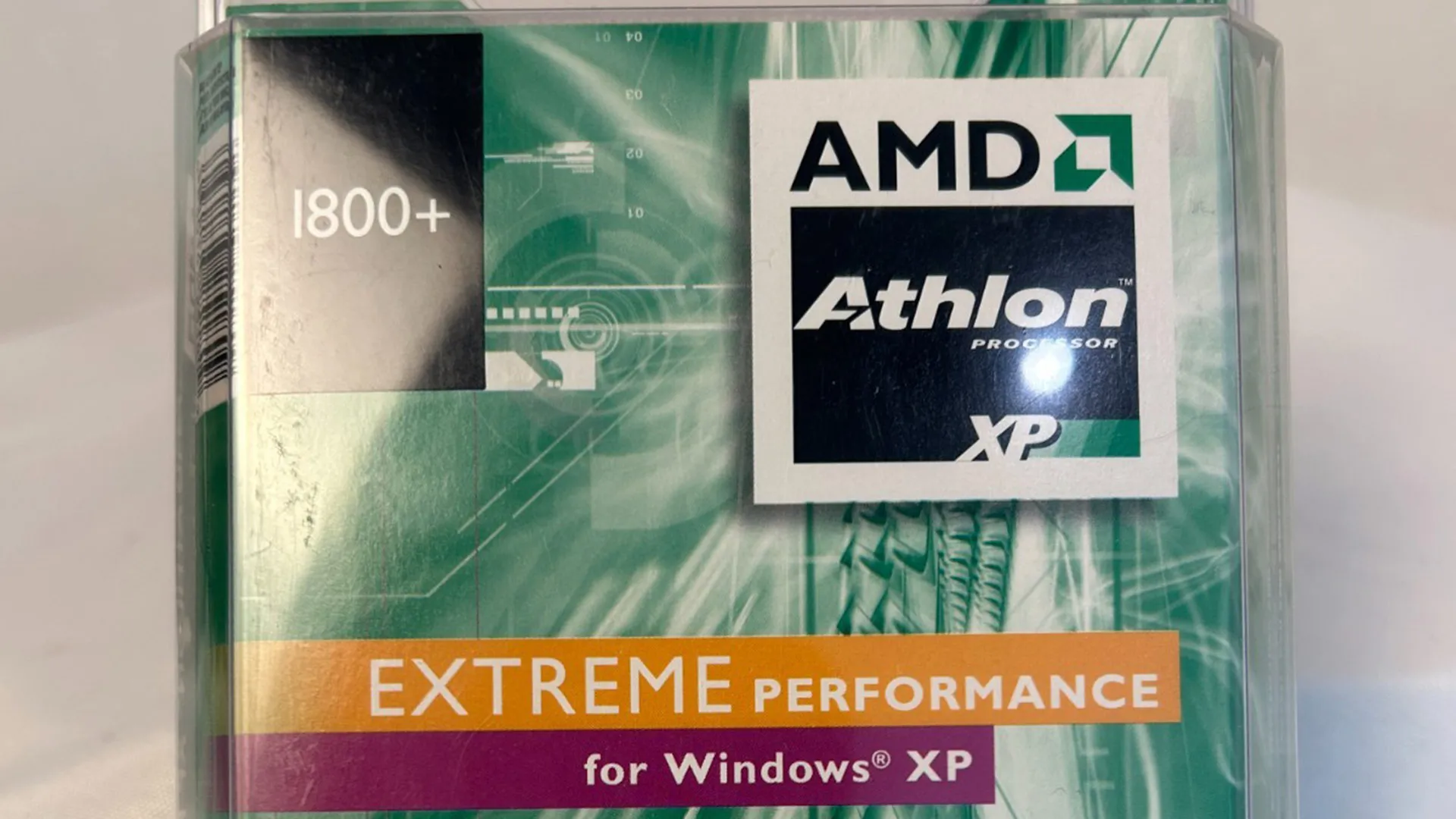
AMD tried to crush the 'megahertz myth' 25 years ago today, debuting its Performance Rating system — Athlon XP chips introduced the scheme, which endured until Intel lost its clock advantage, focus shifted to multi-core
A quarter century ago today, AMD launched its AMD Athlon XP processor family. These were highly performant processors based on the firm’s latest Palomino core, but ran at lower raw clock speeds than Intel rivals. Facing a marketing imbalance between perceived and actual performance, AMD mounted a serious campaign to explode the 'megahertz myth' with this generation of CPUs. Thus, it introduced new Athlon XP processors with a Performance Rating (PR) designation, alongside a slogan insisting “Performance matters more than MHz.”
Intel, with its Pentium 4 processors, was clearly winning the MHz race at the time, while a CPU’s clock speed had long been established by marketers as a key performance metric. Unfortunately for AMD, its CPUs of the era didn’t hit such high clocks, even though the application and gaming performance was just as good (if not better) than Intel's.
Thomas Pabst's view
Our tests from October 2001 noted that AMD wisely undersold its chips, using the newly devised PR naming system. Anything less and it would have faced strong opposition and derision. Our tests clearly showed that a new “AthlonXP 1800+ is able to beat Intel's flagship Pentium 4 2 GHz in the majority of benchmarks,” wrote the original Tom, Thomas Pabst, in a 13-page feature about AMD’s newest CPUs. Moreover, it was observed that “AthlonXP at 1533 MHz is able to reach or even beat Pentium 4 running at an almost 33% higher clock speed.” Pabst concluded that AMD’s clocks/performance situation forced this concerted stand against the MHz myth.
As we broke the news about AMD’s Performance Rating system, some almost straight-away alluded to it being a ‘Pentium Rating’ system, but it was very early days. We didn’t know whether it would become a long-term success. It was known that AMD planned to establish an independent institution to create a new performance measure that is fairer and more realistic than the current MHz system in the following year. But, of course, Intel wouldn’t be interested in validating that. Pabst concluded that “I might not like it too much,” but admitted AMD had little alternative marketing-wise in the Pentium vs. Athlon era at the beginning of the millennium.
Please stop, it hertz
The AMD PR system would be abandoned roughly five years after it was initiated. Subsequent AMD (and Intel) architectures stopped the rating from making practical sense as the market evolved. For example, Intel’s big MHz advantage was lost in the transition from Pentium 4 Netburst to Pentium M/Core chips. Then, the Athlon 64 was so well received by reviewers and enthusiasts that AMD probably felt it might be wise to finish with its inferiority complex PR system that tied it to its obvious rival. Lastly, by the end of the AMD PR era, the marketing fight was clearly going multi-core. CPU marketing and naming completely sidelined any hint at CPU clock speeds later in the noughties.
Mark Tyson is a news editor at Tom's Hardware. He enjoys covering the full breadth of PC tech; from business and semiconductor design to products approaching the edge of reason.
It was at a time when Intel had released it 'Netburst' architecture with the P4. It was all about cranking the megahertz even though IPC went down.
So, the perception was that AMD performance was waning, when in fact they were doing a decent job of competing....
Later, the bulldozer architecture would find them trailing Intel's CoreDuo architecture by every measurable degree for some time.
It wasn't until the Zen architecture arrived that we saw AMD being truly competitive on a clock and IPC basis with Intel and it's Core architecture (I think they got rid of the 2Duo part of the name).
Bulldozer was awful, but a valuable lesson for AMD. Just throwing more cores on a chip doesn't cut it, they have to communicate better. Thus Zen was born.
PR can be found back on the amd K5, K6, cyrix 5x86, 6x86, 6x86mx and others
I remember testing a 233mhz Pentium vs the AMD and Cyrix PR233 CPUs on one of my socket 7 motherboards. In office programs they did very well against Intel. But in games, they weren't even close. I was using Duke Nukem 3D for the gaming tests back then. (Very crude testing).
It was fun being able to use different brand CPUs in the same socket back then. Then Intel went to The Slot...
Core architecture (I think they got rid of the 2Duo part of the name).
It was called core from the beginning.
Core 2 was the second iteration of core (first was "classic" pentium) and core 2 duo was the dual core of said core 2, there was core 2 solo and quad as well.
After that they kept the core name and added i3-5-7 (intel core i3-xxxx ) with the "core 3" being called the 3000 series.
It has to be said that people where just naive thinking that more mhz equals more performance. AMD indeed showed that with their models they required only 33% less actual Mhz to be equal or even better then a pentium. The same was with Cyrix, PR200, 233, 266 and so on, which indeed did perform like the Pentium at those clocks in mostly office based stuff just at a better budget.
It has to be said that people where just naive thinking that more mhz equals more performance. AMD indeed showed that with their models they required only 33% less actual Mhz to be equal or even better then a pentium. The same was with Cyrix, PR200, 233, 266 and so on, which indeed did perform like the Pentium at those clocks in mostly office based stuff just at a better budget.
And of course there was a little bit of overclocking headroom too. I remember clocking the Cyrix to almost it's actual PR rating on some of the more HX/TX chipset boards back in the day... Made computers a bit more affordable for folks.