









Intel leaker claims Nova Lake desktop chips have 5.1 GHz clock limit beyond 90°C — high clock speeds could demand significant cooling for next-gen chips
According to the leaker, the chips will top out at 5.1 GHz if their core temperature isn't kept below 90°C.
According to new information from reasonably reliable Intel leaker Jaykihn, Intel's upcoming Nova Lake desktop CPUs will have an unusual limiter applied. He claims that the next-gen desktop parts from Intel will "universally limit the maximum core frequency to 5.1 GHz when above 90°C." That doesn't mean the parts will top out at 5.1 GHz, which would be disastrous, but it does mean that you're going to need some darn good cooling to reach high clock rates on Nova Lake desktop CPUs.
- Intel VP Robert Hallock sets Nova Lake expectations, teases return to Raptor Lake for DDR4 platforms
- CPU scaling with DLSS
- Intel's one-two punch plan in desktop CPUs is taking shape
- Benchmarking AMD's BC-250, offering Steam Machine-like performance at half the price
- AMD splits Zen 7 into three EPYC families for 2028 and starts selling server CPUs by the agent
Let's be clear about what he's saying. He's not saying that Nova Lake CPUs can't go above 5.1 GHz. He's also not saying that Nova Lake CPUs have their thermal limit at 90°C. While Jaykihn doesn't provide any clock rate information, he does imply that the chips will go above that, possibly quite significantly, as long as the thermals are kept in check, and he does say that the "Tjmax" value of Nova Lake is 100°C. Notably, that's a drop from 105°C in Arrow Lake, although prior-gen Raptor Lake CPUs had the same 100°C peak.
Preliminary. Nova Lake -S desktop processors will universally limit the maximum core frequency to 5.1GHz when above 90C. This is separate behavior from traditional TJMax thermal throttling at 100C. Alike TJMax, this temperature threshold cannot be shifted upwards.November 4, 2026
The mechanism that this most clearly resembles is Intel's own Thermal Velocity Boost. TVB, if you're not familiar, is the feature that allows high-end Intel CPUs to hit their highest clock rates. Put simply, TVB simply says that if the chip isn't overheating, it can go 100-300 MHz higher than its rated Turbo Boost Max speed. It's a little confusing, because these TVB clock rates are often quoted as the "Max Turbo Frequency"; Intel even does this itself. But TVB clocks are not the same as standard turbo clocks, and a lot of users who don't have exotic cooling probably never actually see these speeds in practice since they do require optimal conditions.
Does this mean that the practical limit of Nova Lake desktop CPU clocks is 5.1 GHz? Well, that depends on how hard these parts are to cool. Remember, we're dealing with chips fabricated on a 2nm-class process; in this case, it's reportedly TSMC's N2P for the compute tiles, while the peripheral chiplets are all on Intel's own 18A or 18A-P. This has consequences, as N2P is reportedly much denser than 18A, but it also lacks back-side power delivery, which means that the thermal resistance of the individual dies is considerably lower. Combined with much lower power consumption from a real node step, it may turn out that Nova Lake is actually quite easy to keep cool.
Ultimately, that is going to depend in part on how much Intel decides to push the "fMax", or maximum frequency. Rumors have put AMD's Zen 6 desktop Ryzen processors above 6 GHz for peak clock rates; if that's true, Intel could be looking at as much as a 20% clock rate disadvantage at 5.1 GHz. Obviously, as noted above, the chips are expected to have a higher fMax than that, but it remains to be seen how easily users can keep the parts cool enough to make use of the extra clock rate headroom given this new limit. Both Intel's flagship Core Ultra 9 285K and the Red Team's extant Zen 5-based Ryzen 9 9950X can reach 5.7 GHz before overclocking.
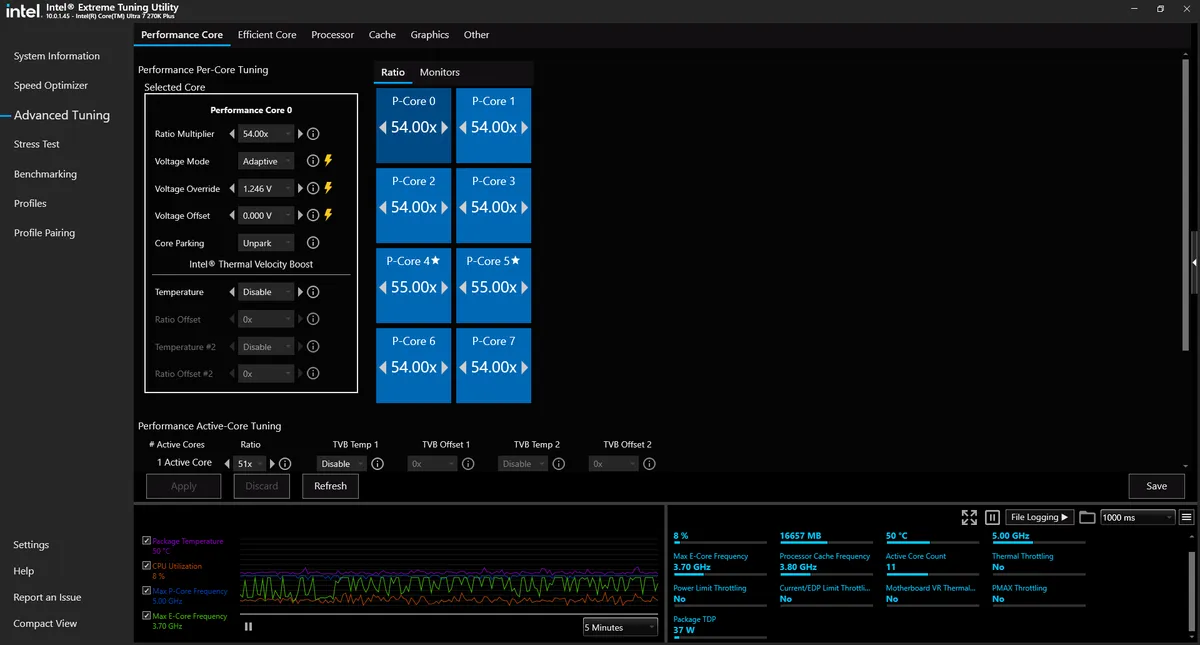
For tuners, a frustrating detail is that this 5.1 GHz hard clock limit apparently "cannot be raised." That means folks doing system tuning on Nova Lake will be strongly encouraged to undervolt to reduce the thermal output of their processors and help them maintain high performance. That's unusual, as historically Intel allows users to adjust the thermal throttle point of their processors when overclocking. That may potentially still be the case on processors unlocked for overclocking, of course; Jaykihn is reporting based on leaks and engineering samples rather than final released products.
Even if Nova Lake doesn't scale clocks much over Arrow Lake, it could still be quite a bit faster than the previous generation. Recall that the new chips will come with new core architectures and new technologies, including APX core extensions and bLLC, Intel's long-awaited response to AMD's 3D V-Cache. Forecasts are indicating that gaming performance could be as much as 33% faster than Arrow Lake, which would be huge. However, this 5.1 GHz limit could be a downer for people who are interested in the rumored 52-core version of Nova Lake. We'll find out how much it matters when the Core Ultra 4000 series launches either very late this year or very early next year, although we wouldn't expect the 52-core flagship or bLLC versions until next summer.
Get Tom's Hardware's best news and in-depth reviews, straight to your inbox.

Follow Tom's Hardware on Google News, or add us as a preferred source, to get our latest news, analysis, & reviews in your feeds.

Zak is a freelance contributor to Tom's Hardware with decades of PC benchmarking experience who has also written for HotHardware and The Tech Report. A modern-day Renaissance man, he may not be an expert on anything, but he knows just a little about nearly everything.
-
TerryLaze Ok! So?Reply
Well hopefully this will keep you guys from running intel CPUs insanely out of spec in your benchmarks...although I already see you guys limiting intel to that 5.1 and claiming it's "out of the box" ,man, we are just reviewers man, we can't set up a decent system...
I hope it doesn't just limit the clocks but actually turns all the settings to the default.
This will let you run it at whatever the tjmax is (prob. 105) forever, just not at full tilt.hotaru251 said:i mean....thats fine?
You wouldnt want to run a cpu past 90c long term anyways. -
ATIRAGEPROTURBO Reply
Tell me you didn't read the post without telling me you didn't read the post.TerryLaze said:Well hopefully this will keep you guys from running intel CPUs insanely out of spec in your benchmarks...although I already see you guys limiting intel to that 5.1 and claiming it's "out of the box" ,man, we are just reviewers man, we can't set up a decent system...
I hope it doesn't just limit the clocks but actually turns all the settings to the default.
This will let you run it at whatever the tjmax is (prob. 105) forever, just not at full tilt. -
usertests ReplyHowever, this 5.1 GHz limit could be a downer for people who are interested in the rumored 52-core version of Nova Lake.
There were always going to be thermal/power challenges with loading up the entire full 52-core monster. This is probably going to be acceptable.
For gaming, very few of those cores are actually needed outside of a lightning fast shader compilation (which could be mitigated by precompilation). -
thestryker The only thing which would make this concerning to me is if 5.1GHz was the stock all-core clock, but I cannot imagine this being the case. To me what this really looks like is a way to push people towards keeping stock power limits and/or ensuring good cooling. At stock power limits ARL is pretty easy to cool and I never saw 90C on either 265K or 270K Plus with them in place (though encoding is the only heavily multithreaded thing I do). Assuming NVL is similar cooling wise (I'd bet bLLC will be easier to cool than non) this limit should mean nothing for the majority of users.Reply -
bit_user Reply
Pfft. I'd like to see how many watts a dual-tile Nova Lake burns, even running all its P-cores at 5.1 GHz! I think just to get temps and power consumption down to reasonable levels, it'll be necessary to reduce clock speeds even more than 5.1 GHz.usertests said:There were always going to be thermal/power challenges with loading up the entire full 52-core monster. This is probably going to be acceptable. -
bit_user Reply
Have you run a traditional multithreaded benchmark, like Cinebench or SuperPi? What's your all-core clock speed, power, and thermals, if you do this on just the P-cores?thestryker said:At stock power limits ARL is pretty easy to cool and I never saw 90C on either 265K or 270K Plus with them in place (though encoding is the only heavily multithreaded thing I do). -
TerryLaze Reply
What are the reasonable levels for a potential 52 core desktop CPU running heavy loads at 5.1Ghz???bit_user said:Pfft. I'd like to see how many watts a dual-tile Nova Lake burns, even running all its P-cores at 5.1 GHz! I think just to get temps and power consumption down to reasonable levels, it'll be necessary to reduce clock speeds even more than 5.1 GHz.
We are talking about something that never existed before...so how do we set realistic "reasonable" levels?
This will potentially be more than twice the cores of the next halo ryzen cpu... -
bit_user Reply
I guess I just mean what you can actually dissipate, at steady-state.TerryLaze said:What are the reasonable levels for a potential 52 core desktop CPU running heavy loads at 5.1Ghz???
In real-world, multithreaded workloads, it won't be just the P-cores that are active. However, we could look at what a CPU like the 9950X can do in all-core workloads to get an idea of what 16 P-cores could draw. According to SatterBencher #81:TerryLaze said:We are talking about something that never existed before...so how do we set realistic "reasonable" levels?
When running the OCCT CPU AVX2 Stability Test, the average CPU core effective clock is 4885 MHz with 1.026 volts. The average CPU temperature is 95.1 degrees Celsius. The average CPU package power is 236.3 watts.
That's not a great point of reference, because:
My above point that almost nobody running all-core workloads is going to limit it to just the P-cores.
Nova Lake will be on a better node.
The above is highly-tuned, far from out-of-the-box performance (which is "4346 MHz with 0.988 volts; package temp: 77.5 degrees C; package power: 181.4 watts").
Intel's P-cores are much larger and (at higher frequencies) more power-hungry than corresponding Zen cores.
So, there are arguments going both ways, but once you add in the E-cores, I'd bet pushing the P-cores above 5.1 GHz is going to exceed what even a fairly high-end water cooling setup could dissipate. -
thestryker Reply
Yeah Cinebench 2024 pulls 265-285W (no power limit) with P-cores running 5.4GHz and E-cores running 4.8GHz with peak temp 88C. I wouldn't check OCCT Extreme/SuperPI without power limits though because those are likely to peg my cooling and pull somewhere around 350W. These would be more likely to go 90C+ as well, but I'm not 100% sure since I've never used them with power limits as I've only used them for maximum cooling testing :ROFLMAO:bit_user said:Have you run a traditional multithreaded benchmark, like Cinebench or SuperPi?
I think it would depend on workload more than anything else. I'd bet the stock clocks wouldn't be any lower than 5.1GHz for the dual Compute Tile part. The most recent leaks have seemingly held steady on PL2 at 474W for dual Compute Tile and 296W for bLLC single Compute Tile. So it'll depend on how Intel approaches boost clocks: all-core could be lower, or they could have varied all core depending on the Tile similarly to how AMD does dual CCD.bit_user said:I think just to get temps and power consumption down to reasonable levels, it'll be necessary to reduce clock speeds even more than 5.1 GHz.