









Customer sends two-stick $16,000 DDR5 memory kit to repair shop — soaring replacement costs make DIMM repairs viable, technician revives dead module with hot-air reflow and new PMIC
The economics of 'throw it away and buy a new one' have shifted dramatically due to the AI components crisis.

A YouTube channel best known for its skillful graphics card fixes has published its first RAM module repair video. Tony from NorthWestRepair’s latest video shows his attempts to mend a pair of high-capacity DDR5 sticks worth a purported $16,000. It isn’t the repair skills that are newsworthy here. Rather, it’s the shift in economics that makes the chuck-it-and-replace-it attitude to bad RAM a philosophy that simply doesn’t apply in 2026. The impact of the AI-pocalypse means that spending a couple of hundred dollars on repair labor to save a several-thousand-dollar DDR5 DIMM is now sensible. If you can repair RAM, you can now start a business.
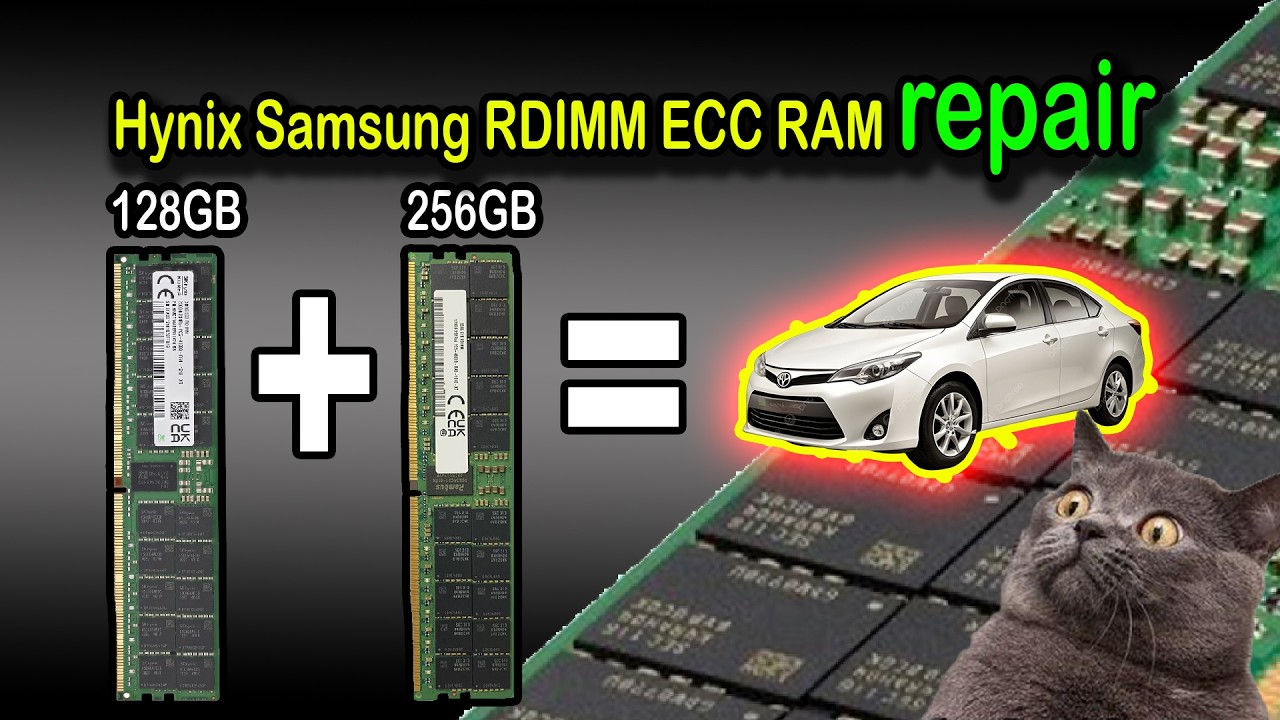
Two DDR5 sticks were sent in to Tony, described as having physical damage. They are both ECC sticks, meant for servers, one with 128GB and the other with 256GB of DRAM ICs onboard. Tony sounded happy at the start of the video, as this is an excuse to use his Unified DDR Flasher Main Board, for which he had just acquired an RDIMM extension that works with these server sticks.
Initial close physical inspection didn’t reveal any conclusive evidence of the source of the problems. So, it was hoped electrical tests would provide more clues. A data line tester didn’t highlight any issues, though. Tony used flux and hot air to reflow the solder on the first DIMM, which is a far simpler process than a reball (where all the memory ICs are taken off, cleaned, and given new solder balls). Initial signs were that the module was now working OK. So, he moved to the next DDR5 DIMM.
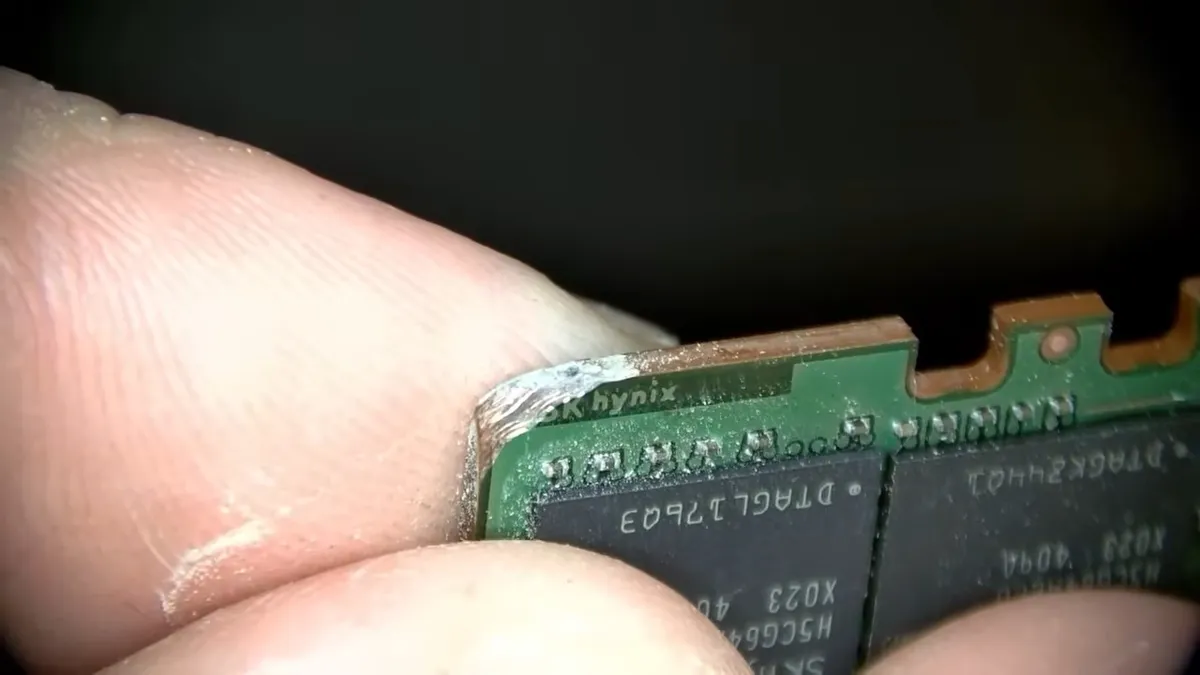
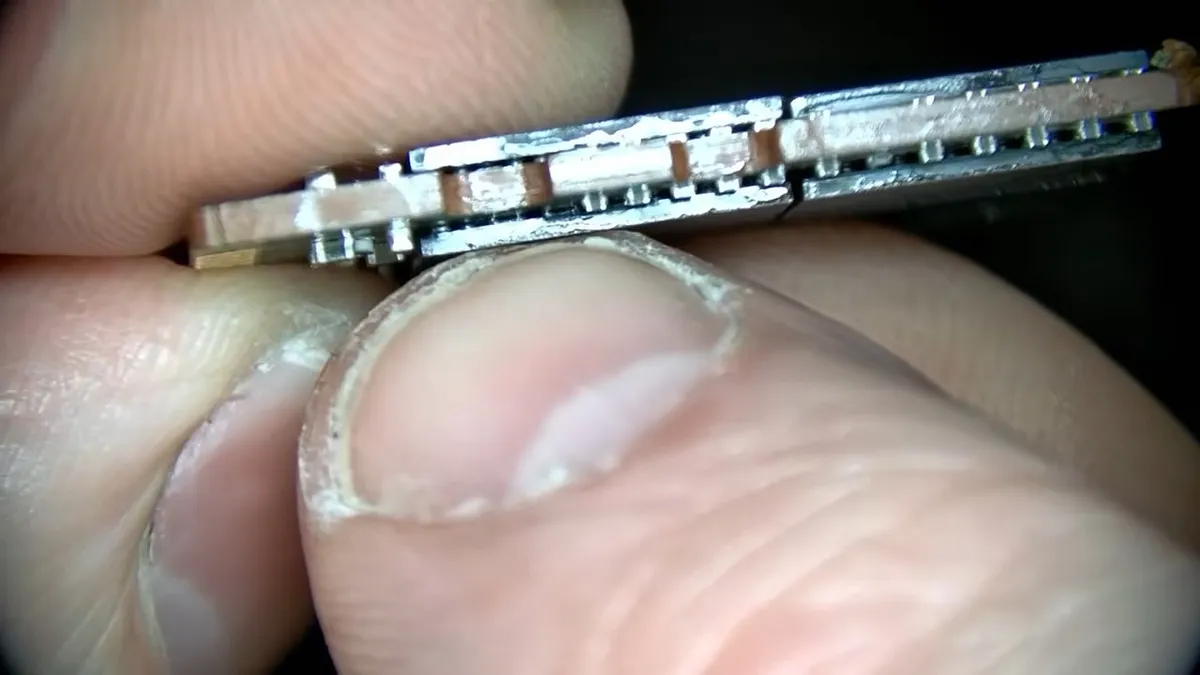


The second DIMM “may have a faulty PMIC chip,” which is why it seemed more severely broken than the first module, Tony indicated. Powering on a system with this DIMM inserted showed no signs of life, and the DIMM didn’t even warm up (thermal camera checks). That contrasts with the first fix.
Because this DIMM is completely dead, Tony did some work on the non-DRAM chips like the PMIC and SPD EEPROM first. Then he decided to reflow some other chips, including memory ICs, like before, while the board was warm. Some ICs were also reballed after inspection, making Tony suspicious of them.
The repairer found a short circuit via voltage injection and thermal camera monitoring. This was fixed with a new capacitor and by fixing the short on the damaged edge of the PCB. Finally, a new PMIC chip ended the quest, and this second DDR5 DIMM powered on and trained successfully.
The repair is good to see, saving these valuable components from e-waste. However, the bigger picture is that repairing memory modules could now be a viable business. Previously, it didn’t make sense to spend a hundred or two on labor to fix a DIMM that would cost about the same or even less to replace with a new one. Now the repair fee might be just a fraction of a replacement price.
Get Tom's Hardware's best news and in-depth reviews, straight to your inbox.

Follow Tom's Hardware on Google News, or add us as a preferred source, to get our latest news, analysis, & reviews in your feeds.

Mark Tyson is a news editor at Tom's Hardware. He enjoys covering the full breadth of PC tech; from business and semiconductor design to products approaching the edge of reason.
-
bit_user The physical damage makes me suspect the second DIMM might've been pulled from an e-waste stream.Reply
At my job, e-waste goes into a giant box on a palette, in our loading dock. When it fills up, somebody comes and hauls it off. The condition of some machines and monitors in that bin tells me that some people are rather violent when they chuck stuff in there. Some of the machines are opened or partly dismantled, which could expose the DIMM to physical damage.
I've recovered working monitors from it that were discarded simply for being old, because a bunch of identical ones were tossed all at once and most of the ones I checked tested perfectly. Unfortunately, a most of them also had blemishes on the panel, by the time I found them. -
helper800 Reply
Where I work, its close to the same process. Each site sends in their surplus e-waste to the district office throughout the year. Things can range from older vga / dvi monitors to corded peripherals. Our DO tech department goes through anything with a storage drive in it to remove and retain those devices. The rest of the PC which is usually reassembled is dumped onto a pallet for tech surplus. Once the DO gets enough e-waste, they either auction it off, sell it by weight, or dispose of it as e-waste depending upon the contents of each pallet. For devices with soldered storage, they are completely wiped before being sent out to the pallets.bit_user said:The physical damage makes me suspect the second DIMM might've been pulled from an e-waste stream.
At my job, e-waste goes into a giant box on a palette, in our loading dock. When it fills up, somebody comes and hauls it off. The condition of some machines and monitors in that bin tells me that some people are rather violent when they chuck stuff in there. Some of the machines are opened or partly dismantled, which could expose the DIMM to physical damage.
I've recovered working monitors from it that were discarded simply for being old, because a bunch of identical ones were tossed all at once and most of the ones I checked tested perfectly. Unfortunately, a most of them also had blemishes on the panel, by the time I found them. -
bit_user Reply
Yeah, our process involves drives getting pulled and wiped before the device goes into the e-waste bin.helper800 said:Our DO tech department goes through anything with a storage drive in it to remove and retain those devices.
Many of our laptops and desktops are leased, in which case they're returned to the leasing company, rather than discarded as e-waste. My laptop was originally meant to be on a 3-year lease, but I'm now starting my 5th year on it. It could use more RAM, but otherwise is holding up alright. -
crypticc HelloReply
Is closing correct or a typo? Reads really oddly to say they've trained a memory module.
"Finally, a new PMIC chip ended the quest, and this second DDR5 DIMM powered on and trained successfully." -
bill001g I wonder what the most common failure of memory modules really is. If you lose one the actual memory chips I can't see it be real viable to replace it or swap it from another module. You likely can't get new memory chips easily since they are all likely committed to the large memory factories.Reply
Getting some random memory chip to function with the other memory chips is not very likely. There are a number of youtube video showing how these are manufactured and the system tests every chip and then groups them with other similar chips to make up a module. If you could just put random chips on a module and it works they would not have that massive testing and sorting step.
It seems this guy just replaces some shorted capacitor and it magically fixed all his boards. Likely there are a lot of boards he can't fix but doesn't bother to show. -
bit_user Reply
Yes, the article is correct. It's explained here:crypticc said:Is closing correct or a typo? Reads really oddly to say they've trained a memory module.
"Finally, a new PMIC chip ended the quest, and this second DDR5 DIMM powered on and trained successfully."
https://www.howtogeek.com/what-is-ddr5-memory-training/ -
alan.campbell99 The majority of ewaste I produce from repairs is enclosures or screens. Most major parts like the mainboards and SSDs go back to the manufacturer for repair . One manufacturer uses soldered on RAM but still uses a discrete SSD, I very rarely have to replace an SSD. Most HPs here still use SODIMMs except for the higher end models where they also go onboard RAM.Reply -
Daniel15 Reply
Hardware is often considered fully depreciated after anywhere from 3-5 years, meaning its value to the company is $0. At that point, they just want it gone and don't care what happens to it. Some e-waste companies sell the good stuff on eBay, and you can find some pretty good deals on ex-office mini / small form factor PCs.bit_user said:discarded simply for being old
At a lot of companies, budgets are reduced if they aren't fully used, so IT goes on a spending spree and buys a bunch of replacement hardware.
I've got a desktop PC at work that's over 5 years old, but it's a workstation-grade system that's way overkill for what I need (AMD Threadripper with 128GB RAM) so it'll probably last me forever.bit_user said:but I'm now starting my 5th year on it. -
bit_user Reply
LOL, some of these monitors were more than 15 years old.Daniel15 said:Hardware is often considered fully depreciated after anywhere from 3-5 years, meaning its value to the company is $0.
There are depreciation curves that accountants and the IRS uses, but the "value to the company" of equipment that's still serving its required purpose is no less than the day it was bought (assuming it doesn't require more maintenance or that an option with sufficiently lower operating costs doesn't exist).
We don't have a blanket policy on when to throw out stuff, especially monitors, UPS, etc. For PCs on the corporate network and administered by corporate IT, they do have a sunset clause where they don't like to support anything that's too old.Daniel15 said:At that point, they just want it gone and don't care what happens to it.
I'm sure they have a contract with an e-waste disposal company, where that company assumes a certain amount of waste has resale value.
Yeah, especially models designed for point-of-sale use, since they tend to have a small footprint and low power-consumption requirements.Daniel15 said:on eBay, and you can find some pretty good deals on ex-office mini / small form factor PCs.
That might be part of the reason why we lease a lot of PCs. We don't lease monitors, however.Daniel15 said:At a lot of companies, budgets are reduced if they aren't fully used, so IT goes on a spending spree and buys a bunch of replacement hardware.
We're a Dell/Intel shop and they're too cheap to buy us Xeon-W systems.Daniel15 said:I've got a desktop PC at work that's over 5 years old, but it's a workstation-grade system that's way overkill for what I need (AMD Threadripper with 128GB RAM) so it'll probably last me forever. -
alan.campbell99 The main PC/Parts retail/online chain here regularly lists ex-lease systems, I imagine there are similar situations in the US and EU.Reply