









CXMT's DDR5 RAM isn't as performant or as consistent as SK hynix dies, early testing shows — reveals resistance to voltage scaling and inferior manual overclocking capabilities
You can't tighten the timings either, apparently.
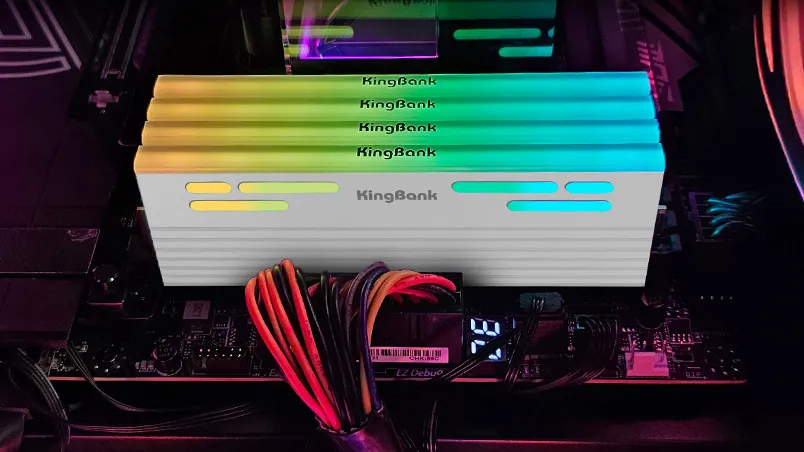
Homegrown DDR5 memory from China, manufactured by ChangXing Memory Technologies, has been making the rounds lately as more and more vendors start legitimizing it. However, new testing from overclocker Safedisk, shared by Uniko's Hardware, purportedly shows that it actually carries inferior performance compared to similar options from SK Hynix, alongside significant variance in the silicon between different batches.
kingbank 2x24 6000c36 1.25 kit (cxmt 3gb dies) on asus c10amanual oc to 8600c44 mt 100%key characteristics of cxmt dies- dont scale with voltage- cant tighten timings- silicon variance appears to be massive between batches- not as strong as hynix when it comes to manual… pic.twitter.com/WNPRiHj233July 15, 2026
CXMT began producing DDR5 in late 2025 despite lacking any cutting-edge EUV lithography tools. Fast forward to today, and reports of the company matching Micron's memory capacity by this year are now floating around. If true, China would become the second-largest memory maker in the world. At such scale, it's no wonder that many companies in China have already started sourcing CXMT-made RAM to fill the gap in the consumer market.
Throughout 2026, we've seen motherboard manufacturers verify CXMT's DDR5 with official BIOS optimizations that allow it to run beyond 8,000 MT/s at this point. OEMs such as Dell and HP are using CXMT RAM in their region-bound systems, and even proper PC hardware companies like Corsair are using CXMT modules. Lexar, Kingbank, Netac, Asgard, Gloaway and more are also producing retail DDR5 kits with CXMT chips.
As such, the testing features a Kingbank 48GB (2x24) DDR5-6000 kit running at CL36 and found several weaknesses despite successfully achieving an 8,600 MT/s overclock at CL44. The first revelation is that CXMT modules don't scale with voltage, meaning you can't just increase voltage in hopes of achieving higher clocks. CXMT's DDR5 apparently doesn't respond well to tuning sub-timings either, forcing you to remain stuck with baseline CAS latency (or higher, like in this case).
Different batches of CXMT-equipped memory perform differently, too, so silicon lottery plays a much bigger role than it would with other vendors. Speaking of which, SK Hynix-made DDR5 modules allegedly performed better at identical clock speeds, while CXMT's modules were less susceptible to overclocking in general. We didn't get any comparative benchmarks for any metric, so take these claims with a grain of salt.
Overall, if the testing is to be believed, it serves as counterprogramming against the popular narrative forming around China as the savior of consumer interests. CXMT's strength lies in the fact that it doesn't have to cater to opulent AI clients as much as the Big Three, which reduces opportunity cost, allowing CXMT to produce more DDR5 memory. That doesn't mean it would be cheaper, though, or at least no evidence has suggested that so far.
CXMT has remained limited to the Chinese region for now, and breaking through to the Western market would mean impressing a lot of skeptics. Not only would pricing play a big factor, but the reliability of a new DRAM manufacturer would raise serious concerns. Stories like these certainly don't help, but with CXMT's IPO on the way, it's only a matter of time before it becomes a serious mainstream contender.
Get Tom's Hardware's best news and in-depth reviews, straight to your inbox.

Follow Tom's Hardware on Google News, or add us as a preferred source, to get our latest news, analysis, & reviews in your feeds.

Hassam Nasir is a die-hard hardware enthusiast with years of experience as a tech editor and writer, focusing on detailed CPU comparisons and general hardware news. When he’s not working, you’ll find him bending tubes for his ever-evolving custom water-loop gaming rig or benchmarking the latest CPUs and GPUs just for fun.
-
usertests I think the real dealbreaker would be the RAM failing quickly instead of lasting decades/indefinitely like you would expect from most RAM. The issues raised could be tolerated (I have never cared about timings), but could suggest higher failure rates are also likely.Reply -
drea.drechsler I think an important thing to remember is they have little to no competition at the low-price end of the market and it will stay that way for quite a while if the big three's forecasts have merit. That gives them a lot of time to improve processes and optimize designs while enjoying the opportunity to sell in volume and generate cash flow. That's an enviable position considering most high-performance semi-conductor markets have a very high bar for entry, especially when the other players are well entrenched.Reply -
edzieba If the sticks meet their rated spec, then that's fine.Reply
Overclocking would be nice, but hardly an issue for the vast majority of buyers; and certainly a stick of can't-overclock RAM you can afford is preferable to a stick of theoretically-overclockable RAM that's at 10x RRP and climbing. -
bigdragon I've never had a good experience overclocking RAM. There always seems to be some sort of compatibility issue that randomly pops up at some arbitrary point in time that causes instability. I've had better experiences sticking to the rated speed and preloaded profiles.Reply
I want the Chinese RAM to undercut the other RAM manufacturers. I want the Chinese to pull the price of RAM downward to more sane levels. Simply releasing a competing product is not enough to gain my interest. Right now it looks like they've simply released a competing product at a similar price point -- not good enough. -
evilpaul Reply
The "communists" aren't running a charity for American gamers. Why would someone running a business undercut when they can sell through their inventory at market rates? Pure wishful thinking.bigdragon said:I've never had a good experience overclocking RAM. There always seems to be some sort of compatibility issue that randomly pops up at some arbitrary point in time that causes instability. I've had better experiences sticking to the rated speed and preloaded profiles.
I want the Chinese RAM to undercut the other RAM manufacturers. I want the Chinese to pull the price of RAM downward to more sane levels. Simply releasing a competing product is not enough to gain my interest. Right now it looks like they've simply released a competing product at a similar price point -- not good enough. -
DS426 Reply
Depends on availability. Who's going to pay the same for "cheap Chinese DDR5" if it's priced the same as the big 3? They'll have to undercut to move huge volume, which is a typical Chinese business playbook anyways, right? They'll still make money hand over first.evilpaul said:The "communists" aren't running a charity for American gamers. Why would someone running a business undercut when they can sell through their inventory at market rates? Pure wishful thinking.
They need to move product too, not just make an appreciable margin. -
setx Another "great" article! Is SK Hynix now "Big Three"?Reply
How about comparing CXMT not with the best one (Hynix) but with the worst (Micron)? It would be much more interesting comparison. -
thestryker The most concerning thing I've seen talked about with the current crop of Chinese DDR5 is the variance. This comes down to the manufacturing technology rather than any issues design wise. The reason it's concerning is that this makes the durability questionable. While I wouldn't touch a kit of memory with 10ns or higher latency for my primary builds not everything needs high performance memory. These could be a viable option, but not if the quality is hit and miss.Reply
The CXMT IC not scaling with voltage is reminiscent of early pre-EUV DDR5. Several early kits using Micron and Samsung IC had decent speed, okay timings and good voltage, but juicing them wouldn't really get you anywhere. This is part of what allowed SK Hynix to dominate the client DDR5 market. While I'm sure CXMT will do better with DUV than any of the big three did that's not by choice. It's also why they'll never be competitive in the enthusiast DDR5 space.
Anyone hoping for a memory price savior is likely to be sorely disappointed. DRAM, despite the shortages, is still a commodity product and there are massive barriers to OEM adoption. The only place to likely see a positive from this is China as the increased capacity is likely to be used to resolve their internal supply issues before any goes world wide. I believe King Bank and Lexar have had some modules available outside of China, but they're no cheaper than anything else currently. -
jackt Tom may benchmark it when released out of china !Reply
Im also interested in benchmarks of DDR5 that uses DDR4-like power consumption levels.