









Broadcom and OpenAI unveil custom-built Jalapeño inference processor — OpenAI's first chip is a massive reticle-sized ASIC built in an ultra-fast nine-month development cycle
Firms fail to disclose (m)any details.

OpenAI and Broadcom have introduced Jalapeño, a custom-built inference processor designed specifically for modern large language models and future agentic AI workloads, which is designed to deliver performance per watt they claim is higher than today's leading-edge hardware. OpenAI considers its hardware project a strategic one and envisions Jalapeño to be the first generation of its inference hardware.
Not another AI accelerator
OpenAI stresses that Jalapeño is a purpose-built inference ASIC and not a repurposed training accelerator or a general-purpose AI processor. OpenAI says the architecture of Jalapeño was designed based on its understanding of LLM behavior and is meant to address practical bottlenecks that matter for inference at scale, including costly data movement, balance between compute and memory resources, networking efficiency, and overall behavior. OpenAI also states that the design of the processor is meant to wed high throughput with low latency (which is why it uses a huge compute chiplet and HBM memory and not cheaper types of DRAM like many other inference accelerators), which will be particularly handy for reasoning and agentic workloads.
In addition, OpenAI and Broadcom claim the processor is built to deliver higher effective utilization than conventional AI accelerators and deliver performance that is close to the theoretical maximum, which means very high efficiency both in terms of costs and in terms of power. Meanwhile, the companies did not disclose performance targets for their Jalapeño ASIC, so these claims should be taken with a grain of salt.
Engineering samples are already operating in the lab at target clock speed and power (though Broadcom and OpenAI do not disclose details about this, either), and OpenAI says it is running machine learning workloads, such as GPT-5.3-Codex-Spark.
The two companies also claim that early internal testing indicates that Jalapeño's performance-per-watt is substantially better than 'current state-of-the-art hardware,' although no hard numbers, benchmarks, memory configuration, or other details are disclosed, so again, we will have to take the claims with a grain of salt. In addition, one must bear in mind that while Jalapeño can purportedly beat existing AMD's Instinct MI350-series and Nvidia's Blackwell-based accelerators, it remains to be seen how competitive it will be against AMD's Instinct MI400-series and Nvidia's Rubin-based offerings.
"Jalapeño was designed from the ground up for LLM inference using detailed insights from our close collaboration with OpenAI researchers," said Richard Ho, who leads OpenAI's hardware program. "We optimized the architecture around the kernels, memory movement, networking, and serving patterns that matter most for frontier AI models. Based on early testing, Jalapeño will efficiently execute our most important workloads close to the hardware’s theoretical limits."
A massive chip with six HBM modules
While Broadcom and OpenAI did not disclose specifications of Jalapeño, they did show its wafer and packaging, so we can do a brief analysis. The package appears to contain one large compute chiplet surrounded by six HBM modules and another chiplet that likely packs input/output interfaces and is surrounded by two structural dummy dies.
Get Tom's Hardware's best news and in-depth reviews, straight to your inbox.
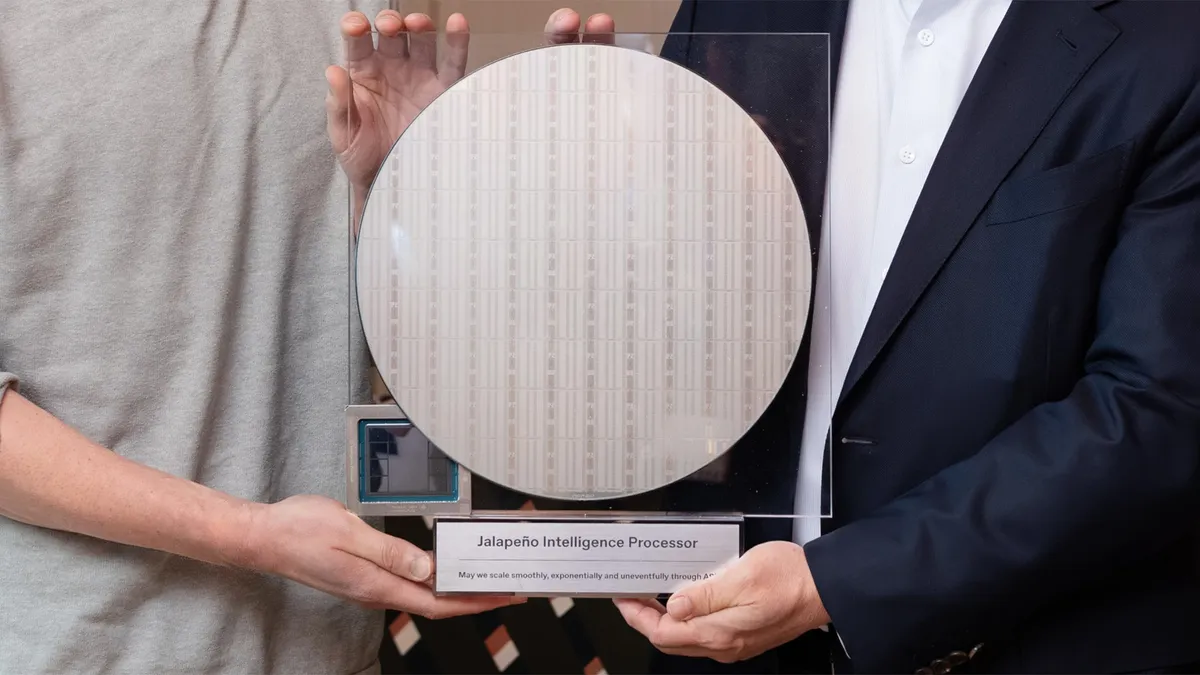
The wafer image does look like a Broadcom-style systolic-array-heavy accelerator, in the sense that it shows a very regular, repeated, columnar floorplan with what looks like replicated compute regions and fixed infrastructure macros. Yet, keep in mind that we are speculating, and the image is not clean enough to say that this is definitely Broadcom's standard TPU-like systolic array template with some perks from OpenAI,
From the image alone, it is impossible to tell whether Jalapeño uses a true 2D systolic array, a set of 1D/2D matrix engines, a collection of vector or tensor tiles, or some other inference datapath. All we can say is that the die has a highly repetitive floorplan consistent with several kinds of tiled AI accelerator architectures.
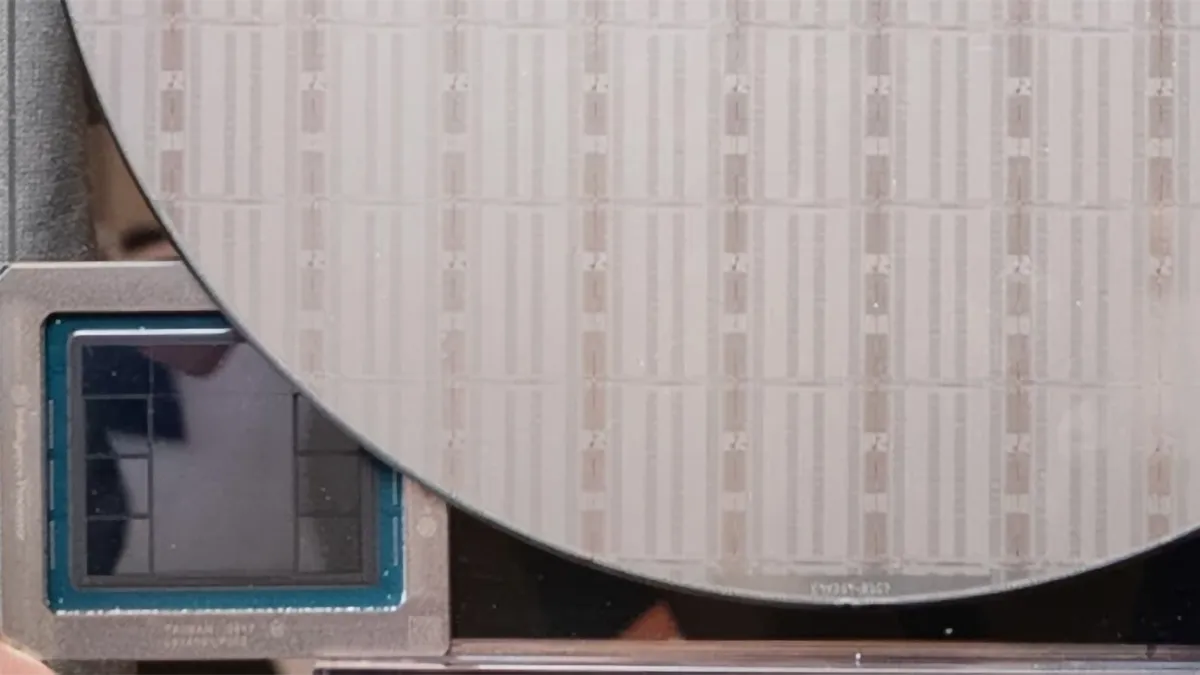
What we can tell from the image is the approximate die size of Jalapeño's compute chiplet based on the size of HBM3/4 packages (10.975 mm × 10.975 mm) that surround it. From what we can tell, the chiplet measures 25.46 mm (width) × 33 mm (height), which means that its die size is around 840 mm2, which is very close to the reticle size of EUV lithography systems (858 mm2). Given that the quality of the shot is poor, the die size we estimate cannot be 100% accurate, but we suspect it is close enough.
The die size of Jalapeño's compute chiplet implies that it packs quite a lot of compute oomph, though, of course, we cannot make performance estimates based on this metric. Yet, it is safe to say that Jalapeño's compute die is considerably bigger than compute dies of other inference accelerators on the market and more resembles processors for AI training. Speaking of processors for AI training, we increasingly see multi-chiplet designs for these workloads as companies like AMD and Nvidia want to pack as much performance as possible. Meanwhile, the fact that OpenAI and Broadcom chose to go with a large compute chiplet possibly indicates that they wanted to reduce latencies by as much as possible.
Designed in nine months
The companies say the chip reached tape-out in just nine months and is slated for deployment beginning in late 2026, which represents an extremely fast turnaround time in ASIC design. It is unclear whether Broadcom and OpenAI extensively used artificial intelligence to define and then develop Jalapeño, though the companies admitted that they used OpenAI's models to speed up parts of the chip's design and optimization work. Typically, it takes 1.5 – 2 years to design an ASIC from scratch, so AI can shrink the development cycle. Another means to accelerate the design cycle is Broadcom's extensive reuse of its logic across different custom designs to deliver new chips faster than other companies.
It is noteworthy that, according to the announcement, Jalapeño is designed to support not only OpenAI's own workloads but also present and future LLMs across the industry, which potentially lets OpenAI sell its hardware to third parties, assuming that it can get enough supply from Broadcom and TSMC. Meanwhile, the chief executive of Broadcom indicates that Jalapeño will be deployed at gigawatt-scale data centers with Microsoft and other partners starting this year, though it is unclear whether the processor will be used exclusively for OpenAI workloads or will be available for other tenants as well.
"Our collaboration with OpenAI represents a fundamental commitment to scaling the physical infrastructure required for the next decade of AI," said Hock Tan, President and CEO, Broadcom. "This is just the beginning of a multi-generation roadmap. By co-developing our industry-leading silicon directly with OpenAI, we are enabling the deployment of gigawatt-scale data centers with Microsoft and other partners beginning in 2026."

Follow Tom's Hardware on Google News, or add us as a preferred source, to get our latest news, analysis, & reviews in your feeds.

Anton Shilov is a contributing writer at Tom’s Hardware. Over the past couple of decades, he has covered everything from CPUs and GPUs to supercomputers and from modern process technologies and latest fab tools to high-tech industry trends.
-
usertests ReplyBased on early testing, Jalapeño will efficiently execute our most important workloads close to the hardware’s theoretical limits.
It sounds like it can be configured to run multiple models and they don't need a new ASIC for every model. For example, Taalas made an ASIC with a similar reticle-limit size that could only run Llama 3.1 8B, but with insanely high performance and efficiency.
Seeing the outcry from users when their beloved models are killed off, maybe it's fine to have the same model available for a few years, using models baked into ASICs for lower operating costs. -
Lieutenant Barclay Reply
Maybe we can start a support group for everyone feeling a loss over their "beloved model". You know, some grief counseling.usertests said:Seeing the outcry from users when their beloved models are killed off, maybe it's fine to have the same model available for a few years
Problem is "AI" pumpers are stuck in the first 3 stages: denial, anger, and bargaining :LOL: -
usertests Reply
https://www.cosmopolitan.com/relationships/a66022416/ai-boyfriend-reddit/https://www.bbc.com/news/articles/crl43dxwwy9ohttps://www.techradar.com/ai-platforms-assistants/chatgpt/im-grieving-openai-has-switched-off-chatgpt-4o-and-angry-users-are-backing-a-keep4o-campaign-to-restore-itLieutenant Barclay said:Maybe we can start a support group for everyone feeling a loss over their "beloved model". You know, some grief counseling.
Problem is "AI" pumpers are stuck in the first 3 stages: denial, anger, and bargaining :LOL: -
alan.campbell99 Assuming these things get deployed, can they be used for anything else when the bubble pops? Also given how it differs from the 'usual' GPU compute modules will this add even more cost to data center projects?Reply -
usertests Reply
I think it's extremely less likely for ASICs to be useful, but not impossible since it doesn't look like it's tied to a single model.alan.campbell99 said:Assuming these things get deployed, can they be used for anything else when the bubble pops?
If SHTF, tech scavengers could at least harvest useless accelerators for the HBM. But more general purpose parts can be used for local AI.
Are they not using an industry standard form factor?alan.campbell99 said:Also given how it differs from the 'usual' GPU compute modules will this add even more cost to data center projects? -
DougMcC Reply
The AI bubble might pop. But the inference demand is not going away. I have uses for at least another quadrillion tokens in mind. So do lots of other people. If this hardware is sold off at a big loss it will still be getting used for inference.alan.campbell99 said:Assuming these things get deployed, can they be used for anything else when the bubble pops? Also given how it differs from the 'usual' GPU compute modules will this add even more cost to data center projects? -
Tiz.io Reply
I know people have had personal reasons to get attached to particular models, but as a professional engineer who integrates llms into products, I can tell you it's a massive pain having to reevaluate every integrated prompt when the underlying model changes. Sonnet 4 was perfectly fine for the sort of classification and categorization we use, but when they discontinued it, we spent many hours retooling and testing just to use the more expensive model.Lieutenant Barclay said:Maybe we can start a support group for everyone feeling a loss over their "beloved model". You know, some grief counseling.
Problem is "AI" pumpers are stuck in the first 3 stages: denial, anger, and bargaining :LOL:
The next forced upgrade will see us moving to self-hosted models for greater stability. -
DS426 Reply
Why wait for the next model rug pull? Find a good open source LLM for local inference that works for your needs and don't look back.Tiz.io said:I know people have had personal reasons to get attached to particular models, but as a professional engineer who integrates llms into products, I can tell you it's a massive pain having to reevaluate every integrated prompt when the underlying model changes. Sonnet 4 was perfectly fine for the sort of classification and categorization we use, but when they discontinued it, we spent many hours retooling and testing just to use the more expensive model.
The next forced upgrade will see us moving to self-hosted models for greater stability. -
DS426 Model-specific ASIC's aren't worth the sand IMO, but ones that still have enough flexibility to run a family of models or several defined characteristics of vendor-agnostic models, sure, especially for models that are built with the intention of having long-term support / stability (minimal tweaks).Reply -
usertests Reply
I think it could make sense if:DS426 said:Model-specific ASIC's aren't worth the sand IMO,
The performance and efficiency benefits are immense
You can do some fine-tuning after the fact
Model quality starts to hit a plateau, taking years to get significantly betterIn the Taalas example, they reportedly got 8.5x the performance of a Cerebras Wafer Scale Engine 3, using ~1/10th the power, and a much smaller, cheaper die. But only for the Llama 3.1 8B model hard-wired into the chip. They claimed that:
While largely hard-wired for speed, the Llama retains flexibility through configurable context window size and support for fine-tuning via low-rank adapters (LoRAs).
The die was 815mm^2 on TSMC N6, which is a big die for an 8 billion parameter model. I wonder if they would need MCMs and a better node to handle 70B.
An ~85x increase in performance/Watt could make model-specific ASICs viable, even if they are considered e-waste within a few years.