Join for quick access. Enter your email below and we'll send confirmation plus sign you up to our newsletter.
By submitting your information, you confirm you are aged 16 or over,
have read our
Privacy Policy
and agree to the
Terms & Conditions. Geographical rules apply.
Join for quick access. Enter your email below and we'll send confirmation plus sign you up to our newsletter.
By submitting your information, you confirm you are aged 16 or over,
have read our
Privacy Policy
and agree to the
Terms & Conditions. Geographical rules apply.
Stay On the Cutting Edge: Get the Tom's Hardware Newsletter
Get Tom's Hardware's best news and in-depth reviews, straight to your inbox.
You are now subscribed
Your newsletter sign-up was successful
Join the club
Get full access to premium articles, exclusive features and a growing list of member rewards.
An account already exists for this email address, please log in.
OpenAI mulling giving US gov't a 5% stake in the company, days after Washington delayed GPT-5.6 — Altman reportedly wants every leading U.S. AI lab paying into an Alaska-style public fund
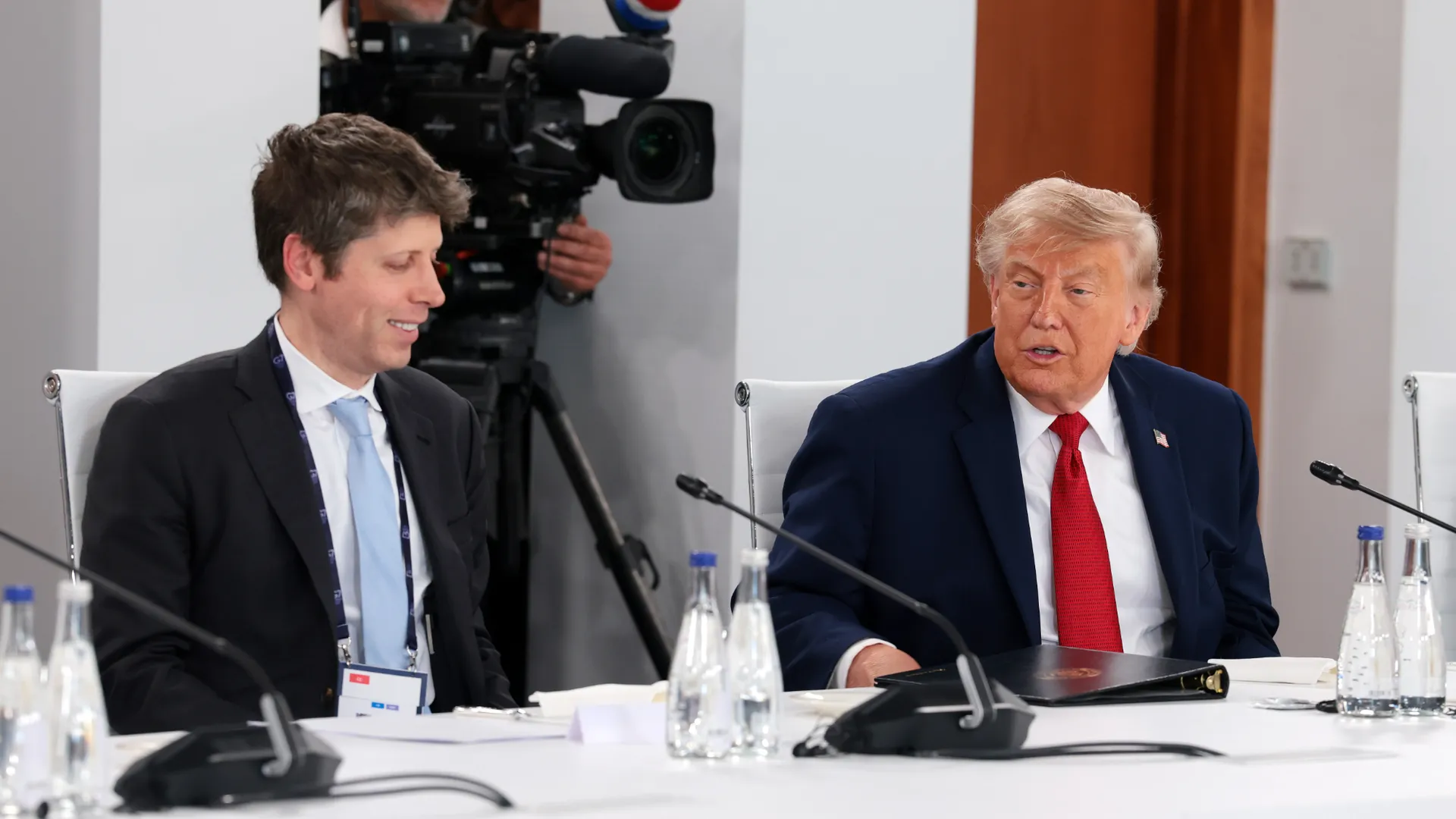
OpenAI has discussed handing the U.S. government a 5% ownership stake, the Financial Timeshas reported, citing two people familiar with the talks, with CEO Sam Altman proposing that every leading U.S. AI developer contribute the same share of its equity to a vehicle modeled on the Alaska Permanent Fund, which pays annual dividends to state residents from Alaska’s oil wealth. At the $852 billion valuation OpenAI set in its March funding round, a 5% stake is worth roughly $42.6 billion. The FT characterized the discussions as conceptual and early-stage, and reported that implementing any deal might require an act of Congress.
Altman is understood to have raised the idea with President Donald Trump, Commerce Secretary Howard Lutnick, and Treasury Secretary Scott Bessent, and has spoken with Senator Bernie Sanders (I-Vt.) in recent weeks. The all-labs structure would pull equity from companies, including Google, Meta, and Anthropic, none of which have indicated they would participate. OpenAI declined to comment to the FT, and the White House didn’t immediately respond.
Altman’s 5% is the smallest figure we’ve seen to date attached to public ownership of the AI sector. Sanders filed the American AI Sovereign Wealth Fund Act in June, seeking 50% of the voting shares of U.S. AI companies through a fund his office valued at $7 trillion, enough to pay every American a $1,000 annual dividend. Trump said last month that he was exploring options to give the public a stake in leading AI firms, and Vice President JD Vance said the president prefers equity over cash payouts.
The administration has already run this playbook on chipmakers, with the federal government having taken a 9.9% stake in Intel last August by converting CHIPS Act grants into equity at $20.47 per share, and AMD and Nvidia agreed to hand over 15% of their China chip revenue in exchange for export licenses. OpenAI itself proposed a “public wealth fund” in an April policy paper, and Altman first pitched a government stake to the administration in early 2025, CNBC reported last month.
News of the talks comes just six days after OpenAI delayed the full public launch of GPT-5.6 at the government’s request, with Lutnick reportedly warning Altman against releasing the model without prior approval. Anthropic spent most of June with its Claude Fable 5 and Mythos 5 models disabled worldwide under the first U.S. export controls ever applied to an AI model rather than to hardware; access was restored yesterday.
Both OpenAI and Anthropic have confidentially filed for initial public offerings, and OpenAI faces a probe from a coalition of 42 state attorneys general. A government shareholding negotiated before a listing would lock in Washington’s position ahead of the ownership expansion that a full float brings, however.
Luke James is a freelance writer and journalist. Although his background is in legal, he has a personal interest in all things tech, especially hardware and microelectronics, and anything regulatory.
To me this sounds more like setting up a situation where it would be in the government's best interest to bail out the company should things go sideways than anything else. It's not that ai is going to disappear overnight or anything of that sort, but the big ai companies haven't come up with a viable business model yet. If investment collapses the companies solely relying on ai seemingly will right with it.
To me this sounds more like setting up a situation where it would be in the government's best interest to bail out the company should things go sideways than anything else. It's not that ai is going to disappear overnight or anything of that sort, but the big ai companies haven't come up with a viable business model yet. If investment collapses the companies solely relying on ai seemingly will right with it.
They know exactly which market segment is profitable. They could be profitable if they cut all free usage and slowed down research and training, but then they'd also leave space for the competition and stop growing. In a way it's a race to the unknown, it could be the top or the bottom, but either way whoever stops first takes the biggest blow, even if stopping is the only path to short term profitability. Once they started running down the hill there's no stopping without injury.