









Palantir co-founder Peter Thiel backs $140M wave-powered AI data center startup — Panthalassa aims to run offshore compute nodes using ocean energy
Fully-integrated offshore data center to transmit data to land via satellite
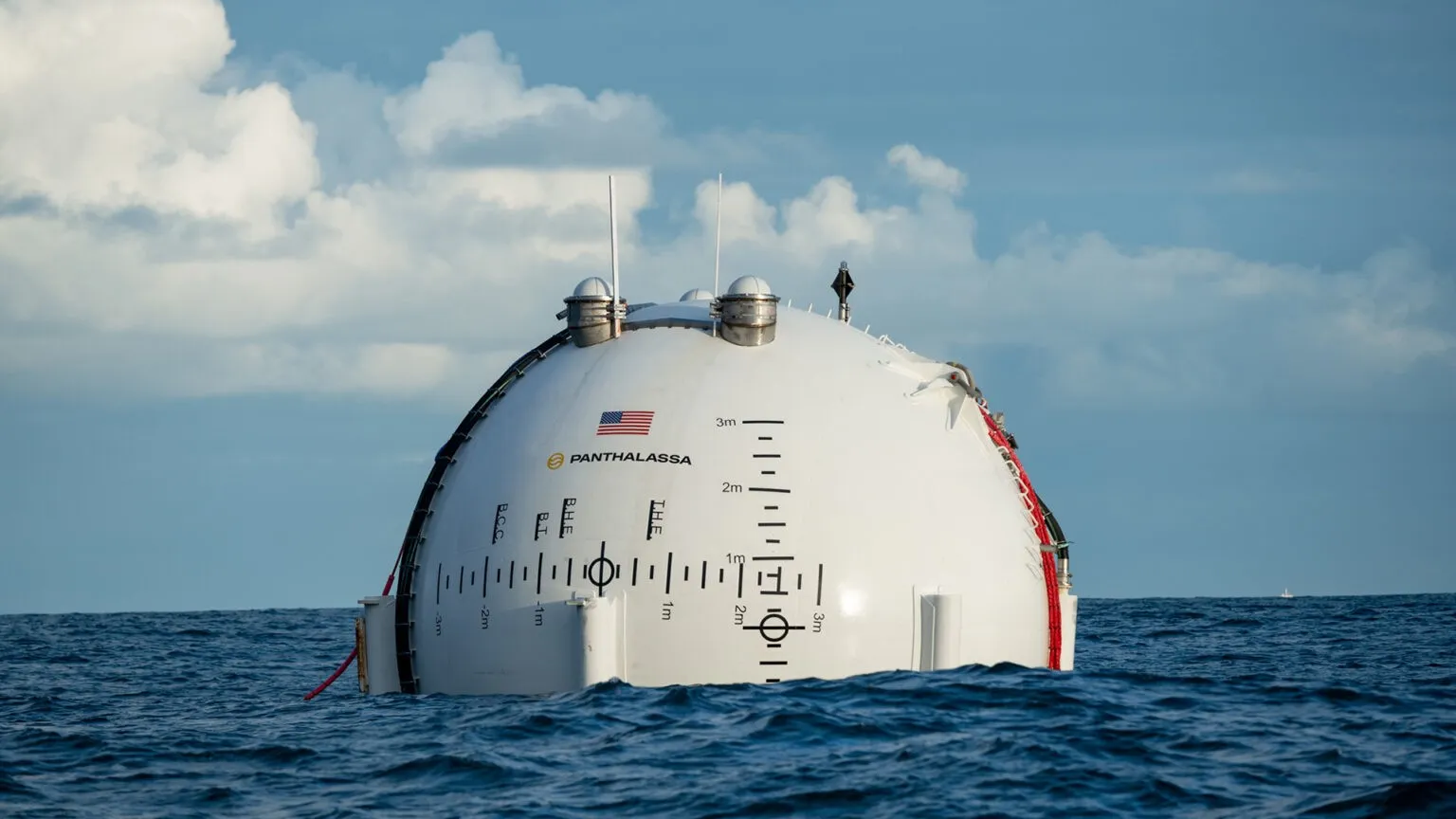
An official press release yesterday confirmed a $140 million investment to power AI data centers at sea. The funding goes to Pathanlassa — a renewable energy and ocean technology company — and was raised in a Series B financing led by avid investor and former PayPal CEO and Palantir co-founder Peter Thiel, alongside several other investors.
The Portland-based start-up said it would use the funding to complete its pilot manufacturing facility in Oregon for its Ocean-3 series nodes — an autonomous platform that will house and power data centers for AI inference computing at sea, using electricity generated from ocean waves.
“There are three sources of energy on the planet with tens of terawatts of new capacity potential: solar, nuclear, and the open ocean,” said Garth Sheldon-Coulson, Co-Founder and CEO of Panthalassa. “We’ve built a technology platform that operates in the planet’s most energy-dense wave regions, far from shore, and turns that resource into reliable, clean power. We’re now ready to build factories, deploy fleets, and provide a sustainable new source of energy for humanity.”
Panthalassa’s solution is an autonomous, fully integrated system called a node that houses both AI infrastructure and power-generating hardware in a single offshore unit. Each lollipop-shaped node consists of a buoyant spherical head connected to a long, submerged vertical tube and structural frame.
As ocean waves pass, the node bobs up and down, but, crucially, the surrounding water moves only in small orbital paths. This relative motion between the structure and the water column induces oscillations within the tube, effectively driving seawater up and down through the system.
That oscillating flow is channeled into the spherical chamber through a high-pressure jet, where it is converted into usable mechanical energy. The water then passes through internal turbines, generating electricity before recirculating back into the tube to repeat the cycle. The system is designed as a closed hydraulic loop that continuously extracts energy from wave-induced motion.
As the ocean never stops moving, the system generates power around the clock. That power runs the onboard payloads. For truly autonomous operation, the system transmits data back to shore via satellite, eliminating the need for tethering. Another noteworthy benefit of the system is that the surrounding ocean provides free supercooling, solving one of the biggest engineering challenges in land-based data centers.
Get Tom's Hardware's best news and in-depth reviews, straight to your inbox.
Each node also incorporates propulsion and station-keeping systems, allowing it to maintain optimal positioning or operate as part of a distributed offshore network, effectively coupling renewable energy generation directly with modular AI compute at sea.
After decades of research and development, and several preceding versions, Panthalassa says it plans to “deploy its Ocean-3 pilot node series in the northern Pacific Ocean, demonstrating AI inference capabilities and refining its manufacturing process in preparation for commercial deployments in 2027.”
AI’s electricity demand is rising much faster than conventional power infrastructure can keep up with. In many regions, grid operators are already struggling to keep up, while communities are increasingly pushing back against new builds over concerns about land use, noise, and energy diversion. In response, companies are scrambling for alternatives, and the solutions are becoming increasingly unconventional. “The future demands more compute than we can imagine,” said Peter Thiel. “Extra-terrestrial solutions are no longer science fiction. Panthalassa has opened the ocean frontier.”
Panthalassa’s wave-powered offshore compute nodes are the latest in a growing line of radical bets on how to power AI sustainably. Last month, we reported that Meta had signed a partnership with an energy start-up to beam solar energy from space to enable continuous, 24/7 power. Other startups are exploring the idea of moving data centers entirely off-planet. These are just a few of the many other initiatives to meet AI’s seemingly impossible electricity demands.

Follow Tom's Hardware on Google News, or add us as a preferred source, to get our latest news, analysis, & reviews in your feeds.

Etiido Uko is a news contributor for Tom's Hardware covering the latest updates in big tech and the PC industry. He is a mechanical engineer and senior technical writer with over nine years of experience in documentation and reporting. He is deeply passionate about all things engineering and technology, and is an expert in gadgets, manufacturing, robotics, automotive, and aerospace.
-
rluker5 How are they going to keep it clean enough to work?Reply
Boats are known to get dirty in the ocean. -
CParsons Reply
They'll just rinse it off with water.rluker5 said:How are they going to keep it clean enough to work?
Boats are known to get dirty in the ocean. -
Krieger-San I'm concerned about the enviromental impacts of adding 'warm spots' in the oceans. If there's heat offshore, weather systems tend to pull this energy up and typically increase the severity of storms.Reply
We already have insane weather...
I also have deep reservations about the directions of said investor. There's nothing good about the parent company and their unbridled, unfathomable spending on AI investments and data collection is downright scary. -
lucyrainboww if the amount of infrasound from these on land is enough to negatively impact the physical health of people nearby , imagine how all of that noise is going to impact the marine environment; we don't need more whales committing s**cide because the ocean is becoming less hospitable to themReply -
Bikki Imagine when the screen freezes and you want that physical reset button so bad, but then you realize it out on the sea🥴Reply -
jonzor82 What will they use to protect these assets from those who want to destroy them? They're literally sitting ducks.Reply -
lucyrainboww Reply
but for real it's not like there's gonna be someone around to swap a RAID eitherBikki said:Imagine when the screen freezes and you want that physical reset button so bad, but then you realize it out on the sea🥴 -
Krieger-San Reply
This is what BMC/IPMI systems (on the motherboard) are for; rebooting or installing an OS when you're not physically there.Bikki said:Imagine when the screen freezes and you want that physical reset button so bad, but then you realize it out on the sea🥴
However, power and network is critical for this to function. ;) -
canders1989 Let me get this straight. They are spending $140 M to develop a wave based energy generating system and put a data center worth of processing inside, then they are going to load and uplink the processed data by satellite? The widest bandwidth to and from satellites is one Gbps RF and 100 Gbps optical. The optical is not going to perform when the optical link attempts to hold focus on a bouncing and rotating optical head unit bobbling in the ocean on one end and the other end moving at 17,500 mph across the sky. So the highest data links they can likely maintain will be 1 to 2 Gbps of RF, and at that rate the satellites will need to be in Low Earth Orbit (LEO) orbits, which means the link must change satellites approximately every eight minutes. To maintain continuous connectivity with either the RF or Optical, it would require a minimum of 144 satellites in a polar orbit , and that is horizon to horizon, which they will never maintain. The 144 satellites would also require intersatellite optical links to move the data across the constellation to Earth based gateway downlink locations. The RF links must use the Ghz frequencies to get the throughput of 1 to 2 Gbps. The GHz frequencies are subject to clouds and rain fade, so that performance will not be continuous. So they best figure out how they can get fiber connected to the units with some form of connection that will withstand and tolerate the significant movement of the entire platform. They could have paid me just $1M and saved the other $139M to tell them all of this. I know these specifics as I spent 10 years designing and developing high-bandwidth satellite links. Plenty of people in the satellite industry could have told them this as well. Or they could just ask a good AI platform and obtain the same information. I wonder who sold them on the satellite link concept... One last thing to think about. How are they going to guard and secure their $140 M floating data centers from pirates or vandals?Reply