Join for quick access. Enter your email below and we'll send confirmation plus sign you up to our newsletter.
By submitting your information, you confirm you are aged 16 or over,
have read our
Privacy Policy
and agree to the
Terms & Conditions. Geographical rules apply.
Stay On the Cutting Edge: Get the Tom's Hardware Newsletter
Get Tom's Hardware's best news and in-depth reviews, straight to your inbox.
You are now subscribed
Your newsletter sign-up was successful
Join the club
Get full access to premium articles, exclusive features and a growing list of member rewards.
An account already exists for this email address, please log in.
US Navy signs deal with AI firm for training underwater drones to detect mines in Strait of Hormuz — $100 million would allow drone minesweepers to update their detection algorithms in days instead of months
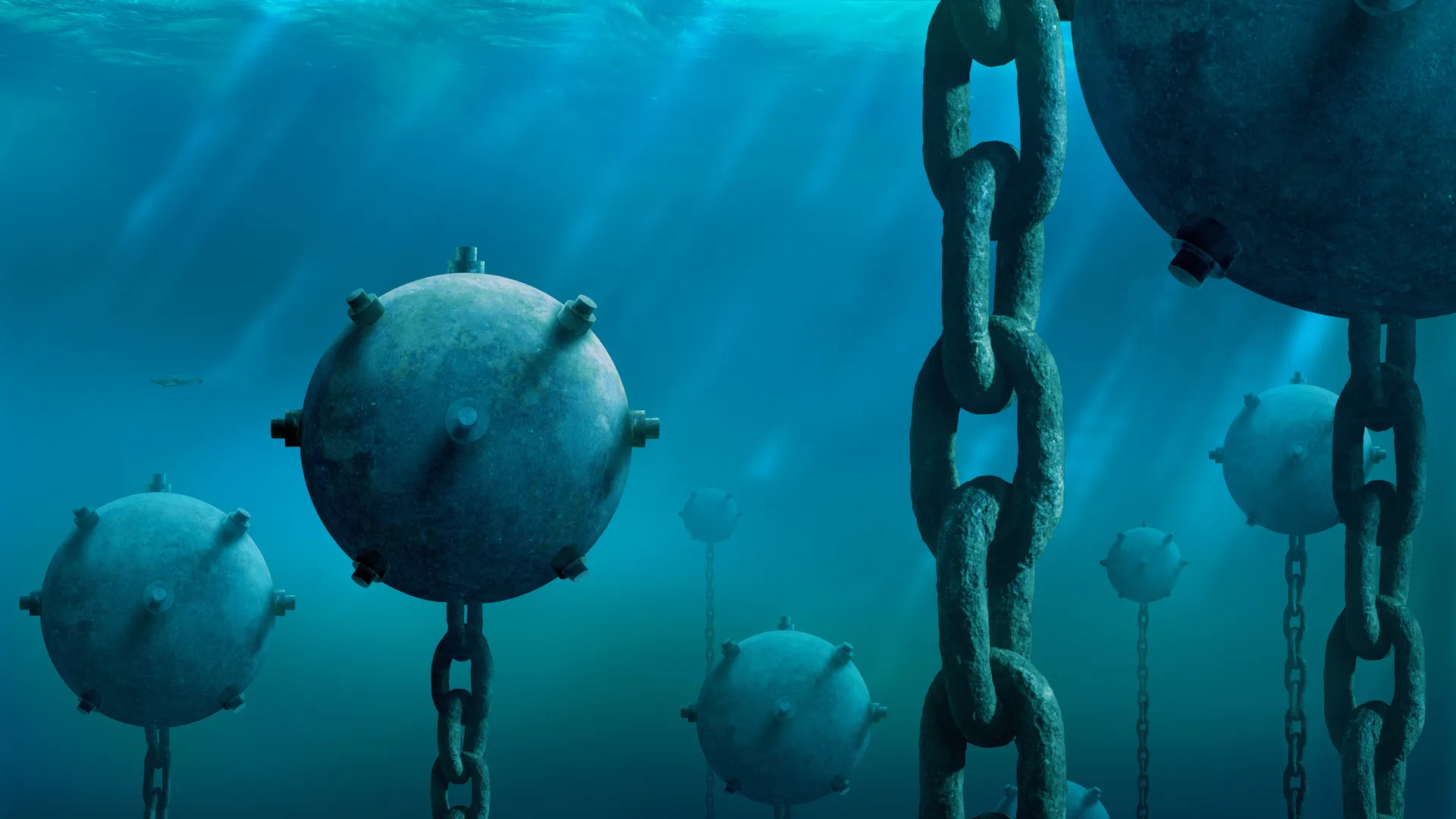
The U.S. Navy just signed a $99.7 million deal with Domino Data Lab, a San Francisco-based startup, to develop AI tech that would allow its undersea minesweepers to learn about new and unseen mines in days instead of months. Reuters reports that this new technology is intended for use in the Strait of Hormuz, a key chokepoint in global sea lanes that Iran has mined to limit the movement of oil and cargo ships since the start of the U.S.-Iran war earlier this year.
The software will use multiple sensor suites, such as side-scan sonar and visual imaging systems, to monitor various other AI detection models operating in the field. This should allow operators to identify failures and push corrections as it operates, rather than sending information back to a lab and waiting for AI developers to train a new model to handle novel threats.
"Mine-hunting used to be a job for ships. It's becoming a job for AI. The Navy is paying for the platform that lets it train, govern, and field that AI at a speed required for contested waters that block global trade and imperil sailors,” Domino CEO Thomas Robinson told the news outlet. "If there were UUVs (unmanned underwater vehicles) in the Baltic Sea trained on Russian mines, and then they needed to be deployed to the Strait of Hormuz to detect Iranian mines, with Domino's technology, the Navy could be ready in a week rather than a year."
The Pentagon has increasingly been turning towards AI to bolster its capabilities, with the Department of War announcing deals with seven AI tech companies — namely SpaceX, OpenAI, Google, Nvidia, Reflection, Microsoft, and Amazon Web Services — to deploy LLMs across its classified networks. These tools are designed to sift through large volumes of data and identify patterns that are simply impossible for people to process in such a short time, thereby speeding up data analysis and decision-making. DARPA, its independent research arm, has also called for proposals to develop the next-generation deep-sea underwater drone that can be built quickly.
The U.S. and Iran have had an on-again, off-again ceasefire in place for several weeks now. This makes mine-clearing operations in the Strait of Hormuz high-risk, especially since strikes could occur at any moment and without warning. Deploying AI technology on undersea drones will reduce this risk, especially by making mine detection and removal much faster.
Jowi Morales is a tech enthusiast with years of experience working in the industry. He’s been writing with several tech publications since 2021, where he’s been interested in tech hardware and consumer electronics.
Mine-hunting used to be a job for ships. It's becoming a job for AI.
Oh, really? AI has suddenly sprung a sensor suite, hull, propulsion, etc. and it taking itself on location to perform readings autonomously?
What's that? No?
Oh, I guess mine hunting is still a job for ships, and some company is just building an ML suite to aid in identification. But evidently Pentagon officials are making decisions based off buzzwords rather than actual capabilities, so we have to call the system "AI" or no one will spend $100 million on it.