Join for quick access. Enter your email below and we'll send confirmation plus sign you up to our newsletter.
By submitting your information, you confirm you are aged 16 or over,
have read our
Privacy Policy
and agree to the
Terms & Conditions. Geographical rules apply.
Join for quick access. Enter your email below and we'll send confirmation plus sign you up to our newsletter.
By submitting your information, you confirm you are aged 16 or over,
have read our
Privacy Policy
and agree to the
Terms & Conditions. Geographical rules apply.
Stay On the Cutting Edge: Get the Tom's Hardware Newsletter
Get Tom's Hardware's best news and in-depth reviews, straight to your inbox.
You are now subscribed
Your newsletter sign-up was successful
Join the club
Get full access to premium articles, exclusive features and a growing list of member rewards.
An account already exists for this email address, please log in.
Lenovo's 'encrypted' fingerprint USB drive is just an unencrypted SD card in a fancy case — AI-assisted follow-up finds a backdoor and hardcoded keys in other ‘secure’ USB products (updated)
Update, Tue 3 Now, 11:30 ET: Following the publication of this story, a Lenovo spokesperson issued the following statement to Tom's Hardware: Lenovo appreciates the work of independent researchers in helping identify and address security issues. The ThinkPlus storage products referenced were designed for the China market and are only available from Lenovo in mainland China. After these vulnerabilities were reported to Lenovo in August 2025, Lenovo worked with the researcher through coordinated disclosure, remediated the issues through hardware and software upgrades, and published a security advisory and three CVEs in January 2026. Customers with affected devices can contact Lenovo Support to arrange a replacement. Further information on the published CVEs is available here:
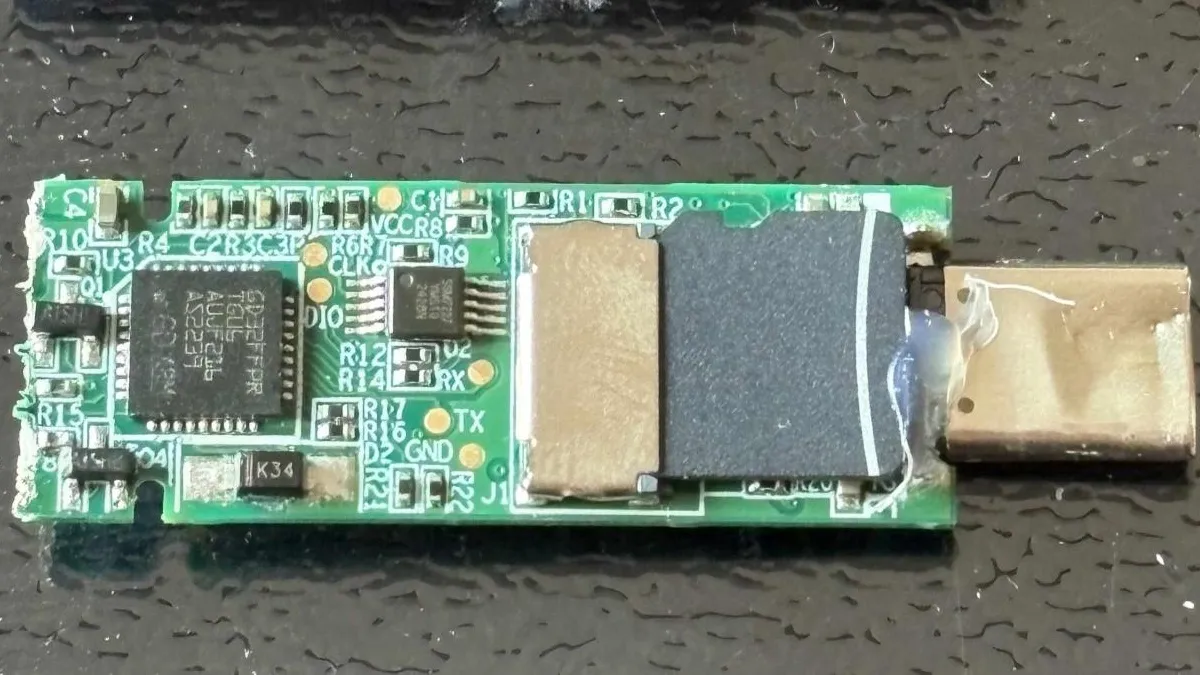
Security researcher Xusheng Li found that a Lenovo ThinkPlus FU100 fingerprint USB stick, sold as an AES-256-encrypted device for data security, ended up being just a plain SD card internally,HackingPassion reports. The fingerprint reader only enabled the USB connection, and nothing on the card was actually encrypted. An AI-assisted follow-up last week discovered what Li calls backdoor accounts on another maker’s drive, as well as hardcoded keys in other supposedly secure USB storage products.
The FU100 is “just an SD card in a fancy case,” Li said in a March conference talk. It is, as a result, trivial for anyone with physical access to get to the drive’s data. One of his takeaways: “‘Hardware security’ can be pure marketing.” This isn’t the first timedrive makers’ own encryption has failed, and it won’t be the last.
The original ThinkPlus FU100 analysis happened last year, with an interim fix using epoxy over the card. A later fix by Lenovo, put out early this year for the FU100, FU200 and TU800 drives, as well as the TSD303 SSD, requires owners to call a China service line, then either send devices back for replacement or get an on-site firmware upgrade. Lenovo advises backing up data first and strongly recommends wiping the drive before sending it in, which is quite an inconvenience. Lenovo rated the advisory’s severity as high, and one of its three CVEs covers the configuration software, which could let a local, logged-in user bypass device authentication and enroll an untrusted fingerprint.
The same research also turned up a different flaw in Lenovo’s TSD303 external SSD. Its data actually was encrypted, but the drive sent the correct password back over USB in plain text for the software to compare, making it easy to capture. The first fix came three months after the initial report, using block cipher encryption with a key derived from a timestamp-like value. Lenovo’s software could derive that key, and the first software fix is vulnerable if taken apart, making it not useful for protecting data if a device is stolen. A later fix, late last year, has the drive check the typed password itself, so the correct one never leaves the drive.
The same software development kit used for the drive covered nine other devices from multiple vendors, most of which could also reveal passwords to a savvy actor. In addition, two left data unencrypted on a microSD card. The full list of vendors was blacked out on Li’s slides.
AI agent use fordriving reverse-engineering tools continues to increase. AI has also beenexposing more security flaws recently. Li used OpenAI’s Codex, an AI programming-centric tool, with his employer’s reverse-engineering tool against other vendors’ protection schemes. Netac’s tool took about seven minutes to break, as Codex found a fixed key built into the program, along with the user’s password written to diagnostic logs.
Copy protection differs from direct access, as the intent is to allow the recipient to view files, just not make copies of them. KakaSoft’s USB Copy Protection has an internal password the program builds itself, which Codex rebuilt to decrypt a test file without the user’s password in around 26 minutes. Nexcopy’s Copy Secure took about 10 minutes, with its key unlocked by a certificate built into the viewer app. Separately, SecZure’s YutianDun has two hidden “backdoor” accounts with simple passwords, discovered with time-travel debugging, stepping through a timeline trace. However, Li’s comments suggest that malicious intent cannot be assumed.
Stay On the Cutting Edge: Get the Tom's Hardware Newsletter
Get Tom's Hardware's best news and in-depth reviews, straight to your inbox.
Li gave no warning to KakaSoft, Nexcopy, or SecZure, arguing that a drive already in an attacker’s hands can’t easily be recalled or updated. He said that “client-side validation is never secure” and you should always verify security claims on your own. Netac had no patch as of Li’s March talk. An example of things done right would bean open-source USB stick that does encryption properly, even though it is built on a microSD card, deriving its key from the user’s password, so reading the card alone gets an attacker nothing.
This is illegal. It's false advertising. And yet nobody is doing anything about it and the government is not stopping them. So basically our society is just giving up on enforcing the false advertising law. If the government cannot comprehend that it's already illegal under current laws to claim a device youre selling has encryption when it does not then what the fuck are we doing. What the fuck is the point of having laws at all.
I wonder if they are able to actually, release a security based product, that has it's data encrypted, at the strongest level. Things like this reminds me they simply comply with the law. Why else do you release a product that internally encrypts but not what ends up on the disk? lol.
Their updated statement is darkly hilarious, it basically reads as "Guys we were only trying to rip off the Chinese customers, but now that we've been caught we'll have to change it" like they thought that was a good excuse.
Lenovo’s ThinkPlus FU100 fingerprint USB drive held an unencrypted SD card, and Codex found fixed keys in other ‘secure’ USB products.
Lenovo's 'encrypted' fingerprint USB drive is just an unencrypted SD card in a fancy case — AI-assisted follow-up finds a backdoor and hardcoded ke... : Read more
> The original ThinkPlus FU100 analysis happened last year, with an interim fix using epoxy over the card.
So in other words Lenovo admits to misleading the public and doesn't intend to resolve that, just the part where the card can be removed 🙄