









Jensen Huang thinks China will develop its own advanced lithography chipmaking tools by 2030 — Nvidia CEO says achievement of that capability 'is just a matter of time'
But it remains to be seen just how advanced those systems will be
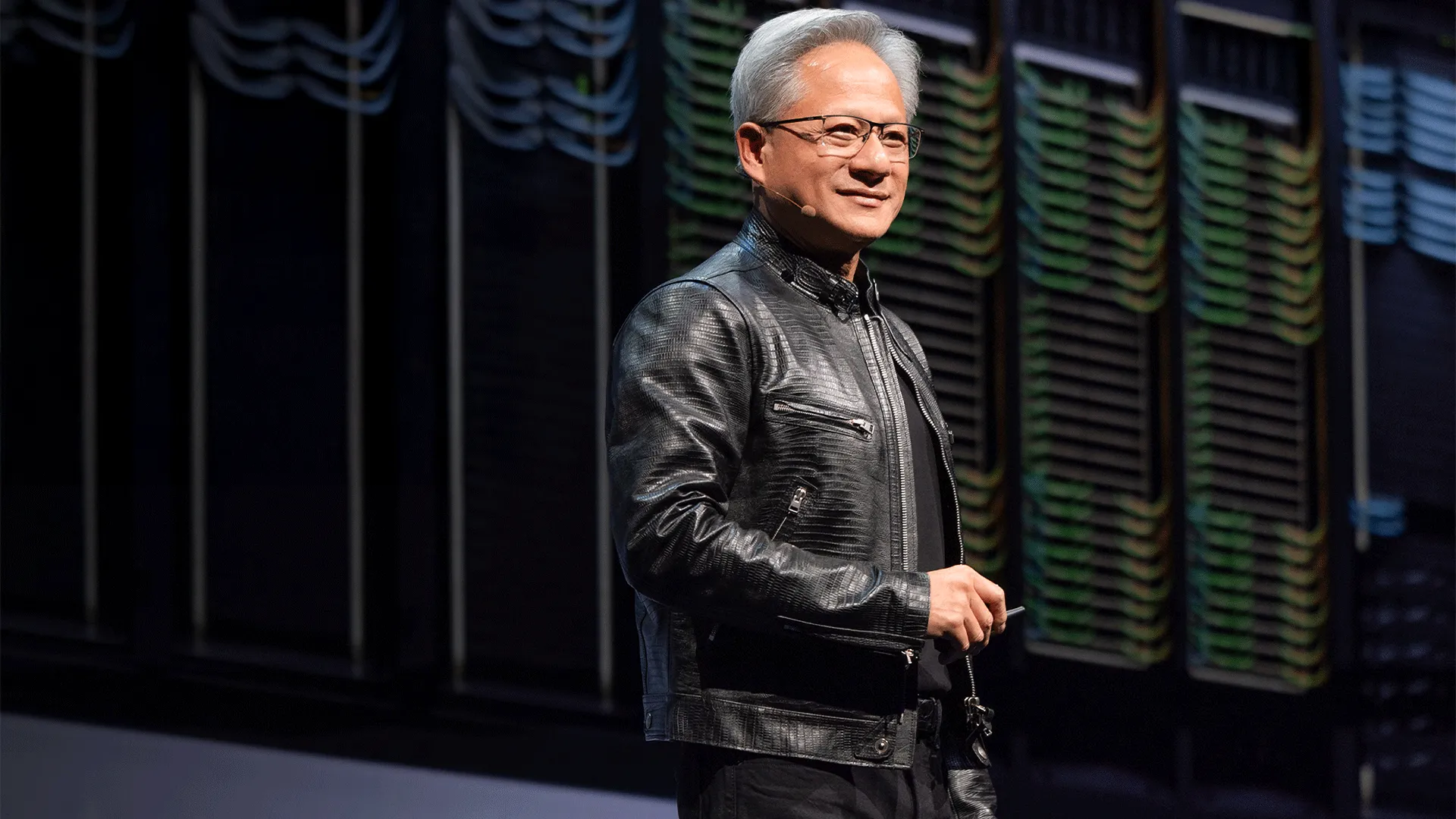
China's progress toward technological self-sufficiency in recent years is undeniable, but there is one thing that the country has so far failed to develop: lithography tools that are on par with those offered by ASML. That shortcoming has greatly hampered its domestic semiconductor industry. But Nvidia CEO Jensen Huang believes China will develop its own advanced lithography systems in just three or four years.
"They are going to get there by 2030," Huang said in an interview with The All-In Podcast (at 43:43). "2030 is just around the corner. The way to think about China is that it is really good at high-volume production. It is just a matter of time[...] so two or three years is just a click; it is nothing. So as far as they are concerned, they are already there."
Huang tends to look optimistically at China's technological development. Specifically, he is known for calling China's AI industry as being 'right behind' American frontier labs, which may well be correct, given how much capital China is investing in AI. But when it comes to the Chinese semiconductor industry in general and its lithography sector in particular, Huang may be too optimistic.
At present, China's leading producer of lithography tools — Shanghai Micro Electronics Equipment — can mass-produce a 193-nm ArF dry scanner that can be used to build chips on 90nm-class process technology. While the company has reportedly developed a 28nm-capable ArF immersion scanner, there is no public evidence that such systems are produced in volume and are used for high-volume chip production.
Although there are reports that Shanghai Aishengna Electronic Technology Group (a unit, or an affiliate of SMEE) has delivered its first immersion scanner that may be capable of printing chips using 28nm-class process technology, these tools will require extensive qualification before they can be used for high-volume manufacturing of semiconductors, so if deployment follows standard timelines, it will take years before this unit will be used for mass producing chips.
Even assuming that the first scanners are delivered to Chinese chipmakers in 2026, widespread production use before 2028–2029 appears unlikely. Furthermore, matching the capabilities of an early-generation ASML immersion scanner would still leave Chinese lithography suppliers considerably behind ASML's contemporary systems, which makes technological parity in ArF immersion lithography by 2030 highly unlikely.
China is considerably further behind in extreme ultraviolet (EUV) lithography. While there are reports that Chinese scientists have managed to develop a laser-produced plasma source that can generate the 13.5-nanometer wavelength light required for the technology, it does not look like China is close to assembling even a prototype EUV scanner itself.
Get Tom's Hardware's best news and in-depth reviews, straight to your inbox.
Even if China can assemble an EUV experimental exposure platform without having mastered production-quality immersion DUV, it is hard to imagine a Chinese company producing EUV scanners without solving the hardest problems common to both DUV and EUV technologies. A production lithography scanner requires extraordinary capabilities in wafer and reticle stages, alignment, overlay, projection optics, and metrology, just to name a few.
If China is still struggling to industrialize these capabilities for immersion DUV, there is little reason to assume it has somehow solved them at the substantially more demanding EUV level. But given the potentially existential stakes of the AI race, and the determination of the Chinese government to achieve technological self-sufficiency, it may just indeed be a matter of time.

Follow Tom's Hardware on Google News, or add us as a preferred source, to get our latest news, analysis, & reviews in your feeds.

Anton Shilov is a contributing writer at Tom’s Hardware. Over the past couple of decades, he has covered everything from CPUs and GPUs to supercomputers and from modern process technologies and latest fab tools to high-tech industry trends.
-
gg83 Jensen actually says whatever he wants. The man who said pubg and fortnight were driving record sales in FebruaryReply -
bigdragon The sooner the better. The lack of alternatives in the advanced tooling sector has made our current shortages worse than they could have been with some proper competition from multiple sources. More is more!Reply -
magbarn Someone needs to compete with ASML, don't care if it's the Chinese. Can't stand the western semiconductor companies at this point so any competitors would be a good thing.Reply -
zsydeepsky the fact that Toms Hardware has not aware that Huawei's Tau-scaling/Logic-folding chip was already out for sale...Reply
In short, Huawei basically reached first-gen 3nm performance with 6nm process, no EUVs needed.
By the year 2030, either China develops EUV, or Huawei extends logic-folding to chips larger than phone SoCs; Jensen's prediction will be realized. -
urn66 Anton Shilov is entitled to his skepticism, but there is much work on this development in China that is not public and reported in media, as well as some interesting R+D that has been published in the public domain that provides some clues to alternative approaches to leapfrog current EUV (definitely not on Jensen Huang's timeline).Reply
Similar skepticism was expressed about other technology manufacturing sectors where Western observers cast doubt or even ridiculed Chinese efforts until they were surprised to find themselves in the rearview mirror, Lithography may not be much different. I remind readers that the leader of ASML's EUV R+D team is a Chinese who retired from the company and now leads a Chinese team; I suppose he may have some other ideas. -
staticks I find it interesting how Western observers and media seem inordinately preoccupied with how China is "several years behind," or how they're currently "far from parity" with ASML. When in reality, it's not where they're at currently, but where they'll be decades from now, that's important. The Chinese don't care where they're at right now, or even where they'll be a couple years from now; they care about where they'll be 20 years from now, 50 years from now, or 100 years from now. That's what matters. The fact that non-Chinese people seem to take such a short-term perspective and are so concerned with immediate results is just slightly bemusing.Reply -
Thunder64 Replystaticks said:I find it interesting how Western observers and media seem inordinately preoccupied with how China is "several years behind," or how they're currently "far from parity" with ASML. When in reality, it's not where they're at currently, but where they'll be decades from now, that's important. The Chinese don't care where they're at right now, or even where they'll be a couple years from now; they care about where they'll be 20 years from now, 50 years from now, or 100 years from now. That's what matters. The fact that non-Chinese people seem to take such a short-term perspective and are so concerned with immediate results is just slightly bemusing.
China certainly cares where they are at now. That's why they will spend money on EV's or lithography equipment and push it out to bankrupt Western competition so they can be a monopoly later.
The problem is just like the rest of the West/Developed countries the aging population. Their replacement rate is terrible and they will lose 100-250 million by 2050. Ideally they would put money into increasing the number of children. No one has figured that out yet though, even with countries like Hungary spending a ton as a percentage of GDP on it. -
jp7189 I used to wonder what was so hard about making euv light, and indeed it's not too hard. Whats hard is getting that flash of euv in an extremely precise location. What's darn near impossible is generating that precise pulse 50,000 times per second 24/7, and ASML's next gen is aiming for 2x - 6x improvement.Reply
To put the difficulty in to perspective, ASML got their first EUV light source operational in the late 90's, the first prototype in the earlier 2000's (this is seems to be where China is), and it took nearly 20 years of iteration to make it reliable enough for commercialization.