ISO Standard: What It Actually Says

Updated in 2001, ISO (International Standards Organization) 13406-2, the standard that all monitor manufacturers refer to, stipulates an array of ergonomic requirements on the quality of liquid crystal display images. The criteria involved are brightness, contrast, reflection, uniformity of brightness and colors, flicker, character analysis and ... defective pixels.
The standard also defines four levels of quality. Class 1, the highest, allows no defects at all. Class 4, the lowest, allows up to 262! Fortunately nobody refers to it. Apart from some exceptions, all manufacturers refer to Class 2. If they do not specify, the monitor is Class 1 by default and you can have it changed at the smallest pixel defect.
The standard distinguishes four types of defective pixel.

- Type 1: number of always-lit pixels.
- Type 2: number of always-unlit pixels.
- Type 3: other defects, particularly on sub-pixels and the RGB cells making up pixels (lit or unlit). This means red, green and blue pixels lit the whole time. Experience shows that this is undoubtedly the most common defect.
To find the total number of defective pixels allowed, add up the defects of Types 1, 2 and 3.
- Type 4 (Fault Cluster): the number of defective pixels in a square of 5 x 5 pixels on a panel.
Lastly, the standard stipulates the number of errors allowed per million pixels on the panel. More dead pixels are allowed on a 17" screen than on a 15" one.
ISO Standard: The Actual Figures
These are all laid out in a table.
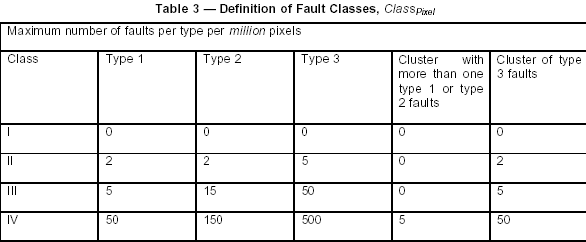
If you want some fun, try and interpret them by yourself. Then compare your results with what follows.
If you get it right, then you are better than 90% of the manufacturers. By the way, it's time to thank ISO itself, and especially Roger Frost and Hans-Juergen Herrmann, for their help in decoding the 146 pages of the 13406-2 tome.
15" LCD Panels
Native resolution is 1024 x 768 pixels, a total of 786,432 pixels.
Class 1 panels: this is the easiest - no pixel defects are allowed.
Class 2 panels are more complicated.
- Type 1: Lit pixels allowed = 2 x 786,432 / 1,000,000 = 1.57.
- Type 2: Unlit pixels allowed = 2 x 786,432 / 1,000,000 = 1.57.
- Type 3: Red, green or blue pixels allowed = 5 x 786,432 / 1,000,000 = 3.93.
If you refer to the standard, 2 always-lit pixels is >1.57. So this is over the top and the warranty comes into play. 15" ISO 13406-2-compliant panels may not allow more than: Type 1 + Type 2 + Type 3 = 5 defective pixels altogether, with a maximum of one lit, one unlit and three red, green or blue pixels.
In addition, the cluster rule stipulates there should never be more than two defective lit and unlit pixels in any one circle with a radius of five pixels. Also counted as defective are screens with several red, green or blue pixels occurring twice or more on a square of 5 x 5 pixels.
17" Panels
This is calculated the same way as for the 15".
Resolution = 1280 x 1024 = 1,310,720 pixels.
Class 1 panels: no pixel defects are allowed.
Class 2 panels:
- Type 1: Unlit pixels allowed = 2 x 1,310,720 / 1,000,000 = 2.62.
- Type 2: Lit pixels = 2 x 1,310,720 / 1,000,000 = 2.62.
- Type 3: Red, green or blue pixels allowed = 5 x 1,310,720 / 1,000,000 = 6.55.
If you refer to the standard, two always-lit pixels is 3>2.62. So, this is over the limit and the warranty comes into play.
17" ISO 13406-2-compliant panels may not allow more than: Type 1 + Type 2 + Type 3 = 10 defective pixels altogether, with a maximum of two lit, two unlit and six red, green or blue pixels.
In addition, the cluster rule stipulates there should never be more than two defective lit and unlit pixels in any one circle with a radius of five pixels. Also counted as defective are screens with several red, green or blue pixels occurring three times or more on a square of 5 x 5 pixels.
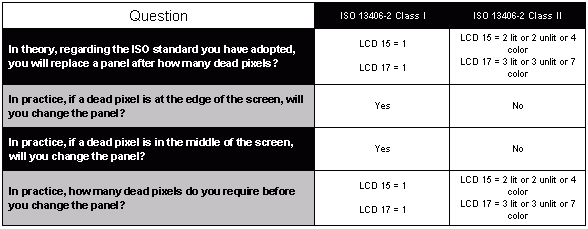
Actually, it turns out that the ISO 13406-2 Class 2 standard is not an adequate guarantee of quality. Initially drafted in 1999 and finalized in 2001, it was evidently designed for small screens. Now it does no more than minimize the damage. Who would be prepared to wait for their screen to have ten defective pixels before replacing it? Not us. It is now crucial for manufacturers to adopt Class 1, the only one that ensures a perfect display, or a new standard should be adopted.