









Quantum Computers From IBM, Google To Leap From Lab To Market In A Few Years

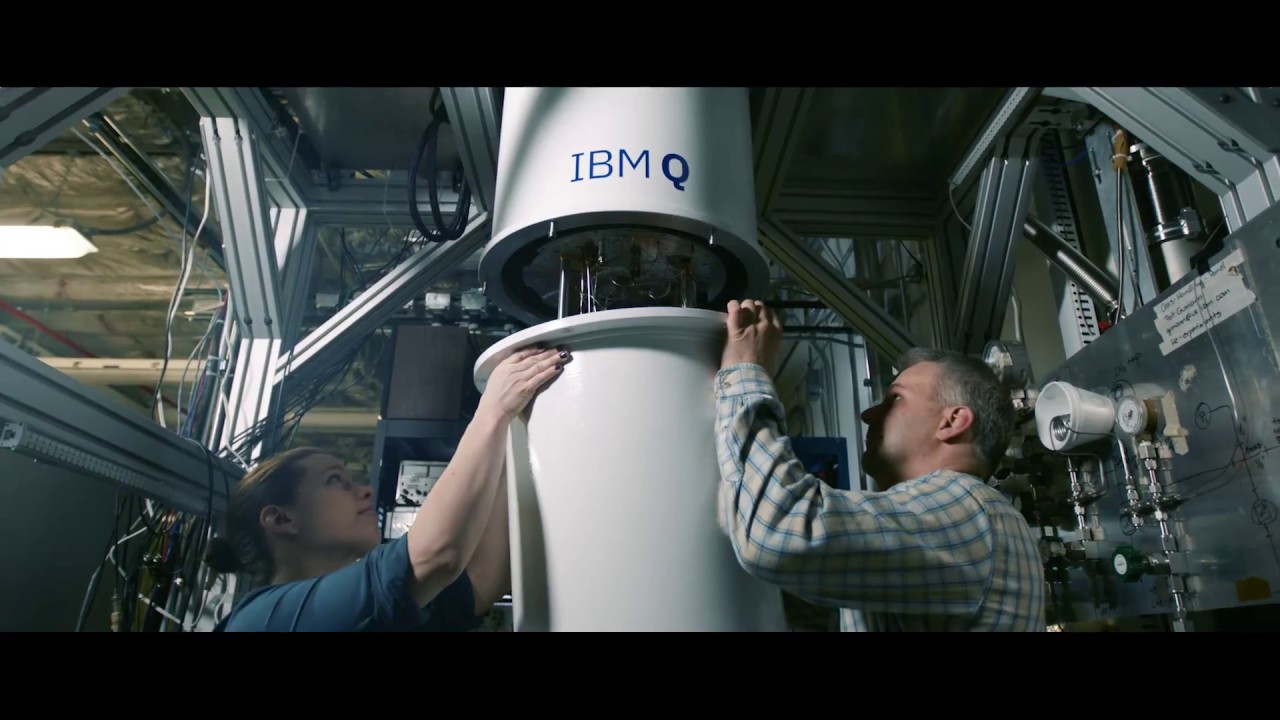
IBM and Google announced roughly at the same time that they plan to start to commercialize quantum computing technologies over the next few years, which would signal the exit of universal quantum computers from lab exclusivity and their entrance on the market. The two companies also predicted that in the next few years “quantum supremacy” will be achieved, which means that quantum computers will be able to solve at least some problems that can’t be solved by today’s fastest supercomputers.
A Race To Build The First Practical Quantum Computer
As nature itself seems to operate based on quantum mechanics, it makes sense that a quantum computer will eventually be better suited to simulate chemical reactions with better accuracy. This will result in better materials, better medicine, and better technologies, in general.
As we’ve recently seen from a Google paper, the company was able to accurately simulate a hydrogen H2 molecule. This was possible with only a 9-qubit quantum computer, so we should be able to see much more impressive simulations as the number of qubits in quantum computers grows. Both Google and IBM are expected to ship 50-qubit quantum computers in a few years.
Of course, we’ve also seen D-Wave reach as many as 2,000 qubits, but D-Wave is not a universal quantum computer; it's more of a specialized type of quantum machine, called a quantum annealing computer. D-Wave could still turn out to be useful for certain optimization tasks, but because we’re in the early days, more experimentation will be needed to prove that usefulness.
Microsoft has also recently entered this market, with plans to build a topological quantum computer. The idea is that the qubits are more stable in a topological quantum computer, so it could bring a practical quantum more quickly to market.
Meanwhile, both Google and IBM use superconducting quantum computing technology, and other companies have invested in trapped-ion quantum computers that also promise to have better stability (but inferior performance) than superconducting quantum computers. It remains to be seen which technology will win, but so far IBM's and Google's projects seem to be the most promising.
IBM To Commercialize A 50-Qubit Quantum Computer Soon
Although IBM has been working on universal quantum computers for about two decades, D-Wave has started to steal some of its thunder by being the first to market with its quantum annealing computer. Even as IBM was the first to give everyone access to its 5-qubit universal quantum computer, we learned that Google already had a 9-qubit universal quantum computer, and that it planned to soon upgrade to a 50-qubit quantum computer.
Get Tom's Hardware's best news and in-depth reviews, straight to your inbox.
IBM doesn’t seem to want to be left behind and forgotten in the quantum computing market, before it even materializes as a real market. For now, the company has released an easier to use Application Programming Interface (API) so that more developers can take advantage of its quantum computer over the internet without quantum physics knowledge. It has also built a 20-qubit simulator, so that the developers can already start building applications that use 20 qubits. IBM also plans to commercialize a 50-qubit quantum computer over the next few years.
It seems that both Google and IBM believe that 50 qubits are necessary to achieve “quantum supremacy.” That’s the point when a quantum computer will be able to solve problems that even the fastest supercomputer can’t.
For instance, IBM said that although the Watson AI, powered by classical computers, can find patterns by looking at vast amounts of data, quantum computers would be able to see patterns. Classical computers are great at processing vast amounts of data--as long as it has all the data--whereas quantum computers can infer and fill in the gaps. Classical computers would need to compute an enormous number of possibilities to get to the same results that quantum computers could achieve much more easily.
Google To Sell Access To Its Quantum Computers
The engineers at Google’s Quantum AI Laboratory published a report in Nature in which they also see a path forward to commercialization of quantum technologies within the next five years. The company was initially expected to release a 50-qubit quantum computer by 2018, but it’s not clear whether it still intends to do so or whether it wants to wait a few more years.
Either way, the company said that although it could take another decade before full error correction can be brought to quantum computers, the early quantum computers could still be of use to at least to the financial and healthcare industries. The financial industry could use quantum-assisted optimization for more accurate stock price prediction, while the healthcare industry could better simulate chemical reactions to create more effective medicine.
Google’s engineers said that for quantum computers to evolve, both better hardware and better algorithms will be needed. The company said that this is why academia and industry will need to work together over the next decade to bring more useful quantum computers to market. Google believes that in less than five years, it should be able to commercialize access to its quantum computer, as well.
Lucian Armasu is a Contributing Writer for Tom's Hardware US. He covers software news and the issues surrounding privacy and security.
-
jaber2 Quantum computing will change everything we do, its like going from left to right only option to a left to any direction solutionReply -
WFang One of the possible (even likely) and scary outcomes of Quantum computing (like any significant leap in technology) is that it very well could drive further socio-economic separation class divisions. Companies and individuals that can afford quantum computing and those who cant. If the advantage is sufficiently big (like Quantum computing could be), it could (worst case) really worsen the gap between the powerful and wealthy and 'the rest'. Nothing new in that risk/danger, and not proposing we pretend Quantum computing doesn't exist.. but something to be wary of.Reply
For those reasons, I hope Google, IBM and many more, bring viable and competing capability to market.
Also: it would be interesting to see if quantum powered investing will be the technology that (finally?) is able to outperform index-matching funds. :) -
photonboy Quantum Computing is NOT going to change most areas of computing as many people seem to think. Running any kind of program is incredibly hard so this has a very limited use case until/if they are able to create software that works more like a regular computer.Reply
I've never seen an article that discusses any of the memory aspects.
One serious bottleneck is memory. How do you store a program, then write the results in anything near the speed of the quantum CPU? Regular servers will be around for a long time. -
tsnor Reply19388361 said:Here's the big question, can it play Crysis? :)
As the server or as the player ?
-
virtualban Here is the bigger question: Can it PLAY Crysis? Not run it, play it. And even enjoy it maybe? Learn the objectives, deal with the situations, etc. : )Reply -
hoofhearted D-wave anealing = no good for Shor.Reply
Don't know anything about IBM language. link?
What about qcl? Nice examples of Shor and Grover available.
http://tph.tuwien.ac.at/~oemer/doc/quprog/node32.html
http://tph.tuwien.ac.at/~oemer/doc/quprog/node18.html
http://tph.tuwien.ac.at/~oemer/doc/quprog/node17.html