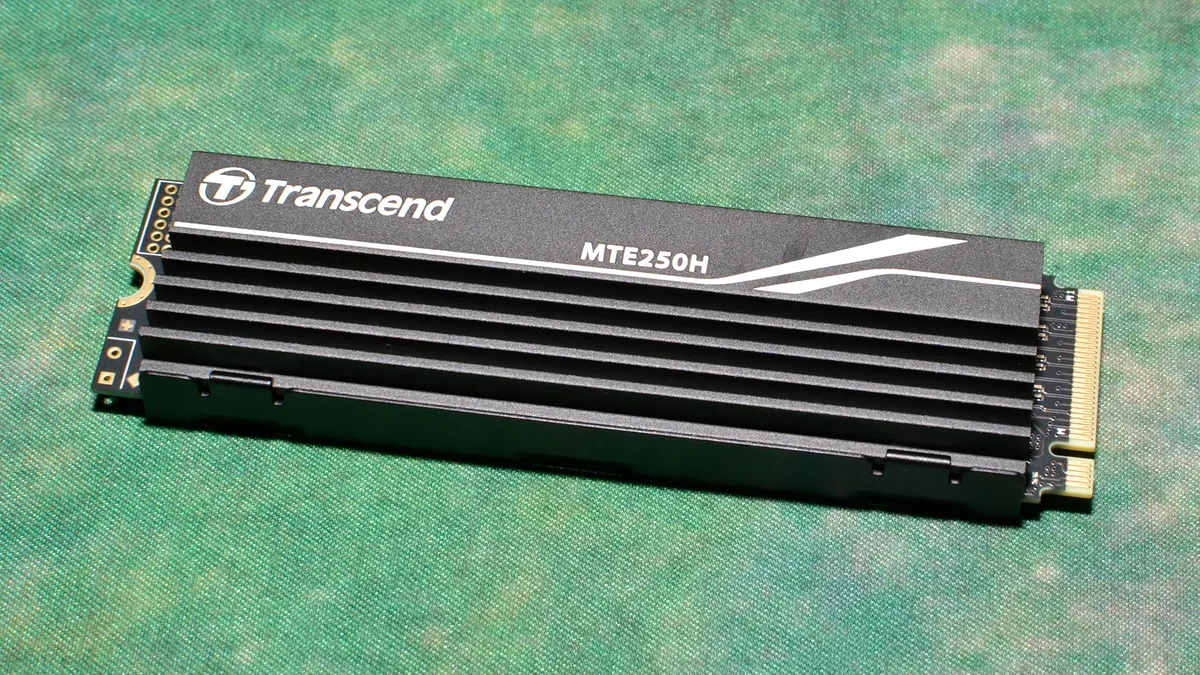
The Transcend 250H is not the fastest drive, and it’s also not very cost-effective in the U.S. Transcend does back it with a reasonable warranty, however, and it could be a safe option in regions with a limited SSD selection.
Pros
+
Good warranty with software support
+
PS5-compatible heatsink
Cons
-
Underwhelming performance
-
Too expensive in the U.S.
Why you can trust Tom's Hardware
Our expert reviewers spend hours testing and comparing products and services so you can choose the best for you. Find out more about how we test.
Transcend is not the most widely known brand, but it definitely has a history with memory and especially flash. In the past, it wasn't uncommon to see Transcend memory cards and USB flash drives everywhere, and the company produced DRAM modules, as well. With the explosion of generic SSD manufacturers and so many great options from known brands, Transcend has often served a bigger role in the OEM market, where it has served clients well, nostalgia aside. They still make consumer SSDs, which are often reliable choices in places where you can’t find the SK hynix drive of your dreams. The MTE250H, or 250H for short, is designed along those lines.
The Transcend 250H is an acceptable PCIe 4.0 NVMe SSD, but its lackluster performance and poor efficiency make it a hard sell with current pricing. Although it’s positioned for the high-end, it is mostly mediocre or worse against a wide field of better choices. Transcend backs it with a decent warranty and software support, but this is not too unusual for a drive of this caliber. The 250H also comes with a PS5-compatible heatsink, which does at least help keep the drive cool under load, while its sibling, the 250S, only has a heat-spreading label.
Transcend has quite a few things going for it. The company is usually direct about the hardware it uses and tries to maintain it as much as possible during the product’s lifespan. Transcend also focuses on reliability and support for its products. This is very important in places where its products are more widely sold, which includes regions with a limited SSD selection. Transcend’s SSDs will have better availability and pricing in those places, too. That means, if the price is right, the 250H can be a good choice if you are restricted in drive choice.
Specifications
Swipe to scroll horizontally
Product
1TB
2TB
4TB
Pricing
$ 94.99
$ 134.99
$ 289.99
Form Factor
M.2 2280
M.2 2280
M.2 2280
Interface / Protocol
PCIe 4.0 x4 / NVMe 1.4
PCIe 4.0 x4 / NVMe 1.4
PCIe 4.0 x4 / NVMe 1.4
Controller
SM2264
SM2264
SM2264
DRAM
DDR4
DDR4
DDR4
Flash Memory
112-Layer Kioxia BiCS5 TLC
112-Layer Kioxia BiCS5 TLC
112-Layer Kioxia BiCS5 TLC
Sequential Read
7,200 MB/s
7,100 MB/s
7,500 MB/s
Sequential Write
6,200 MB/s
6,500 MB/s
6,700 MB/s
Random Read
530K
530K
540K
Random Write
420K
420K
420K
Security
N/A
N/A
N/A
Endurance (TBW)
780TB
1560TB
3120TB
Part Number
TS1TMTE250H
TS2TMTE250H
TS4TMTE250H
Warranty
5-Year
5-Year
5-Year
The Transcend 250H is available at 1TB, 2TB, and 4TB. Current prices are $94.99, $134.99, and $289.99 (this model currently goes for ~$325 at retail), respectively. These prices are high for retail, but this drive will be available at places and in regions more inexpensively when compared to a weaker field of alternatives. The 250H can reach up to 7,500 / 6,700 MB/s for sequential reads and writes and 540K / 420K random IOPS. Transcend backs the drive with a five-year warranty and 780TB of warrantied writes (TBW).
This TBW is higher than the industry average but matches the similar ADATA Legend 960 and Legend 960 Max. This is despite using different flash. It has a heatsink, like the latter, which is a nice feature for any high-end PCIe 4.0 SSD. This also makes it a good choice for use in the PlayStation 5. Transcend does not recommend the removal of the heatsink as it can impact the drive’s warranty, although whether or not this could be upheld depends on your jurisdiction. Transcend’s 250S model is similar but without a heatsink and would be the better choice for a laptop if yours takes double-sided drives.
Software and Accessories
Transcend offers a download of its SSD Scope software for all of its SSDs. This SSD software toolbox includes SMART monitoring, diagnostics, firmware updating, diagnostics, TRIM, health monitoring, and drive cloning.
The 250H has an SSD controller, a single DRAM package, and two NAND packages per side for a total of four. This all lies beneath the double-sided heatsink.
Stay On the Cutting Edge: Get the Tom's Hardware Newsletter
Get Tom's Hardware's best news and in-depth reviews, straight to your inbox.
The 250H uses SMI’s SM2264 controller, a competitor to the Phison E18 and InnoGrit IG5236. It should also be on par with proprietary solutions from SK hynix, Solidigm, Western Digital, and Samsung. These are all high-end PCIe 4.0 SSD controllers that can saturate the x4 M.2 link. In previous testing, we have shown the SM2264 to be less efficient due to its architecture, which is distinct from the popular E18. The 250H also promises far less random IOPS than alternative, otherwise comparable drives. This is partly due to its flash and Transcend’s OEM-like market positioning.
Transcend has opted for Kioxia’s 112-Layer TLC (BiCS5) on the 250H. This differs from the 176-Layer Micron TLC (B47R) we’ve seen on the other SM2264-based drives. BiCS5 has been used with exceptional results on SSDs like the WD Black SN770, but it is generationally behind the competition and also lacks any sort of CMOS-under-Array (CuA) technology. This means the flash may not be as fast in many circumstances, and it is also usually less efficient, all else being equal. However, it is probably a good choice for a drive like the 250H and will hold up better at 4TB due to having the option of denser dies.
These are 512Gb / 64GB dies paired with 1GB of Samsung DDR4 for the DRAM cache. There are more efficient options for the cache, but this is sufficient to meet a reasonable level of performance. Transcend could have gotten away with two NAND packages and a single-sided design, but instead, there are four 256GB packages with just four dies (QDP) each. This probably scales to 512GB and 1TB each, with the latter using 1Tb / 128GB dies.