









D-Wave Launches 2,000-Qubit Quantum Annealing Computer, Announces First Customer

Back in fall, last year, D-Wave announced its new 2,000-qubit quantum annealing computer that was up to 1,000 times faster than its previous 1,000-qubit computer. The company officially launched the new computer, as well as announced its first customer, Temporal Defense Systems, which is a cybersecurity company trying to use quantum computation to improve its security solutions.
“The combined power of the TDS / D-Wave quantum cyber solution will revolutionize secure communications, protect against insider threats, and assist in the identification of cyber adversaries and attack patterns,” said James Burrell, TDS Chief Technology Officer and former FBI Deputy Assistant Director. "Combining the unique computational capabilities of a quantum computer with the most advanced cyber security technologies will deliver the highest level of security, focused on both prevention and attribution of cyber attacks,” he explained.
Quantum Annealing
D-Wave has faced much criticism from the quantum research community, mainly because other researchers didn't believe D-Wave's quantum annealing computer would be as useful as the company said it could be.
Unlike universal quantum computers, which themselves will only offer some specialized forms of computation, quantum annealing computing is an even more specialized form of computation. If a universal quantum computer is more like a CPU, or even a GPU, then a quantum annealing computer is more like an ASIC, which should mainly only be able to solve quantum annealing (optimization) problems. D-Wave’s team has produced a six-minute video to explain what quantum annealing is:
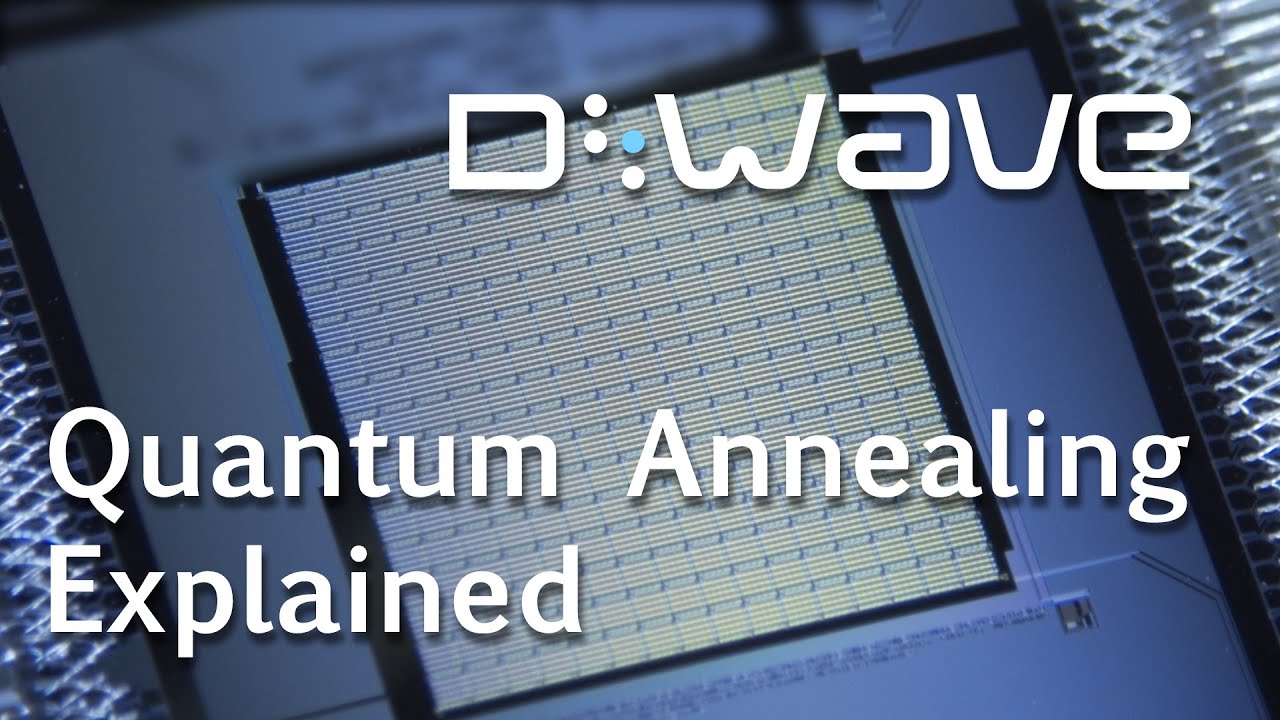
According to D-Wave’s team, quantum annealing could be useful to solve machine learning problems. Therefore, even if the company’s computer is a one-trick pony, that’s one trick that could make D-Wave highly valuable, if it can offer much higher performance for machine learning tasks.
Machine learning is also all about optimization problems and solving a given task through probabilities, so D-Wave’s quantum annealing computing may fit right in. However, someone will still have to write those machine learning algorithms for D-Wave to take advantage of them, in order for the computer be useful.
D-Wave 2000Q
Since its official launch in 2007, D-Wave has doubled its number of qubits roughly every two years. That sounds similar to Moore’s Law for classical computers, except due to the nature of how qubits work, quantum computers benefit from much more than a doubling of performance.
Get Tom's Hardware's best news and in-depth reviews, straight to your inbox.
According to the company, the new D-Wave 2000Q is 1,000 times times faster than the previous 1,000-qubit generation released in 2015. With this kind of exponential increase in performance, quantum computers of all kinds may start being practical and useful before long, even if they still haven’t reached that point yet.
“Using benchmark problems that are both challenging and relevant to real-world applications, the D-Wave 2000Q system outperformed highly specialized algorithms run on state-of-the-art classical servers by factors of 1000 to 10000 times. The benchmarks included optimization problems and sampling problems relevant to machine learning applications,” said the company in its press release.
D-wave took highly specialized optimization algorithms for classical computers and developed implementations for its own “quantum processing units” (QPUs). Its 2,000-qubit QPU was up to 10,000 times faster than a single-core CPU coupled with a 2,500 graphics core GPU. It was also 100 times more efficient in terms of performance/Watt compared to a classical GPU-based implementation of one algorithm.
It’s important to note that D-Wave’s computer still costs millions of dollars ($15 million to be exact) while a single-core classical computer with a 2,500 graphics core GPU would cost a few thousand dollars at most.
Therefore, we’re still talking about a factor of around 10,000:1 in terms of dollar amount/computer purchased, without even mentioning the much larger complexity of implementing an algorithm for a D-Wave computer, compared to doing so on a more traditional computer.
However, we’re starting to reach the point where a D-Wave computer may just be worth it for certain companies, if only for research purposes and for trying to stay one step ahead of the competition. A couple of generations from now, D-Wave’s QPUs may just become a no-brainer for companies wanting efficient machine learning computation, as long as D-Wave’s computers keep improving at this pace.
Looking at the future roadmap for the D-Wave quantum annealing computers, Jeremy Hilton, Systems Senior Vice-President at D-Wave, said the following:
“The D-Wave 2000Q quantum computer takes a leap forward with a larger, more computationally powerful and programmable system, and is an important step toward more general-purpose quantum computing," said Hilton.“In the future, we will continue to increase the performance of our quantum computers by adding more qubits, richer connections between qubits, more control features; by lowering noise; and by providing more efficient, easy-to-use software,” he added.
Lucian Armasu is a Contributing Writer for Tom's Hardware US. He covers software news and the issues surrounding privacy and security.
-
IndignantSkeptic No matter how many videos I watch that explain quantum computers, I still have utterly no clue how to build one.Reply -
jdlech In 1946, the ENIAC computer cost $400,000, which is roughly $5.3M today. So, if ever there will be a personal quantum computer, even if specialized, the first few will likely cost about $9K in 2017 dollars. I'm looking forward to playing the quantum equivalent of 'pong'.Reply -
dstarr3 Quantum computing is still such a mind-bender. I feel like I need to unlearn everything I know about how computers work to wrap my mind around it.Reply -
bit_user Reply
Do you know that it needs to run at a fraction of the temperature of interstellar space? I think the refrigeration is probably the most expensive part, in addition to consuming most of the energy and requiring most of the maintenance.19207103 said:In 1946, the ENIAC computer cost $400,000, which is roughly $5.3M today. So, if ever there will be a personal quantum computer, even if specialized, the first few will likely cost about $9K in 2017 dollars.
In addition to that, it must be specially shielded from interference. That's not going to be cheap or small, either.
So, I think we can safely rule out such quantum computers ever coming into the home. It would have to be some fundamentally different technology. Until then, you'll have to be satisfied renting time on them via the cloud.
-
tsnor "..I think we can safely rule out such quantum computers ever coming into the home...."Reply
LOL, that's been said before in computer science. -
bit_user Reply
This isn't a CS problem - it's physics.19214441 said:LOL, that's been said before in computer science.
How are you going to keep the qbits entangled @ temperatures achievable in a home setting? What's even the use case for such computers in the home vs. cloud?
I'm no expert on quantum computing, but I think it's naive to assume that just because conventional computers also started out big & expensive, that we'll one day buy quantum annealing computers for a couple bucks and carry them around in our pockets.
-
dstarr3 Reply19214508 said:
This isn't a CS problem - it's physics.19214441 said:LOL, that's been said before in computer science.
How are you going to keep the qbits entangled @ temperatures achievable in a home setting? What's even the use case for such computers in the home vs. cloud?
I'm no expert on quantum computing, but I think it's naive to assume that just because conventional computers also started out big & expensive, that we'll one day buy quantum annealing computers for a couple bucks and carry them around in our pockets.
I'm skeptical, too, but hey, never say never. Anything could happen.