




Intel Demos System Based on 48-Core Processor
That's a lot more cores than we've got right now in our systems.
Last month Intel announced that it was shipping systems with its experimental 48-core processor. Now we get to see what a system with the radical chip looks like.
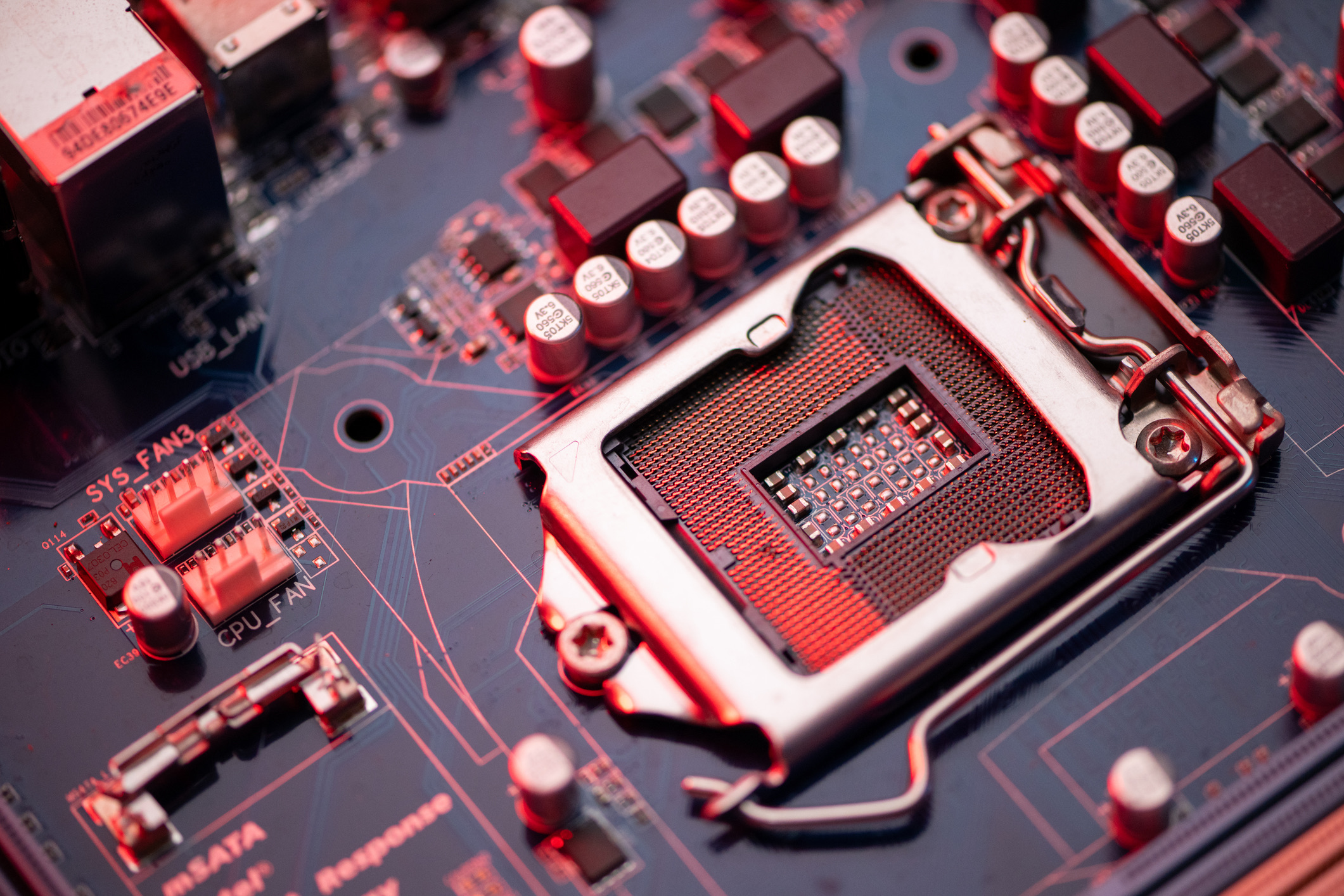
X-bit labs caught the supercomputer on chip (SCC) system on demonstration in Europe, which runs on an experimental "Copper Ridge" motherboard with integrated I/O and graphics and eight DIMM slots. There's no SATA ports, instead an Intel USB flash disk is used for storage.
According to the report, the SCC contains 24 tiles with two x86 cores per tile, each of which has its own L2 cache and can run a separate OS and software stack and act like an individual compute node that communicates with other compute nodes over a packet-based network. The SCC also has four integrated DDR3 memory controllers.
The 48-core chip features 24 small routers between the cores, which facilitate faster data exchanges across the chip. Each core also has on-chip buffers that can instantly exchange data in parallel across all the cores.
Intel also says that the 48-core chip has a more advanced on-die power management system that can vary the power draw between 25 watts to 125 watts. It can also reduce clock speed and shut down cores.
As far as clock speeds go, current desktop and even laptop offerings outpace this 48-core wonder. Intel revealed that its experimental chip runs at about the same frequencies as the Atom CPU, so we're looking in the neighborhood of 1.2GHz to 1.83GHz.
- Nvidia Announces 480M Fermi GPU for Notebooks
- HP Tablet Running Palm's WebOS Launching Q4?
- Google is Making the PAC-MAN Doodle Permanent
- 3D Stereo Gaming Without Expensive Shutters
- VIDEO: Dell Confirms M11x Getting Core i3/i5/i7
- Deals for May 24: PS3, Wii, Xbox 360 Games Sale
- Ninth Foxconn Worker of 2010 Commits Suicide
- Futuremark Reveals 3DMark 11; Screens & Video
- Should You Feel Guilty Owning an iPhone?
- Get a Free Trial of Norton and Enter to Win [USA]
- Deals for May 25: Don't Forget Your Towel
- We Spent 4,819,352 Hours on Google PAC-MAN
- Nvidia Unleashes 'Release 256' Graphics Drivers
- Intel Moves Nehalem to ULV for Ultra-Thin Laptops
- Father of the Xbox Leaves Microsoft, Leaves Letter
- Blizzard, AT&T Sign Multimillion Dollar Hosting Deal
- Deals for May 26: $300 Off for HP Envy 17 & Dv8t
- Nvidia CEO: Z6 Moorestown Won't Be Competitive


but can it play crysis?
Cool, so now when a core dies I need to replace my entire processor! sweeeeeeeet. IBM Z system CPU boards for the win.
but can it play crysis?
That is indeed the question...
Hmm... If it possible, get 4 of these under 1 rig for a total 192 cores...... That would make a killer F@H rig.
Nice. So now when I play Dragon Age I'll have to disable 47 cores so the game won't crash
Cool, so now when a core dies I need to replace my entire processor! sweeeeeeeet. IBM Z system CPU boards for the win.
Well if the chip can shut down cores I can only assume that if a core fails the rest of the chip can survive without it.
Defo one for the future, watch this space.
Why do people thing this is going to be for gaming rigs, or more so that it's going to be sold to the general public? I think they would release it to businesses only.
Great all we need now this new 48 core cpu to become self aware.
but can it play crysis?
But can that joke die already?
Did Intel say if it was possible to run a single OS instance
on the system? ie. do the chips include NUMA support?
Ian.
Dope slap is right , what to do with numerous cores, if most aaps use no more than 1 core.
As slow as an Atom that chip needs some crazy over clocking to make it meaningful to me. i dont needs a slow atom but it could be great for servers. It probably save alot of money for people checking e-mail and junk dont need high performance servers to do jobs like that. 48 cores pc games can barely use 2, we need to learn to program to actually use such a chip. No gpu or ssd. lol well at least the chip works we can only hope that this chip is the next step to high performance pc's in your home. Wonder what video games would be like that run on 48 core cpu, and 12 gpu graphics cards, hmmm dreaming.
Gpu's have a lot of cores at less speed so that means this is faster for mass calculations in realtime.
But, can it play crysis 2 is the main question here
This is HUGE for the Visualization Space !!
One server with this chip can replace the 10 we're currently running !!
The problem I see here is that no matter how many cores you`re putting in the package, it`s still a serial processor. I am in agreement with Bill Dally that we need to concentrate more on parallelism in our processor designs. I have no doubt that this CPU can probably parallel task very well, but we`re just delaying the inevitable here. This is not entirely semiconductor companies or hardware companies fault. Programmers are still writing in serial fashion, and the majority of programs cannot properly utilize all the abilities of the current hardware. That statement of course does not include those who are writing for Knoppix, beowulf, compute cluster and the like.
Wow this would be great for raytracing, i wonder how many frames per second i could get with that! 4-5FPS? that would revolutionize the way i render scenes!
As slow as an Atom that chip needs some crazy over clocking to make it meaningful to me.
They said "same frequencies as the Atom CPU" not "same power as the Atom cpu". The IPC of this cpu is probably equal or better than what we see out there right now. Although as dalta centauri said, (for the time being)thoses 48 core cpus are not going to be released to the general public. There just targeted for business. (doesn't mean you cant get them for your self though.)
Why do people thing this is going to be for gaming rigs, or more so that it's going to be sold to the general public? I think they would release it to businesses only.
Well, i dont get it either for gamers. More cores doesn't equal better games unless the games can use it.
Although even if it's sold only for businesses, The general public can still get there hands on them but only people that have the money and need for them, can buy them.
Did Intel say if it was possible to run a single OS instanceon the system? ie. do the chips include NUMA support?Ian.
NUMA is for multiple processors(meaning sockets), not multiple cores within a processor.
It might be a viable competitor for the sorts of applications that are currently being run on RISC machines.
Frankly I see future systems at the high end resorting to the equivalent of (or extension of) the front end and back end array, but with a much meatier central processing array.
An array of simple homogeneous cores all tied to ine bus won't cut it though, but as it is, I would imagine it might make a pretty good decrytion engine.
High praise to Intel for getting hardware out there for preview, which is excellent.
I suppose these are simpler variants of the Atom core then?
Why do people thing this is going to be for gaming rigs, or more so that it's going to be sold to the general public? I think they would release it to businesses only.
All these technologies start for businesses cause they are too expensive for the general public, but eventually they make it to regular people too
The problem I see here is that no matter how many cores you`re putting in the package, it`s still a serial processor. I am in agreement with Bill Dally that we need to concentrate more on parallelism in our processor designs. I have no doubt that this CPU can probably parallel task very well, but we`re just delaying the inevitable here. This is not entirely semiconductor companies or hardware companies fault. Programmers are still writing in serial fashion, and the majority of programs cannot properly utilize all the abilities of the current hardware. That statement of course does not include those who are writing for Knoppix, beowulf, compute cluster and the like.
Actually, you sound like someone that read something, somewhere, without really understanding what's really going on.
Nehalem based processors are very wide, and have about as much ILP (instruction level parallelism) as is feasible. Some even suggest it is too wide. It's why hyperthreading works - the processor has more execution resources than one thread can typically use. It's also one reason it works better than on the Pentium 4, which was narrower.
Going wider would increase size, power use, and even limit clock speed slightly. At this point, it's very difficult to improve performance on a single thread, and it's much easier to add cores and improve TLP (thread level parallelism).
Itanium was designed to be much wider and be able to handle more instructions per cycle, but in practice, it hasn't been as successful as Intel might like.
Intel has given up on maximum thread level performance when they gave up on the Pentium 4 design. Very high clock speeds would be the best way, (although the Pentium 4 was a bad design by any measure) but high clock speed designs also take disproportionate amounts of energy and can be quite large, so Intel decided against continuing to follow that path. It would be very difficult to get a good performing high clock speed quad core with reasonable power use.
Now before someone says the Pentium 4 was slow, that's not an indictment against high clock speed processors, it was just a bad implementation of it. IBM was very successful with it. The Pentium 4, strangely, had only one decoder, and if the trace cache didn't have the instruction stream, it ran as a scalar processor. This happened almost 50% of the time the cache miss rate was so high. So, it wasn't that the processor had such a long pipeline (it was double-pumped anyway, which effectively made it a lot 'shorter') that made it slow, it was just a terrible design on Intel's part that happened to have a long pipeline.
Put another way, if you had the trace cache and single decoder on a Nehalem, it would run like a dog too. Actually, dogs aren't that slow, as natural as that expression sounds. How about a Sloth?
While these advances in multicore CPU research are very interesting, I don't understand the significance of them. We've also seen earlier tech demos of 80 cores or more already. But what place is there for such devices? If it's graphics and media processing, GPU-like designs seem to be much better suited with their floating point capabilities. If it's server-type computation work, the current bottleneck is usually in I/O, not the CPU. Everything else that I can think of and is common doesn't seem anywhere close to fully utilizing 8 cores, much less 48.
is anyone else concerned that its got 48 cores but uses a usb connection for its hard drive? That's like selling you a ferrari engine hooked up to a 1982 toyota turcell transmission and crammed into a clown car with bald tires. That is unless its usb 3.0 and they are using an ssd external enclosure instead of a 13mb/sec flash drive.
You know what? That thing is going to be massively hard drive limited.....
Eat your heart out Tilera.
If it's server-type computation work, the current bottleneck is usually in I/O, not the CPU.
That's where having all these cores on a chip comes into play. Read the article again and pay attention to the mention of included routers and cores sharing data between them. Each core can talk to the other core without going to the system board first. This reduces that network IO in a 48 core CPU that uses many systems connected together.
Almost any task that benefits from a super computer today would be suitable for this system and depending on scale may see performance improvements.
I doubt this would be very suitable for virtualization as the system board IO bottle neck would limit connectivity to each OS running on the chip.
Cool, I'll install SQL server on it and save a bunch on licensing
to bad for Oracle they charge by the core not by socket
Why do people thing this is going to be for gaming rigs, or more so that it's going to be sold to the general public? I think they would release it to businesses only.
Not sure, says "Single Chip Cloud Computer" right on the damn thing. Seems like a bunch of kids are on here, much more so than previous years.
Super Talent RAIDDrive 128 GB USB 3.0 Flash Drive STU28GSRK
go take a look at this thing and you will understand why they used usb flash drives to boot lol this thing is super fast...
Proper usage of multi-core will certainly affect gaming. I think it's the only way we're going to get photorealism in real time. If you think about it though, once true photorealism and physics are attained, the "engines" used for games wont matter nearly as much as the art and story. Not holding me breath though.