AMD Vs. Intel - 64 Bit Support
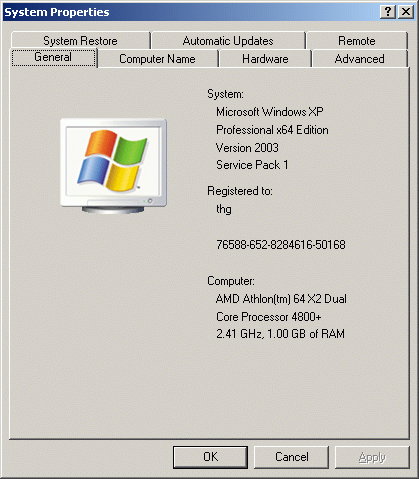
Both AMD and Intel have processors with 64 bit capability today. However, credit for this advance belongs to AMD, since the Athlon 64 family has been ready since its introduction almost two years ago. In contrast, Intel did not see the necessity for 64 bit computing in the desktop mainstream until the beginning of this year.
Right now, all AMD Athlon 64 and certain Intel desktop chips for socket 775 are 64 bit ready. These include:
- Pentium 4 630 to 670
- Pentium D 820, 830, 840
- Pentium Extreme Edition (dual core)
- Celeron D 326, 331, 336, 341, 346, 351, 355
While only the Mobile Sempron is not ready for 64 bits, Intel will not transition its notebook processors to 64 bits any time soon, simply because the architecture is not yet ready. We expect the Yonah processor architecture - both the single core 7x6 series and the dual core product, likely the 800 series - to hit the market in early Q1/2006, and the 64 bit enabled version called Merom to follow as it is required by the market.

64 Bit Processor Modes
AMD's Athlon 64 runs in legacy mode when using 32 bit Windows; the x86 64 extensions are not used. Using a 64 bit OS will cause an AMD64 processor to run in 64 bit Long Mode, while Intel chips will enable IA32e mode. Both of course are the same, because Intel is using AMD64 technology thanks to a cross-license agreement with AMD.
Long Mode knows 64 bit native instructions and has a compatibility submode, the latter making the chip binary compatible with 16 bit and 32 bit applications. Even if it does not make much of a difference today, the physical address space is limited to 52 bits (AMD) or 40 bits (Intel) right now. However, this should not be a disadvantage any time soon because 40 bits are enough to address 1 TB (teraByte) or 1024 GB of RAM.
More details about 64 bit support can be found here:
