









Intel CEO Says It Should Get More CHIPS Act Money Than TSMC, Samsung
“All of my essential R&D is done here,” reasoned Gelsinger.

Intel CEO Pat Gelsinger spoke at the Aspen Security Forum 2023 in July; The topic under the spotlight was that of semiconductors and national security, and the issues that have arisen from the passing of the CHIPS Act. One of Gelsinger’s most eyebrow-raising assertions was that Intel deserves a bigger slice of the $52 billion US CHIPS Act pie than foreign rivals TSMC and Samsung. It was a bold claim, and he put forward a convincing case in what could be a high-stakes / high-reward gambit (h/t to EETimes).
Security, and China export controls particularly, is a thorny topic for successful global semiconductor businesses with their roots in the US. As US sanctions on China tighten, business becomes more difficult for the likes of Intel (and Nvidia, Qualcomm and AMD). Last month we reported on US semiconductor industry bosses having negotiations with senior US government economics and national security figures.
At Aspen, Gelsinger put forward the case for Intel to face fewer restrictions from trade regulation and get a larger portion of the US CHIPS Act cash. His multi-pronged argument appeared designed to hammer home the following points:
First, China represents 25% to 30% of Intel’s market, and the company's current $30 billion US expansion plans were partly put in place to address this demand, according to Gelsinger. If trade restrictions tighten and further cut this geographic revenue stream, Intel may not want to continue making significant investments in US projects, which have been touted to be good for US jobs, the US economy, and even US national security. Overall, the point was that China export controls unfairly target Intel business -- and that's bad for the US.
Second, Gelsinger described the current set of trade restrictions as excessive and badly targeted. “Today we have over 1,000 companies on the Entity List, many of which have nothing to do with national security, and nothing to do with security concerns in China,” noted the Intel CEO. So, in essence, Gelsinger was arguing for a loosening of the restrictions now in place, to refocus tightly on areas of undeniable national security.
Finally, and probably most controversially, Gelsinger made his case that Intel should get a bigger slice of the US CHIPS Act's $52 billion pie. The Intel CEO’s argument was quite clear and reasoned. He said the US should celebrate the fact that TSMC and Samsung were investing in building in the US, but there is a glaring difference in their operations and Intel’s. “All of my essential R&D is done here. Most of their work is done overseas,” Gelsinger underlined. “We should benefit more.”
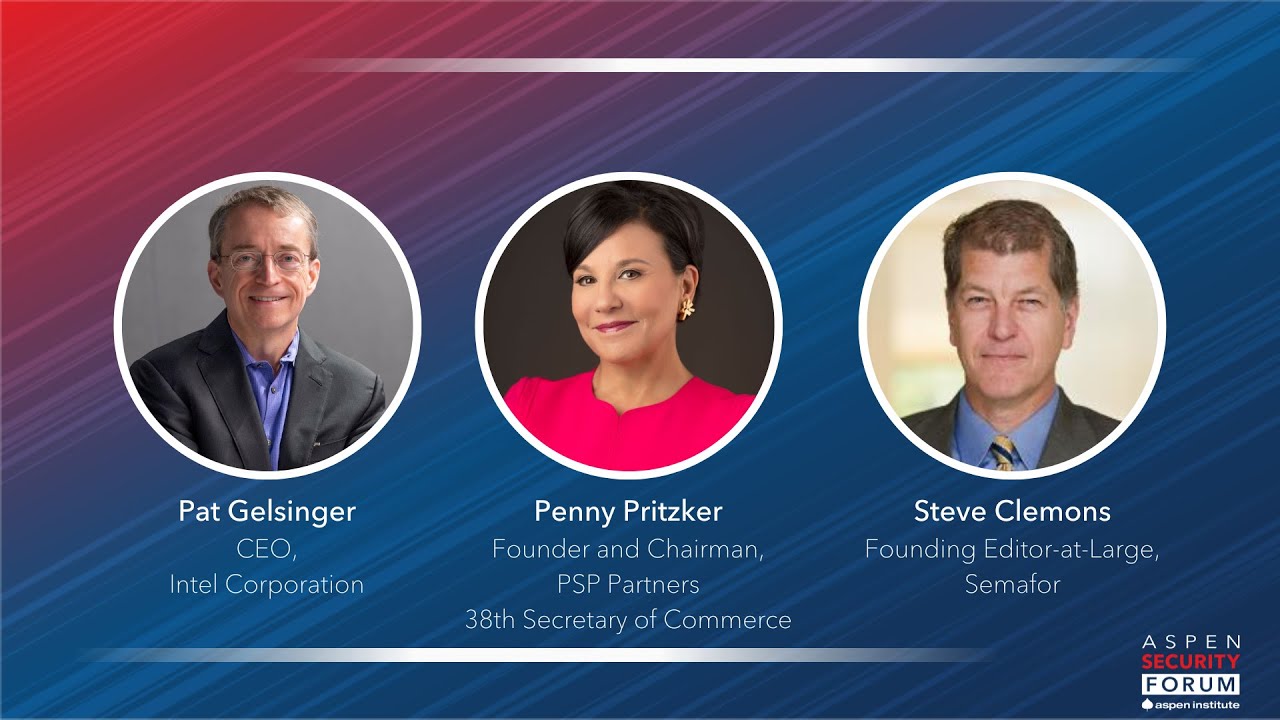
If you care to watch the video embedded above, you can see Gelsinger underline the necessity for the CHIPS Act, and provide some of the history leading up to its passing. Moreover, you can listen to him make Intel's key arguments for loosening the current trade restrictions, while being more generous to Intel - and his reasoning.
Get Tom's Hardware's best news and in-depth reviews, straight to your inbox.

As well as the interviewer Steve Clemons, an editor at Semafor, you will see Penny Pritzker, the US Commerce Secretary, sitting alongside Pat Gelsinger. As a representative of US government, Pritzker discussed the Fed's thinking and strategy. For the US to reinvigorate the semiconductor industry, it isn’t all about throwing money at chipmakers. For example, there is the widening chasm in skilled worker requirements compared to actual labor availability.

Mark Tyson is a news editor at Tom's Hardware. He enjoys covering the full breadth of PC tech; from business and semiconductor design to products approaching the edge of reason.
-
Kamen Rider Blade No, Intel needs to do more with less.Reply
Competition is good, Intel needs to operate with less. -
georgebaker437 Great idea! Let's give more money to the people who shipped the industry to the Third World for a few decimals of profit on the quarterlies and big bonuses for talentless MBA's. All while laying off the engineers who create the tech which created the industry and tying their hand with ridiculous "Do Not Compete" nonsense, making many of them unemployable.Reply -
NeoMorpheus No my dear Pat.Reply
If anything, Intel shouldnt get a penny and instead be forced to use all the money that your beloved company made via illegal ways, like bribing Dell to keep AMD away. -
bit_user I do get his points about the trade restrictions that have hurt Intel since the CHIPS act was passed, but if part of his rationale is where the R&D happens, well he should've had his lobbyists put something about that in the bill.Reply
: P
I'm being only partially facetious, here.
Anyway, from the US Government's perspective, the ideal outcome is to have a US semiconductor industry with multiple competitive players. And the funding was allocated to serve the interests of the country and the tax payers, not a corporation and its investors. So, although it might be nice to have some additional R&D tax credits, the money is best spent more broadly, and not going predominantly to one or two players. -
mac_angel none of them should be getting money. When they, and their 'investors' are making billions in profit each year, they should NOT be getting more money from any government.Reply -
bit_user Reply
The CHIPS bill has some strings attached to the funding, including that recipients can't build any new fabs in China (and I think at least certain other countries?) for some years afterwards. Also, there's a clawback clause for windfall profits, as well as restrictions that they have to actually spend the money on fabs and can't effectively pass it through to their investors.georgebaker437 said:Great idea! Let's give more money to the people who shipped the industry to the Third World for a few decimals of profit on the quarterlies and big bonuses for talentless MBA's. All while laying off the engineers who create the tech which created the industry and tying their hand with ridiculous "Do Not Compete" nonsense, making many of them unemployable.
For this type of legislation, it actually seems above par.
You have to balance that righteous indignation against the very real possibility that Taiwan will go "offline", in 2027 or so. The US will need enough capacity that there's not an epic chip shortage, at that time, that makes the one from a few years ago look like a walk in the park.mac_angel said:none of them should be getting money. When they, and their 'investors' are making billions in profit each year, they should NOT be getting more money from any government.
The right solution to excessive corporate profits is something else. And it should apply to more than just a few chip makers. -
DavidLejdar Does that mean he wants less public money in Germany (as Intel is in Europe as TSMC is in the U.S.) ?Reply
Or would it then be all like: "Oh noes, violation of free market principles, and stuff.", when some would get an advantage just for being locals ? -
PlaneInTheSky TSMC getting taxpayer money and then bringing over hundreds of workers from Taiwan is ridiculous.Reply
TSMC is now literally cutting pay of workers who are part of any union and replacing them with Taiwanese workers.
This benefits no one in the US and it costs US taxpayers billions of $.
-
PlaneInTheSky ReplyGreat idea! Let's give more money to the people who shipped the industry to the Third World for a few decimals of profit on the quarterlies and big bonuses for talentless MBA's.
Almost all of Intel's fab capacity is located in the US.
Intel fabs:
D1Bhttps://upload.wikimedia.org/wikipedia/en/thumb/a/a4/Flag_of_the_United_States.svg/23px-Flag_of_the_United_States.svg.png U.S.300mm, DevelopmentRB1https://upload.wikimedia.org/wikipedia/en/thumb/a/a4/Flag_of_the_United_States.svg/23px-Flag_of_the_United_States.svg.png U.S.300mm, DevelopmentD1Chttps://upload.wikimedia.org/wikipedia/en/thumb/a/a4/Flag_of_the_United_States.svg/23px-Flag_of_the_United_States.svg.png U.S.300mm, DevelopmentRP1https://upload.wikimedia.org/wikipedia/en/thumb/a/a4/Flag_of_the_United_States.svg/23px-Flag_of_the_United_States.svg.png U.S.300mm, ResearchD1Dhttps://upload.wikimedia.org/wikipedia/en/thumb/a/a4/Flag_of_the_United_States.svg/23px-Flag_of_the_United_States.svg.png U.S.300mm, DevelopmentD1Xhttps://upload.wikimedia.org/wikipedia/en/thumb/a/a4/Flag_of_the_United_States.svg/23px-Flag_of_the_United_States.svg.png U.S.300mm, DevelopmentFab 11Xhttps://upload.wikimedia.org/wikipedia/en/thumb/a/a4/Flag_of_the_United_States.svg/23px-Flag_of_the_United_States.svg.png U.S.300mm, 45 nm/32 nm, PackagingFab 12https://upload.wikimedia.org/wikipedia/en/thumb/a/a4/Flag_of_the_United_States.svg/23px-Flag_of_the_United_States.svg.png U.S.300mm, 22 nm/14 nm/10 nmFab 22https://upload.wikimedia.org/wikipedia/en/thumb/a/a4/Flag_of_the_United_States.svg/23px-Flag_of_the_United_States.svg.png U.S.300mm, 22 nm/14 nm/10 nmFab 24https://upload.wikimedia.org/wikipedia/commons/thumb/4/45/Flag_of_Ireland.svg/23px-Flag_of_Ireland.svg.png Ireland300mm, 14 nmFab 28ahttps://upload.wikimedia.org/wikipedia/commons/thumb/d/d4/Flag_of_Israel.svg/21px-Flag_of_Israel.svg.png Israel300mm, 22 nmFab 28https://upload.wikimedia.org/wikipedia/commons/thumb/d/d4/Flag_of_Israel.svg/21px-Flag_of_Israel.svg.png Israel300mm, 22nm/14nm/10nmFab 38https://upload.wikimedia.org/wikipedia/commons/thumb/d/d4/Flag_of_Israel.svg/21px-Flag_of_Israel.svg.pngIsrael300mm, 22 nmFab 32https://upload.wikimedia.org/wikipedia/en/thumb/a/a4/Flag_of_the_United_States.svg/23px-Flag_of_the_United_States.svg.png U.S.300mm, 22 nm/14 nm/10 nmFab 34https://upload.wikimedia.org/wikipedia/commons/thumb/4/45/Flag_of_Ireland.svg/23px-Flag_of_Ireland.svg.png Ireland300mm, Intel 4Fab 42https://upload.wikimedia.org/wikipedia/en/thumb/a/a4/Flag_of_the_United_States.svg/23px-Flag_of_the_United_States.svg.png U.S.300mm, 10 nm/5 nm (2024)Fab 52https://upload.wikimedia.org/wikipedia/en/thumb/a/a4/Flag_of_the_United_States.svg/23px-Flag_of_the_United_States.svg.png U.S.300mm, Intel 20AFab 62https://upload.wikimedia.org/wikipedia/en/thumb/a/a4/Flag_of_the_United_States.svg/23px-Flag_of_the_United_States.svg.png U.S.300mm, Intel 20A;Fab 27https://upload.wikimedia.org/wikipedia/en/thumb/a/a4/Flag_of_the_United_States.svg/23px-Flag_of_the_United_States.svg.png U.S.300mm, 5 nmSC2https://upload.wikimedia.org/wikipedia/en/thumb/a/a4/Flag_of_the_United_States.svg/23px-Flag_of_the_United_States.svg.png U.S.Intel Mask OperationsPelicanhttps://upload.wikimedia.org/wikipedia/commons/thumb/6/66/Flag_of_Malaysia.svg/23px-Flag_of_Malaysia.svg.png Malaysia300mm, PackagingFab 29https://upload.wikimedia.org/wikipedia/en/thumb/b/ba/Flag_of_Germany.svg/23px-Flag_of_Germany.svg.png Germany