









Functionality, Continued
- With the ability to get control of memory management if they want it, applications will then be able to adopt and dynamically change a policy. However, the application developers will have to incorporate usage hints for each object and communicate to OpenGL what the application knows about the data usage pattern. This will result in a true, "use once, use many times, write only, bind data asynchronously." It will also provide a unifying mechanism for all objects (e.g., textures, display lists, vertex arrays, images, pixel buffers and shaders). There's no distinction between textures, display list, vertex array memory, etc., and this does not prevent OpenGL implementations from having these object specific pools. Alternatively, an application can still let OpenGL manage memory; it's just another policy.
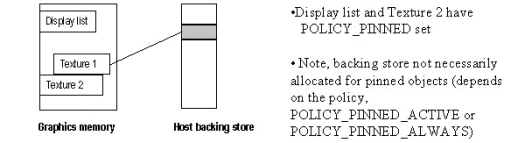
OpenGL 2.0 will use a pinned policy where the application gets control so that OpenGL will not move, copy, pack, or delete an object, once data is loaded. The object is pinned down in high performance graphics memory, which lets the application be responsible for storing or deleting objects, or for initiating a packing operation. The new organization is more efficient, as illustrated by the following diagram.
TOPICS