Athlon 64 X2 Model Overview
The following table includes all current Athlon 64 X2 processor models that are available for AMD's Socket AM2. Be sure to check the model number (right column) if you want to purchase a specific processor.
| Model | Frequency | L2 Cache | Core | Multiplier | Voltage | TDP | Released | Model Number |
|---|---|---|---|---|---|---|---|---|
| Athlon 64 X2 3600+ | 2.0 GHz | 2 x 256 kB | Windsor 90 nm | x10 | 1.20-1.25 V | 65 W | May 2006 | ADO3600IAA4CU |
| Athlon 64 X2 3800+ | 2.0 GHz | 2 x 512 kB | Windsor 90 nm | x10 | 1.30-1.35 V | 89 W | May 2006 | ADA3800IAA5CU |
| Athlon 64 X2 3800+ | 2.0 GHz | 2 x 512 kB | Windsor 90 nm | x10 | 1.20-1.25 V | 65 W | May 2006 | ADO3800IAA5CU |
| Athlon 64 X2 3800+ | 2.0 GHz | 2 x 512 kB | Windsor 90 nm | x10 | 1.025-1.075 V | 35 W | May 2006 | ADD3800IAA5CU & ADD3800IAT5CU |
| Athlon 64 X2 4000+ | 2.0 GHz | 2 x 1024 kB | Windsor 90 nm | x10 | 1.30-1.35 V | 89 W | May 2006 | ADA4000IAA6CS |
| Athlon 64 X2 4000+ | 2.0 GHz | 2 x 1024 kB | Windsor 90 nm | x10 | 1.20-1.25 V | 65 W | May 2006 | ADO4000IAA6CS |
| Athlon 64 X2 4000+ | 2.1 GHz | 2 x 512 kB | Brisbane 65 nm | x10.5 | 1.25V-1.35V | 65 W | Dec 2006 | ADO4000IAA5DD |
| Athlon 64 X2 4200+ | 2.2 GHz | 2 x 512 kB | Windsor 90 nm | x11 | 1.30-1.35 V | 89 W | May 2006 | ADA4200IAA5CU |
| Athlon 64 X2 4200+ | 2.2 GHz | 2 x 512 kB | Windsor 90 nm | x11 | 1.20-1.25 V | 65 W | May 2006 | ADO4200IAA5CU |
| Athlon 64 X2 4400+ | 2.2 GHz | 2 x 1024 kB | Windsor 90 nm | x11 | 1.30-1.35 V | 89 W | May 2006 | ADA4400IAA6CS |
| Athlon 64 X2 4400+ | 2.2 GHz | 2 x 1024 kB | Windsor 90 nm | x11 | 1.20-1.25 V | 65 W | May 2006 | ADO4400IAA6CS |
| Athlon 64 X2 4400+ | 2.3 GHz | 2 x 512 kB | Brisbane 65 nm | x11.5 | 1.25V-1.35V | 65 W | Dec 2006 | ADO4400IAA5DD |
| Athlon 64 X2 4600+ | 2.4 GHz | 2 x 512 kB | Windsor 90 nm | x12 | 1.30-1.35 V | 89 W | May 2006 | ADA4600IAA5CU |
| Athlon 64 X2 4600+ | 2.4 GHz | 2 x 512 kB | Windsor 90 nm | x12 | 1.20-1.25 V | 65 W | May 2006 | ADO4600IAA5CU |
| Athlon 64 X2 4800+ | 2.4 GHz | 2 x 1024 kB | Windsor 90 nm | x12 | 1.30-1.35 V | 89 W | May 2006 | ADA4800IAA6CS |
| Athlon 64 X2 4800+ | 2.4 GHz | 2 x 1024 kB | Windsor 90 nm | x12 | 1.20-1.25 V | 65 W | May 2006 | ADO4800IAA6CS |
| Athlon 64 X2 4800+ | 2.5 GHz | 2 x 512 kB | Brisbane 65 nm | x12.5 | 1.25V-1.35V | 65 W | Dec 2006 | ADO4800IAA5DD |
| Athlon 64 X2 5000+ | 2.6 GHz | 2 x 512 kB | Windsor 90 nm | x13 | 1.30-1.35 V | 89 W | May 2006 | ADA5000IAA5CS & ADA5000IAA5CU |
| Athlon 64 X2 5000+ | 2.6 GHz | 2 x 512 kB | Brisbane 65 nm | x13 | 1.25V-1.35V | 65 W | Dec 2006 | ADO5000IAA5DD |
| Athlon 64 X2 5200+ | 2.6 GHz | 2 x 1024 kB | Windsor 90 nm | x13 | 1.30-1.35 V | 89 W | Sept 2006 | ADA5200IAA6CS |
| Athlon 64 X2 5400+ | 2.8 GHz | 2 x 512 kB | Windsor 90 nm | x14 | 1.30-1.35 V | 89 W | Dec 2006 | ADA5400IAA5CZ |
| Athlon 64 X2 5600+ | 2.8 GHz | 2 x 1024 kB | Windsor 90 nm | x14 | 1.30-1.35 V | 89 W | Dec 2006 | ADA5600IAA6CZ |
Model Research: Wikipedia Better Than Amd.com
AMD's 65 nm processors aren't really available yet, so when we researched them, we decided to start off with Google. We looked for the part number of our Athlon 64 X2 5000+ sample, and only found a link to AMD's forum instead of a model table. The fourth link led us to Wikipedia, and the Athlon 64 summary page proved to be more helpful than the information we found on AMD's website.
Overclocking The Athlon 64 X2 5000+ Brisbane
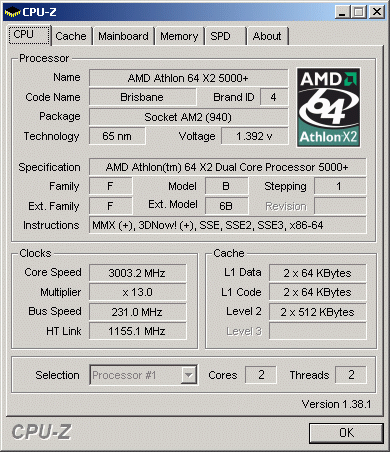
Of course we wanted to see if the new 65 nm processor offers a better overclocking margin than the 90 nm chips. To make a long story short: as of early January, they do not. We were able to run our test sample with a 3.0 GHz clock speed and increased 231 MHz HyperTransport base clock. Having started at 2.6 GHz, this equals a clock speed increase of approximately 15%. Compared to Intel's Core 2 Duo processor, which users report running at far beyond the 3.0 GHz mark, we had expected a bit more - especially since the fastest version of the 90 nm Windsor core (Athlon 64 FX-74) also runs at 3.0 GHz.
We didn't spend a lot of time tweaking and fine-tuning the system, and there might be some room for a few megahertz of additional clock speed, but since this is AMD's first-generation 65 nm processor we expect upcoming products and steppings to do clearly better. From an overclocking point of view, it doesn't make a lot of sense to upgrade to the latest processor type right away anyhow, unless you're specifically looking to save some energy. As our test results show, Brisbane is clearly more efficient than Windsor.


