Hard Drive Technology
Perpendicular Magnetic Recording

Today's state-of-the-art recording technology is called Perpendicular Magnetic Recording (PMR), which is based on vertical alignment of magnetizable data storage particles. Traditional longitudinal recording aligns bits horizontally along the track. However, increasing storage densities also increase the risk of the superparamagnetic effect, which has magnetically aligned elements < 10 nm become temporarily magnetic when an influencing external magnet such as the read/write heads is present. Superparamagnetism hence can cause magnetically aligned elements to influence each other, which would jeopardize data integrity on a hard drive.
Realigning magnetism to follow a vertical or perpendicular orientation allows hard drive manufacturers to increase storage densities, because it circumnavigates the superparamagnetic effect.

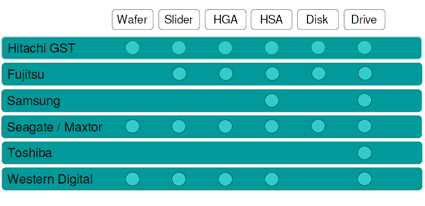
Only Hitachi and Seagate manufacture all hard drive components themselves; others rely on external suppliers. HGA refers to Head Gimbal Assembly; HSA means the Head Stack Assembly.
Future Technology

Hard drive makers are already working on several technologies to further increase data density and performance.
Patterned Media is a technology that attempts to replace conventional platters - which simply offer a certain recording area that consists of x random grains - by platters that come with a pre-patterned substrate. Each bit would then be stored on a single, isolated magnetic "island" on the surface of the medium. Obviously, this helps to further increase data integrity, while working on even smaller structures and providing higher data density.
To reach higher magnetic stability and coercivity, the hard drive makers are also working on an enhancement to the classic magnetic recording technology: Thermally-Assisted Recording uses a tiny laser to create hotspots on the disc surface. These spots show a lower coercivity when heated, which allows the drive manufacturer to use lower-energy magnets. While this facilitates the writing process, the lower-power magnets make sure that only the intended spot is altered magnetically. At the same time, the coercivity at operating temperature can be higher, which provides better magnetic integrity.
Patterned media could be ready for market at around 2010, while Hitachi doesn't expect thermally-assisted writing to be ready before 2013. Combining both technologies could yield a capacity of up to 50 TB in 3.5" drives or 12 TB in a 2.5" drive for notebooks.


