Shop for All
|
Core 2 Duo E8400 Dual Core Processor |
Compare the top 5 lowest prices by hovering your mouse over the product names on the left |
$199.99 |
|
Core 2 Quad Q6600 Processor | $199.99 | |
|
Core i7 I7-920 Quad Core Processor | $349.99 | |
|
Core 2 Q9550 Quad Core Processor | $219.99 | |
|
Phenom II X4 940 Quad Core Processor | $189.99 |
- cpu charts
- toms hardware cpu charts
- cpu comparison
- toms hardware cpu comparison
- toms hardware cpu comparison chart
- tom s hardware guide cpu charts
- mother of all cpu charts
- toms hardware guide cpu chart
- cpu comparison guide
- toms hardware cpu graph
- mother cpu chart
- comparison graph intel processors
- toms hardware cpu comparisons
- computer cpu comparison
- toms cpu comparison
Partners
The Games selection
violent :
Friday the 24th
Exterminate Santa Claus's elves. Use the arrows to move, S to grab the elves, and A or W to attack them with your sword.
|
violent :
Interactive Buddy
Unwind on your interactive buddy: Do anything you want to him, it will earn you money, and you can buy other stuff to torture him with.
|
Sponsored links
The Mother of All CPU Charts 2005/2006
Table of contents
- 1 – Charts Updated With Dual Cores
- 2 – Thermal Dissipation Prevents Higher Clock Speeds
- 3 – Facts & Figures - The Evolution Of Performance
- 4 – Energy Efficiency By Performance Per Watt
- 5 – Processor Updates
- 6 – The 600 Series, Continued
- 7 – Two Cores Sharing A Home: The Dual Core 800 Series
- 8 – Two Cores, Sharing A Home: The Dual Core 800 Series, Continued
- 9 – Extreme Edition: Extreme Extra Performance?
- 10 – Higher Thermal Power Loss Of Up To 130 Watts
- 11 – Higher Thermal Power Loss Of Up To 130 Watts, Continued
- 12 – Higher Thermal Power Loss Of Up To 130 Watts, Continued
- 13 – AMD Platform Troubles
- 14 – AMD Code Name Troubles
- 15 – Socket 754 Is Still Around
- 16 – Core Overview
- 17 – Codenames, Continued
- 18 – Codenames, Continued
- 19 – Impressions And Highlights
- 20 – CPU History
- 21 – Overview Of All Intel CPUs
- 22 – Test Setup
- 23 – Benchmarks And Settings
- 24 – Benchmark Results
- 25 – OpenGL, Continued
- 26 – OpenGL, Continued
- 27 – OpenGL, Continued
- 28 – DirectX 8
- 29 – DirectX 9
- 30 – DirectX 9, Continued
- 31 – DirectX 9, Continued
- 32 – Video
- 33 – Video, Continued
- 34 – Video, Continued
- 35 – Video, Continued
- 36 – Video, Continued
- 37 – Audio
- 38 – Audio, Continued
- 39 – Application
- 40 – Application, Continued
- 41 – Application, Continued
- 42 – Application, Continued
- 43 – Application, Continued
- 44 – Synthetic
- 45 – Synthetic, Continued
- 46 – Synthetic, Continued
- 47 – Synthetic, Continued
- 48 – Synthetic, Continued
- 49 – Synthetic, Continued
- 50 – Synthetic, Continued
- 51 – Synthetic, Continued
- 52 – More on this topic

It's time for a new CPU comparison using our newly developed benchmark suite. The most noteworthy additions are certainly the dual-core processors, but we have also added some new sections focusing especially on the platforms for AMD's Socket 939 and Intel's Socket 775.
An overview as comprehensive as this one also brings up the question of what has changed over that period of time, and how much performance has improved. Naysayer are often quick to point out that your typical word processor doesn't run any faster today than it did in 1993, without qualifying this claim further. Are they completely off the mark?
Well, no, but let's not forget that the way we use our computers has also changed dramatically over the past decade. Today, CPUs handle many tasks simultaneously by running several applications in parallel. In the early 1990s, specialized chips would have been necessary to perform this feat which we take for granted today. Fluid video or audio streaming and playback were unthinkable back then, but are common now. A good current example of such an application is Internet telephony or video conferencing. Here, data is encrypted in real-time, while normal office applications or even games continue to run in parallel. Simply put, much of what we take for granted with computers today was not even on the radar screen just a few years ago.

Behold the first step in an incredibly fast evolutionary process: Intel's first processor, the 4004, circa 1971. It consisted of 2,300 transistors, required a core voltage of 12 V and could address up to 640 Bytes of memory. It didn't even require any heatsink.
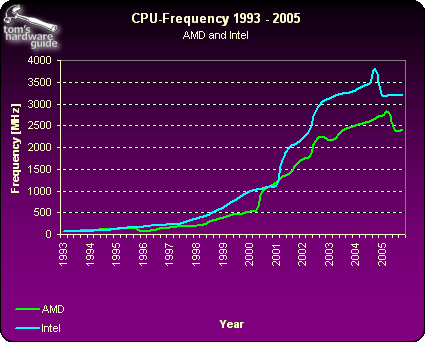
This is a graph of the clock speed development of AMD and Intel processors from 1993 until the end of 2005. Between 1993 and 1999, the average clock speed increased tenfold. Then stagnation set in; over the past four years, frequencies haven't even doubled.
We must realize that the personal computer is edging its way into practically every aspect of our lives. The biggest part of this development was driven by two large processor companies, namely AMD and Intel, the latter of which has had decisive influence on the development of most of today's standards.
How about a few concise examples to illustrate the rapid developments of the past few years? Intel's first processor, the 4004, debuted in 1971 and consisted of 2,300 transistors. Compare that to the 230 million transistors found in today's Pentium Extreme Edition 840. That's an increase by a factor of 100,000!
Let's try that again using a different measure. The space that used to be occupied by a single transistor now houses 5,845 of them. This development went hand in hand with a reduction in core voltage from 12 V (1971) to currently 1.2 V. And that's not even the lower limit; a conventional silicon-based transistor requires a minimum voltage of 0.7 V to perform one transition.

- Pentium D 820 vs. Athlon 64 3700+ San Diego [CPU & Components]
- Should a NON-GAMER upgrade to i7? [CPU & Components]
- CPU Buyers' Guide (updated 10 May 2008) [CPU & Components]
- Radeon HD 3870 X2 - Fastest Yet! (ARTICLE BACK UP!) [Graphic & Displays]
- P4 Benchmark Result Confusion [CPU & Components]
Questions? Ask Tom's community!
