Download the Tom's Hardware App from the App Store
The reference for current tech news
Yes No
Signin with

SETI@home Results

by

If you thought video conversion was time-intensive, wait until you look for aliens. Simply processing a single 373K file with a modern dual-core CPU took me nearly an hour and a half, a source:transcode time ratio of approximately 1:50. By default, the SETI@home benchmark only throws one work unit at a processor. With a dual-core chip, each core handles 50% of the load; with a quad-core, expect 25 percent. However, we want to see full utilization, so using the command benchcpu.bat 2 throws two instances at the processor, filling both cores.

You’ll notice that the CPU-only score on the 9800 GTX config is slightly lower than on the 9600 GT. This is merely within the statistical margin of variance. Additional runs show numbers that, averaged out, put the results about even.

There are two important take-aways here. First, check out the incredible runtime benefit CUDA delivers over CPU-only processing, requiring only 17% of the work time on a 9600 GT and only 11% of the time on a 9800 GTX. Consider how many years it typically takes to see such application performance leaps through CPU evolution alone.

Second, we clearly see the benefit of those extra stream processors in the 9800 GTX at play here. The 9800 GTX turns in a 50% superior performance over its cousin in the GPU-only tests. For $20, that’s one heck of a boost.

Since this was a synthetic benchmark, we weren’t as concerned about tracking CPU utilization during the GPU tests. If you’re curious, running our SETI@home tests on the CPU resulted, of course, in 100% use. The GPU test kept the CPU running around 50% to 60% utilization.

If you’d rather pursue disease cures than alien civilizations, we recommend running Folding@home. If you want to benchmark Folding@home, Nvidia recommends starting with the new OpenMM tool available right here.
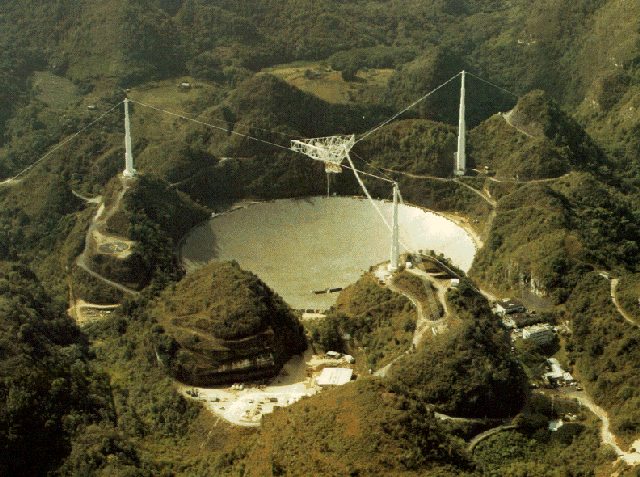
As a fan of science and technology, I feel bound to point out that the SETI@home effort is under imminent threat of closure. The Arecibo radio telescope, the world’s largest single-dish telescope, is located in Puerto Rico and has been the source of all the data processed by the SETI@home project since 1999. Arecibo is run by Cornell University and receives funding from several sources, both public and private. Unfortunately, though, budget shortfalls have led the National Science Foundation to declare that Arecibo will close in 2011, possibly taking SETI@home offline with it, unless funding improves.

Share:
55
Comments
X
Submit

Comments
SpadeM 05/18/2009 7:04 AM
Hide
-1+

The 8800GS or with the new name 9600GSO goes for 60$ and delivers 96 stream processors. Would it be correct to assume that it would perform betwen the 9600 GT and 9800 GTX you reviewed?

Other then that great article, been waiting for it since we got a sneak preview from Chris last week.

curnel_D 05/18/2009 7:08 AM
Hide
-6+

And I'll never take Nvidia marketing seriously until they either stop singing about CUDA being the holy grail of computing, or this changes: "Aside from Folding@home and SETI@home, every single application on Nvidia’s consumer CUDA list involves video editing and/or transcoding."

anonymous 05/18/2009 7:15 AM
Hide
-0+

As more software will use CUDA, we will not only see a great boost in performance for e.g. video performance, but for parallel programing in general. This sky rocket this business into a new age!

curnel_D 05/18/2009 7:18 AM
Hide
-4+

l0bd0n :
As more software will use CUDA, we will not only see a great boost in performance for e.g. video performance, but for parallel programing in general. This sky rocket this business into a new age!


Honestly, I dont think a proprietary language will do this. If anything, it's likely to be GPGPU's in general, run by Open Computing Language.(OpenCL)

one-shot 05/18/2009 7:23 AM
Hide
-4+

Are we both thinking about the same "Pirates 2"? Or am I missing something...

IzzyCraft 05/18/2009 7:35 AM
Hide
-2+

Who knows it's just a clip he used he could be naming it anything for the hell of it.

CUDA transcoding is very nice to someone that does H.264 transcoding at a high profile and lacks a 300+ dollar cpu who would spend hours transcoding a dvd on high profile settings.

Else from that CUDA acceleration has just been more of a feature nothing like a main event. Although can easly be the main attraction to someone that does a good flow of H.264 trasncoding/encoding.

Encoding/transcoding in h.264 high profile can easily make someone who is very content with their cpu and it's power become sad very quickly when they see the est time for their 30 min clip or something.

anonymous 05/18/2009 7:38 AM
Hide
-0+

I'm using CoreAVC since support was added for CUDA h264 decoding. I kinda feel stupid for buying a high end CPU (at the time) since playing all videos, no matter the resolution or bit-rate, leaves the CPU at near-idle usage.
Vid card: 8600GTS
CPU: E6700

IzzyCraft 05/18/2009 7:49 AM
Hide
-0+

Well you lucked in considering not all of the geforce 8 series supports H.264 decoding etc.

ohim 05/18/2009 8:01 AM
Hide
-2+

they should remove Adobe CS4 suite from there since Cuda transcoding is only posible with nvidia CX videocards not with normal gaming cards wich supports cuda.

adbat 05/18/2009 8:05 AM
Hide
--2+

CUDA means Miracle in my language :-) I it will do those
The sad thing is that ATI does not truly compete in CUDA department and there is not standard for it.

JeanLuc 05/18/2009 8:26 AM
Hide
-0+

I was only really interested in the Badaboom benchmarks and I was fairly impressed but I seem to remember the last time you guys done an article based on GPU accelerated apps (Cuda vs Stream) Badaboom suffered from output quality issues something that hasn't been mentioned in this article. It's all very well a 9800GTX being able to encode HD video content in half the time if the final product is no good.

cangelini 05/18/2009 8:56 AM
Hide
-1+

Jean,

Actually, I don't believe we've done a comparison between the two. However, I have read that comparison at other sites, and it's actually ATI's Stream app that has the quality issues. Version two of the software is on the way, and it purportedly fixes the quality issues (though it still isn't demonstrating much GPU scaling, from what I've seen thus far).

ohim 05/18/2009 9:17 AM
Hide
--1+

cangelini :
Jean,Actually, I don't believe we've done a comparison between the two. However, I have read that comparison at other sites, and it's actually ATI's Stream app that has the quality issues. Version two of the software is on the way, and it purportedly fixes the quality issues (though it still isn't demonstrating much GPU scaling, from what I've seen thus far).

yeah but chose your words carefouly since readers could be misslead on this one :) the quality of the transcoding is related to the aplication used not to the computing technology like cuda or stream.

anonymous 05/18/2009 9:27 AM
Hide
-0+

Cangelini, Badaboom definitely has lower quality output compared to the newest x264 builds. I'd definitely like to take advantage of my 9600 GT, but not unless I can use it with Handbrake or some other app on my own terms (NOT BASELINE OR MAIN PROFILE.)

stlunatic 05/18/2009 11:46 AM
Show
randomizer 05/18/2009 12:34 PM
Hide
-1+

SpadeM :
The 8800GS or with the new name 9600GSO goes for 60$ and delivers 96 stream processors.


The 9600GSO has 2 versions (ignoring VRAM variations), one with only 48 SPs (essentially a castrated G94, not G92).

anonymous 05/18/2009 1:12 PM
Hide
-0+

There is a plugin for people who do audio engineering/recording/mixing/mastering from this guy:

http://www.nilsschneider.de

It runs on CUDA, but TBH, it has not manifested itself as anything special just yet, it's more a "proof of concept". However, as someone who's been doing that kind of thing for years, any quad-core ever made is good enough for real-time audio work, so there's not much point in CUDA acceleration.

jgoette 05/18/2009 2:31 PM
Show
anonymous 05/18/2009 2:38 PM
Hide
-0+

I enjoyed the article, and just like in the dual-core versus quad core debate, there remains few applications that can fully exploit CUDA.

By the way, I have quick correction. The author writes, "...that can leverage parallelism in a way that jives with CUDA’s architecture." The correct word is "jibe" not "jive."

Best offers

All about Graphics Cards
 Graphics Cards performance charts
All Graphics Cards charts

Newsletters


OK