Spatial Uniformity
We measure the uniformity of the panel's lighting.
For those of you who aren't used to the Tom's Hardware tests, we'll recall the method we use:
We set the panel at 50% brightness and 50% contrast and measure the uniformity of the lighting on a white image separated into 64 areas of equal size. The brightest point is considered to be 100%, and the previously measured black value - the darkest point - is considered 0%, with the other values we record distributed between them.
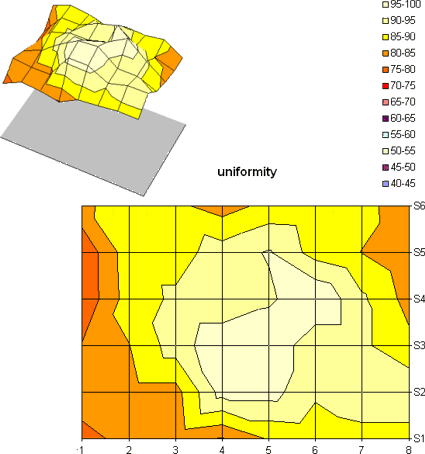
This characteristic wasn't any better on the F20 than on the AL2032W. Up to this point, where pure performance is concerned, the F20 just didn't have much more to offer than the AL2032W.
We should recall that we judge color rendering on a 5-point scale according to several criteria. Naturally, color fidelity is one. The black depth and the suitability of the brightness to the device's function are also taken into consideration-a computer monitor that's too bright will be penalized just as much as a TV set that's too dark.


