Hard Labor - The Best CPU For MPEG-4

Curtains up for MPEG-4! Right now there is hardly a more interesting topic for the majority of PC-users than the creation of video sequences in the space-saving MPEG-4 format or conversions to this format. The available amount of video material for MPEG-4 which, e.g. from the Internet, is constantly growing. Even the very latest movies that are still unavailable in European movie theaters can be downloaded as MPEG-4 videos from numerous Internet sites. The data volume is no longer a problem: in the past a single film required several CD-ROM's in order to be saved as a video in MPEG-1 format, today however, up to 110 minutes of video material in high quality can be squeezed onto a single CD-ROM. In addition: writeable CD's are very inexpensive and are practically ideal for MPEG-4.
In order to create MPEG-4 videos, or to convert existing digital film material, a lot of CPU performance is required, more than any other application demanded before. In our previous article concerning MPEG-4 (MPEG-4: Copying a DVD video onto a CD-ROM ) we confirmed that for example, the conversion of sequences in MPEG-2 format to MPEG-4 required enormous computing power and a lot of time. As a consequence, we subjected the current processors from AMD and Intel to a detailled test. The key questions that we were concerned with were: which processor is best suited to the creation of MPEG-4 sequences and how high is the workload for the CPU during playback? The test included Intel's Pentium III (Coppermine core) from 600 MHz to 1000 MHz, Intel's Celeron with 667 MHz and 833 MHz, AMD's Athlon from 1000 MHz to 1100 MHz and AMD's Duron from 700 MHz to 880 MHz. Let one thing be said in advance: the processor is never fast enough!
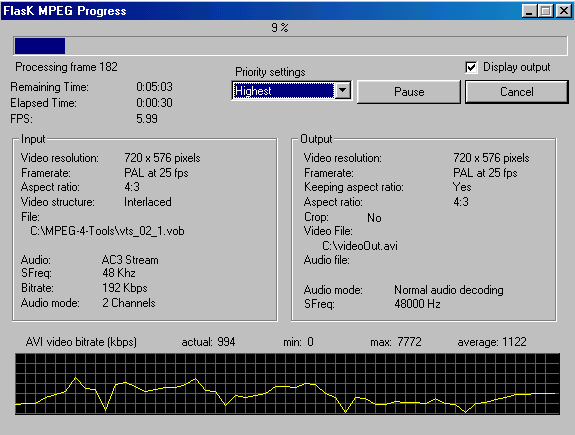
MPEG-4-Conversion with the help of the Flask MPEG-Encoder: The conversion speed from MPEG-2 to MPEG-4 depends strongly on the processor used.

MPEG-4 Encoding: Which CPU Is The Best?
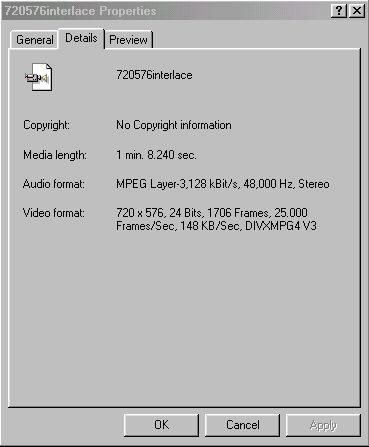
Video file in MPEG-4 format: Good sound and image quality can be attained with a data rate of 148 kb/s. Although the resolution is twice as high as that of MPEG-1, the data rate is lower than that specified in the MPEG-1 specification.
Let's not forget: hardly any other application demands as much processor-power as MPEG-4 conversion. In comparison to most Office applications, which can be used with slower processors down to 400 MHz, a really fast processor is required for MPEG-4 conversion. In order to measure the performance of a processor during MPEG-4 encoding, we encoded a four minute MPEG-2 format video sequence using the progam Flask Mpeg. To do this job, the processor has to be able to handle two main tasks simultaneously:
- Conversion of the MPEG-2 video stream to MPEG-4
- Conversion of the AC3 audio stream to MPEG-1 Layer 3
Whereas the creation of the audio stream is principally the same as MP3 encoding, and doesn't demand too much from the processor, the conversion of the MPEG-2 video part is extremely compute-intensive.