SRC: Sound In Time
Among the various modules comprising the X-Fi, the Sample Rate Converter (SRC) probably seems the most mysterious and least interesting to most potential users. Yet it's the one that gets the biggest share of the processing power! To understand its importance, you have to consider the nature of digital sound itself.
The sampling frequency indicates the number of times per second the value of the signal is read: 44,100 times per second for stereo CD Audio, for example. Today, numerous other values are possible, depending on the source used (e.g. DVD or DVD-Audio). In addition, even sources that use the same theoretical value can differ slightly, since clocks aren't absolutely precise. When you want to mix these sources, for example, these differences can cause errors that result in very audible defects in the sound. Professional equipment - like the kind used in recording studios - uses synchronization systems that consumer equipment doesn't have. Interconnections between the various pieces of equipment also become more complex. Conversion of sampling frequencies can solve all these problems, but until now it's been considered a workaround; a necessary evil. In certain cases, it results - at least in principle - in a reduction in audio quality, especially if there isn't a lot of processing power available for the operation.
For its SRC, though, Creative has used a new architecture that results in a totally transparent audio signal. Converting a 997 Hz test signal from 44.1 to 48 kHz produced a distortion of -136 dB and a ±0.00025 dB pass-band ripple. That's less distortion and noise than is introduced by other audio components, which guarantees the absence of artifacts due to the conversion.
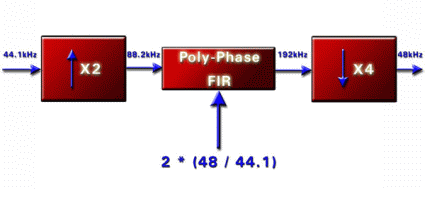
Processing by the SRC to convert a digital signal from 44.1 kHz to 48 kHz

THD+N (distortion + noise) resulting from conversion from 44.1 to 48 kHz. There's no chance you'll be able to hear it!


