The Core 2 Duo is based on Intel's Core microarchitecture, which was designed to reach high performance while maintaining very limited power requirements. You will find all important information in our technology review: Game Over? Core 2 Duo Knocks Out Athlon 64.
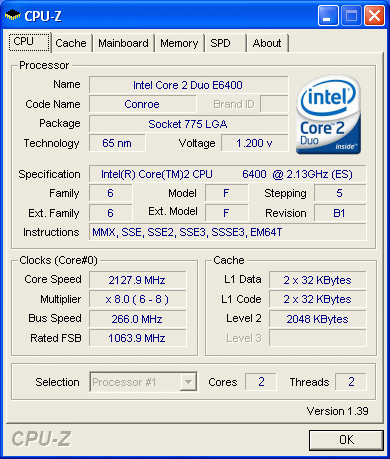
Intel Core 2 Duo E6400
The E6400 is the 2.13 GHz version of Intel's Core 2 Duo. It comes with a 2 MB L2 cache, and runs at 266 MHz interface speed (better known as FSB1066). The current price in quantities of 1,000 and up is $183, which is a great deal for a powerful upper mainstream processor. We picked this processor because it compares very well to AMD's Athlon 64 X2 5600+, which can be purchased for $188 at similar quantities. The question, of course, is which is better.
The E6300 and the E6400 can be seen as entry-level processors to the Core 2 Duo family, and although they represent the slowest models, they have to be rated as upper mainstream. There are still several Pentium D models on the market, which you should avoid. Not only are these slower, but they'll also consume more energy and thus dissipate more heat than the more advanced Core 2 Duo processors. In addition, the Core 2 Duo processors are far better overclockers, just in case you intend to squeeze some extra performance out of your investment.
We also added benchmarks of the more powerful Core 2 Duo E6600 at 2.4 GHz and 4 MB L2 cache to our benchmark charts on the following pages, because getting a more powerful processor seems like an obvious option (at $224 instead of $183).
Stay On the Cutting Edge: Get the Tom's Hardware Newsletter
Get Tom's Hardware's best news and in-depth reviews, straight to your inbox.
Patrick Schmid was the editor-in-chief for Tom's Hardware from 2005 to 2006. He wrote numerous articles on a wide range of hardware topics, including storage, CPUs, and system builds.