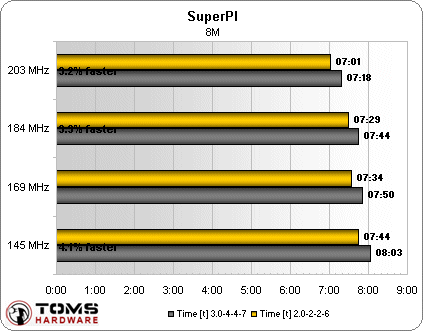
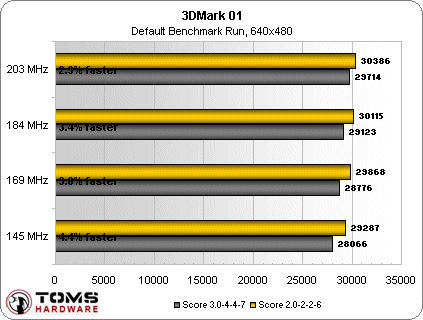
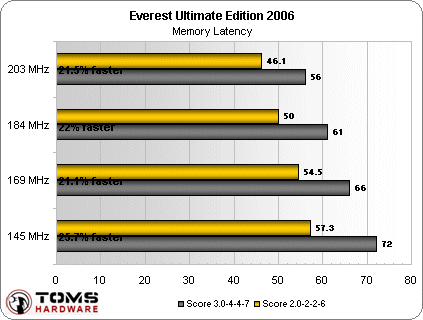
In an attempt to project how memory at tight timings (Winbond) compares to memory at relaxed timings and higher clock frequencies (Samsung), we ran the benchmarks using CL2.0-2-2-6 and CL3.0-4-4-7 at different clock speeds. We experienced very strange performance scaling when using a 9x CPU multiplier and different memory speed dividers. The results didn't form a curve, so we had to settle with a 7x CPU multiplier, resulting in a CPU speed of 2,030 MHz.
We see here that at the different tested memory speeds, tight timings outperform relaxed timings by 3.2% to 4.1% in SuperPI, and 2.3% to 4.4% in 3DMark01. Unfortunately, our CPU speed of 2030 MHz is acting as a bottleneck when the memory frequency is increased, which takes away the significance of tightening the timings.
At a 1450 MHz core clock and 193 MHz memory frequency, the difference between tight and relaxed timings in 3DMark01 is 1.9%; at 2030 MHz it is 2.3%, and at 2610 MHz it is 5.7%. It's not unreasonable to then guess that if we were to double the increase in clock speed from 2030 to 3190 MHz (instead of to 2610 MHz), we might see a difference in the area of 8-12%, if the memory speed were kept the same.
Good Article I guess. I've been wondering that exact question now that i got 2x1GB of Patriots PC2-8500 Viper Series from NVISION08. The timings are 5-5-5-15 2T at 1066MHz. When i try to lower it 1T it's not reliable. Anyways, thanks tomshardware for another good article, I hope there is a sequel to this, specifically DDR2 or 3 memory.
As most of you are probably aware, the MHz clock speed of the Athlon 64 and Opteron is the product of the HyperTransport speed (HTT) times the multiplier of the CPU.
Correct me if I'm wrong, but shouldn't this be written as, "the MHz clock speed of the Athlon 64 and Opteron is the product of the HyperTransport speed (HTT) and the multiplier of the CPU."