Would You Rather Have Air Cooling Or CPU Water Cooling?
It isn't only PC rookies who like to question the raison d'être of CPU water cooling. It's well known that an efficient water cooling unit generates less noise than a standard air-cooled system. For many users, however, this argument is not compelling enough to make them want to buy. After all, water coolers cost many times more than a good air cooling system.
The clincher in favor of water cooling remains its substantially higher cooling performance. This is especially important for performance computing enthusiasts, or overclockers, who seek to take their system to the very limits. The average user who treats his system to an upgrade at regular intervals can also reap the benefits of water cooling. Not every CPU upgrade necessitates a new cooler, though. What water cooling does offer is a certain measure of "investment security."
Why is water cooling so much more efficient at keeping temperatures down? To get to the bottom of it, let's take a short excursion into the world of physics. The combination of CPU surface material, thermal grease, heat sink and air represents a series connection of thermal resistances (= reciprocal value of the heat transfer variable) that can simply be added together.

The heat flow through the heat sink can be represented by the following, highly simplified, equation:
Iw = G*(TD -TA ) mit G=λ* (A/l) bzw G=1/Rtherm
where
Iw : heat flow
G: heat transfer value
λ: thermal conductivity of the heat sink material
A: surface through which the heat flows (contact surfaces between die and heat sink)
distance traveled by heat flow
TD : maximum admissible die temperature according to specs.
TA : temperature in the fan vicinity
Rtherm: thermal resistance [K/W]
To avoid overheating the CPU, the heat flow through the heat sink must be at least as large as the CPU's current heat dissipation.
The higher the thermal conductivity of the material used, the "better" the CPU can be cooled. Since, at 0.58W/mK, water has fifteen times the thermal conductivity of dry air, it is eminently more suitable than air as a medium for heat transfer.
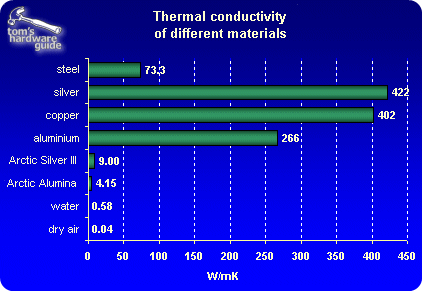
In conventional air cooling, the heat sink absorbs the heat and passes it to the air in the PC's interior. A system of this kind is subject to performance restrictions determined by the temperature prevailing inside the housing, the heat-sink material and the size of the active cooling surface.
In a water-cooled system, the water block first takes up the heat and passes it to the water flowing into it. Via the hose system, the water carries the heat to the radiator. Once it arrives in the radiator, the water passes the heat to the air via the ribs. The thinner the ribs and the larger the radiator's surface is as a result, the more powerful the cooling system. A fan with a large diameter and a low speed mounted in front of the radiator ensures quick thermal exchange with the environment at a tolerable noise level. The "cooled" water flows from the outlet side of the radiator back into the CPU water block. The air flow within the water block is also important in ensuring adequate cooling. That's because the more thermal discharge the water can absorb from the surrounding material in the block, the better the cooling performance.