How It Works
A flatbed scanner is little more than a hollow box, containing a mechanical and optical system that illuminates documents placed on its glass plate. The reflected light is captured and dispatched to a computer in bit form by an analog/digital converter.
In this context, the key points in choosing a scanner are its resolution on the one hand, and the number of colors it is capable of managing on the other. If you take a closer look, you'll notice that both these details are clearly indicated in the product specifications, but still have to be assessed in various ways. Sometimes the results are quite surprising. Even if all the scanners currently on the market are of the same type, there are two basic families:
CCD Scanners

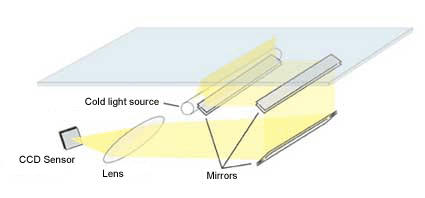
This is the largest family, and the four scanners reviewed here belong to this category. With this type, the light reflected by the document being scanned is reflected by a system of mirrors to a lens, which has the job of streaming the image to a CCD (charge-coupled device) detector. This is a fragile, accurate and quite expensive system, since the mirrors must always be perfectly aligned and the lens must be of the highest quality.
CIS Or LIDE Scanners
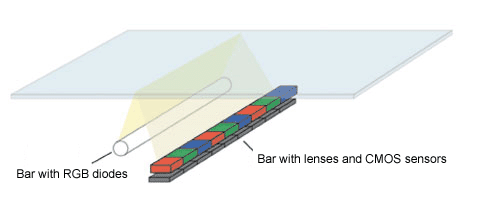
CIS (Contact Image Sensor) or LIDE (LED Indirect Exposure) scanners, developed by Canon and Umax, are two and three times more precise than their CCD counterparts, due to the fact that they do not need the set of mirrors. This is replaced by a simple CMOS detector bar that covers the whole width of the page. This bar is located a few millimeters below the glass panel, and directly captures the reflected light without it passing through any secondary system or lens. An additional advantage is that these scanners are less sensitive to shock and the technology less expensive. There is a disadvantage however, in that CMOS detectors are less sensitive than CCD detectors, which translates into less color accuracy. Another feature with these detectors is that they require very little power. That is why most CIS and LIDE scanners are powered solely via the USB cable and do not need an external power supply.