









The Atom Z2760: Specs And Theoretical Processor Performance

Samsung's ATIV Smart PC 500T is made possible by Intel's Atom Z2760 processor, formerly known as Clover Trail. Sub-2 W power consumption helps facilitate passive cooling, despite the fact that this SoC employs a pair of cores (with 1 MB of L2 cache) at 1.8 GHz, a dual-channel memory controller, PowerVR SGX545 graphics at 533 MHz, and all of the other north/southbridge components you'd normally find spread across a PC motherboard, optimized for a tablet, of course.
| Hardware Comparison | ||||
|---|---|---|---|---|
| Tablet | SoC | CPU | RAM | GPU |
| Kindle Fire HD | OMAP 4460 | 1.2 GHz Dual-Core Cortex-A9 | 1 GB | PowerVR SGX540 @ 384 MHz |
| Surface And Nexus 7 | Tegra 3 (T30L) | 1.3 GHz Quad-Core Cortex-A9 | 1 GB | ULP GeForce @ (Unknown Speed) |
| iPad 3 | A5X | 1.0 GHz Dual-Core Cortex-A9 | 1 GB | PowerVR SGX543MP4 @ (Unknown Speed) |
| ATIV Smart PC 500T | Atom Z2760 | 1.8 GHz Dual-Core Saltwell with Hyper-Threading | 2 GB | PowerVR SGX545 @ 533 MHz |
According to Intel's data sheet, the Atom Z2760 employs Burst technology, though we weren't able to observe the SoC speeding up beyond 1.8 GHz using any of the tools at our disposal. Moreover, Intel isn't clear about the circumstances in which Burst is triggered, or how long it can be sustained. The Atom Z2760 supports Hyper-Threading as well, so each physical core shows up as two logical processors to Windows 8.
The SoC's Graphics Media Accelerator component incorporates a handful of features, including Imagination Technologies' PowerVR SGX545 engine operating at up to 533 MHz. Almost three years old now, this is not particularly new hardware. It is, however, D3D feature level 9_3-compliant, giving it Shader Model 2.0 support. Not that you'll be playing many 3D games; the Atom's 3D capabilities are only slightly better than what you'd find in a Kindle Fire HD, and it's slower than Nvidia's Tegra 3.
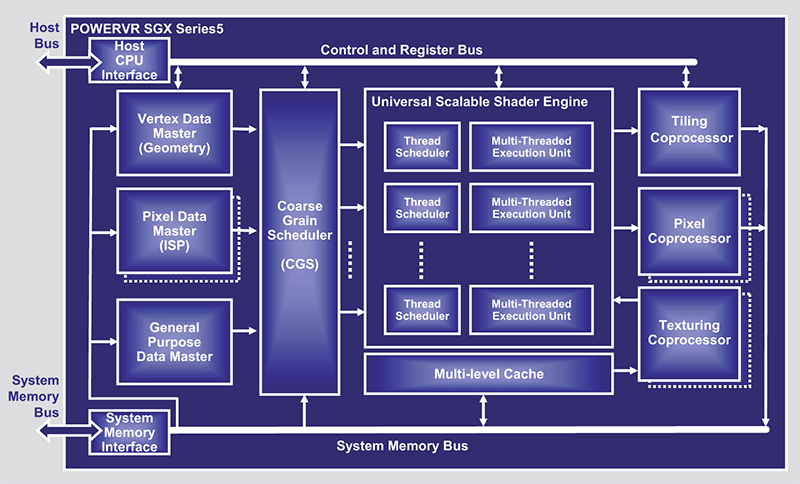
Intel also endows the GMA with hardware-accelerated video encode and decode support, including 24-FPS H.264 and VC-1 at 1080p (up to 20 Mb/s). It also handles several stages of MPEG-2 decoding in hardware. The company claims MPEG-4 Part 2 is supported as well, but only in software mode. Likewise, Flash decoding is not accelerated.
H.264 can be accelerated in hardware at 30 FPS using a 1280x720 resolution.
An integrated display controller with two independent pipelines means that Samsung's ATIV Smart PC 500T can drive its own screen and output to a 1080p display over HDMI 1.3a at the same time, too.
Theoretical CPU Performance

Although it's a synthetic benchmark, Geekbench is useful in this case for comparing a number of dissimilar platforms, from Apple's iPad to this new Atom and Intel's higher-end Core i5 CPUs.
Geekbench would have us believe that the Atom Z2760 delivers 23% of the Ivy Bridge-based Core i5-3320M's performance, 43% of the Sandy Bridge-based Core i5-2467M's score, 52% of whatever an Arrandale-based Core i5-470UM can do, 72% of Qualcomm's S4 Pro, and 91% of Nvidia's Tegra 3. But that's the suite's overall ranking. We can break its analysis down even further.

It's most important for us to look at the outcome of integer math, since that's most prevalent in mobile-only operating environments like iOS and Android for performance reasons. Of course, you can put whichever applications you want on an ATIV Smart PC 500T.
But the synthetics suggest the Atom is only narrowly faster than Qualcomm's S4 and Nvidia's Tegra 3 in the integer test. Meanwhile, the S4 Pro platform enjoys great floating-point throughput. Given these numbers, we can't wait to see how it does in Windows RT-based tablets.
On the bright side, Intel's Atom Z2760 is a massive improvement over the Atom N450 on our Dell Mini.

The new Atom's two 32-bit memory channels, populated with low-power DDR2-800, should be able to move up to 6.4 GB/s. That puts it under the S4 Pro and Tegra 3 platforms.