Join for quick access. Enter your email below and we'll send confirmation plus sign you up to our newsletter.
By submitting your information, you confirm you are aged 16 or over,
have read our
Privacy Policy
and agree to the
Terms & Conditions. Geographical rules apply.
Stay On the Cutting Edge: Get the Tom's Hardware Newsletter
Get Tom's Hardware's best news and in-depth reviews, straight to your inbox.
You are now subscribed
Your newsletter sign-up was successful
Join the club
Get full access to premium articles, exclusive features and a growing list of member rewards.
An account already exists for this email address, please log in.
We connected the outputs from the solar panels directly to the PC, so it has 16 V DC of power at its disposal. Depending on the intensity of sunlight at any given moment, though, these modules output anywhere between 12 and 20 V DC. That's why we chose a very special power supply - namely, the M2-ATX from Ituner - that can handle input voltages in a range from 6 to 28 V DC.
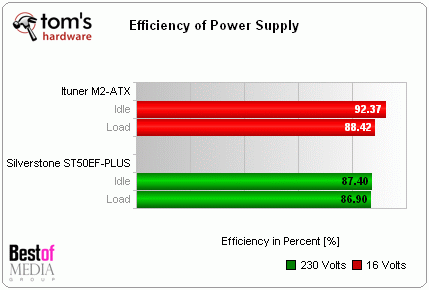
Because this is a low-voltage power supply, the maximum rated power for this device is a scant 160 W. The input voltage to the PSU is also very close to the output voltage it needs to produce for a PC. This narrow difference between input and output voltages has the happy consequence of enabling extremely high efficiency, compared to a PSU that handles conventional A/C power. We use this power supply to drive all the components in our solar-powered PC, including the monitor.
The Ituner M2-ATX includes only a single 5.25" drive connection and a single SATA connector, so we used a Y-adapter to hook up the rest of our components.
We used a Y-Adapter to route power to additional devices in our PC
We measured the efficiency of the power supply in our solar-powered PC at idle, and under heavy load, as shown in the following chart.
Stay On the Cutting Edge: Get the Tom's Hardware Newsletter
Get Tom's Hardware's best news and in-depth reviews, straight to your inbox.
Tom's Hardware is the leading destination for hardcore computer enthusiasts. We cover everything from processors to 3D printers, single-board computers, SSDs and high-end gaming rigs, empowering readers to make the most of the tech they love, keep up on the latest developments and buy the right gear. Our staff has more than 100 years of combined experience covering news, solving tech problems and reviewing components and systems.