









Why you can trust Tom's Hardware Our expert reviewers spend hours testing and comparing products and services so you can choose the best for you. Find out more about how we test.
AMD Radeon RX 9070 XT and RX 9070, by PowerColor


View Original

View Original

View Original

View Original

View Original


View Original

View Original

View Original

View Original

View Original

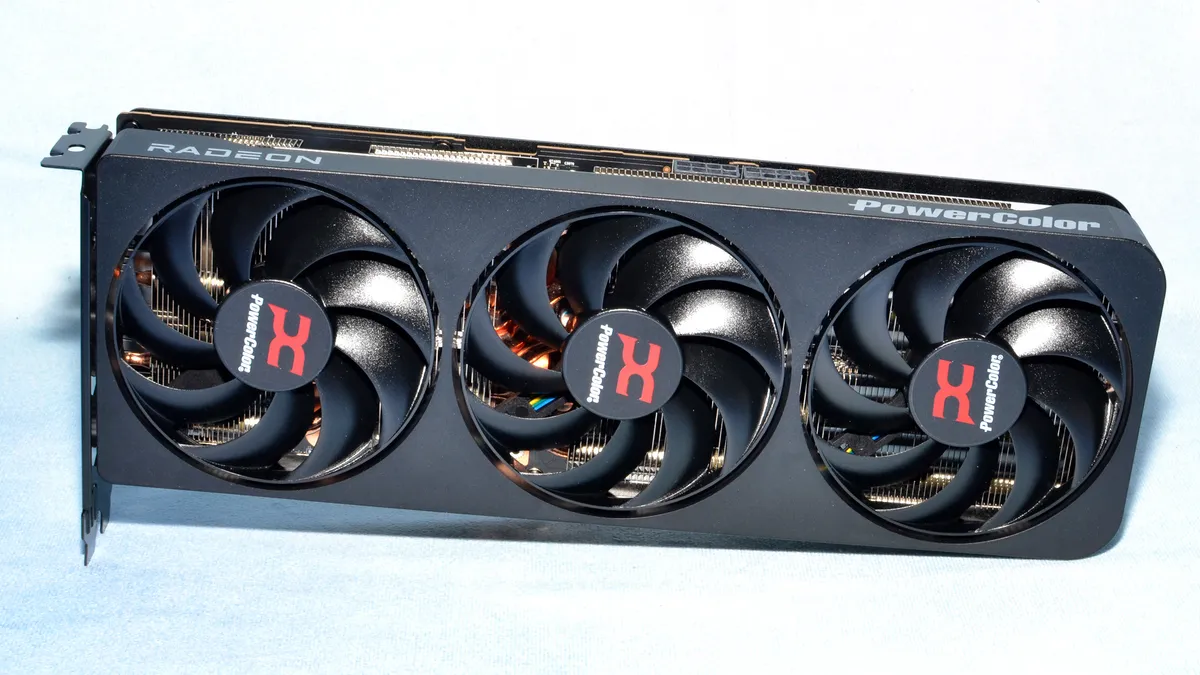
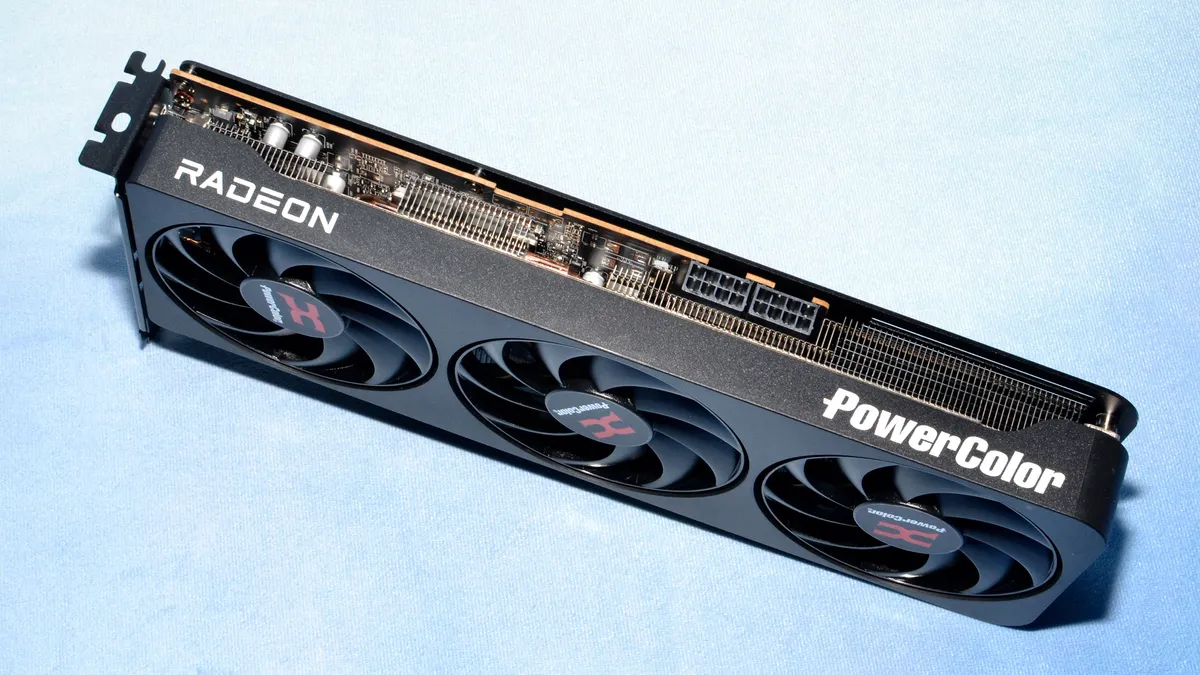
AMD provided two graphics cards for this review, both from PowerColor and both with reference clocks. They're branded Reaper, a new family for PowerColor that presumably sits near the lower end of the product stack. These are triple-fan cards, but everything else says base model — no RGB lighting, no dual BIOS, no extras in the box. That's fine, as base MSRP cards usually don't have a lot of extras.
We're primarily focusing on the higher spec RX 9070 XT for this review, though we'll have all the performance data for both cards. It's again a matter of time constraints. Doing three full graphics card writeups in one week is just a bit too much. But we'll have plenty to say about the vanilla RX 9070 as well.
Both cards have the same physical dimensions: 292x111x41 mm. The fans are 88mm models with integrated rims that help improve airflow. But while the dimensions are the same, there are some differences between the two cards. Specifically, the 9070 XT card has a copper heat plate while the 9070 has an aluminum (or some silver metal) heat plate. There are likely other differences under the shrouds, as the 9070 XT will have to dissipate more heat.


View Original

View Original

View Original

View Original

View Original

View Original

View Original




View Original

View Original

View Original

View Original

View Original

View Original

View Original

PowerColor takes the traditional approach of including three DisplayPort 2.1a ports and a single HDMI 2.1b port. However, the specifications note that only two simultaneous DP2.1 connections can be active at the same time. Also, these are UHBR13.5 (54 Gbps) ports, rather than the full 80 Gbps maximum that DisplayPort 2.1a allows for.
The RX 9070 XT has a 304W TBP (Total Board Power), so it makes sense that it comes with dual 8-pin power connectors. Along with the 75W maximum power provided by the PCIe x16 slot — and yes, it's a PCIe 5.0 slot — that's up to 375W of power.
The 9070 only has a 220W TBP, so technically it could even be run off a single 8-pin connector plus the power from the PCIe slot, but taking the safer route of providing a second 8-pin connection is appreciated.
Of course, being the old and reliable 8-pin connectors means there shouldn't be much risk of any meltdowns happening, and you can get away with using pre-ATX 3.0 power supplies. Either way, these are minimalist designs that should work well in general. Which brings us to the important part for anyone reading: the benchmarks.
- MORE: Best Graphics Cards
- MORE: GPU Benchmarks and Hierarchy
- MORE: All Graphics Content
Get Tom's Hardware's best news and in-depth reviews, straight to your inbox.
Current page: AMD Radeon RX 9070 XT and RX 9070, by PowerColor
Prev Page Introducing the AMD Radeon RX 9070 XT and RX 9070 Next Page AMD Radeon RX 9070 XT and RX 9070 Test Setup
Jarred Walton is a senior editor at Tom's Hardware focusing on everything GPU. He has been working as a tech journalist since 2004, writing for AnandTech, Maximum PC, and PC Gamer. From the first S3 Virge '3D decelerators' to today's GPUs, Jarred keeps up with all the latest graphics trends and is the one to ask about game performance.
-
Crazyy8 I don't have much money, but I might have just enough for the 9070 XT. I might finally be able to say I have high end hardware! :smile:Reply
Look forward to release, hope it isn't scalped! -
cknobman I'll be online super early to try and snag a $599 9070xt.Reply
Count me in the market share shift over to AMD. -
palladin9479 Now it's all down to availability and how much product AMD can pump into the channel. Anyone trying to buy a dGPU is left with almost no real options other then to pay ridiculous markups to scant supply. If AMD can pump enough product into the channel, then those prices will go down cause well, that's how the supply vs demand curve works.Reply -
Elusive Ruse Thank you for the detailed review and analysis as always @JarredWaltonGPU I’m glad that we finally have a proper offering at the midrange. AMD dealt a powerful blow to Nvidia, maybe a bit late but better than never.Reply
The ball is now in Nvidia’s court, let’s see how much they care about the gaming market, I also believe this is a matter of brand image as well; losing to AMD even if it’s not at the high end still hurts. -
JarredWaltonGPU Reply
Seriously! Well, more like late 2020 or early 2021. Everything is basically sold out right now (though 5070 has a few $599 to $699 models actually in stock right this second at Newegg).Gururu said:Very nice review although the setting feels like a time warp to Dec 2022. -
Colif They are nice cards but I will follow my own advice and not buy a card this generation and see what next brings. Xt beats mine in some games but not all, and since I don't play RT games anyway, I don't think its worth itReply
I am saving for a new PC so it wouldn't make sense to buy one now anyway. Maybe next gen I get one that is same color as new PC will be... -
SonoraTechnical Saw this about the Powercolor Reaper in the article:Reply
PowerColor takes the traditional approach of including three DisplayPort 2.1a ports and a single HDMI 2.1b port. However, the specifications note that only two simultaneous DP2.1 connections can be active at the same time. Also, these are UHBR13.5 (54 Gbps) ports, rather than the full 80 Gbps maximum that DisplayPort 2.1a allows for.
So, 3 monitors using display port for FS2024 is a non-starter? Have to mix technologies (DP and HDMI?) Is this going to be true for most RX 9070 XT cards? -
JarredWaltonGPU Reply
Not by my numbers. AMD said the 9070 XT would be about 10% slower than the 7900 XTX in rasterization and 10% faster in ray tracing. Even if that were accurate, it would still make the 9070 XT faster than the 7900 XT.baboma said:I watched the HUB review, since it came out first. The short of it: 9070XT = 7900XT (not XTX), both in perf and power consumption. So if you think Nvidia (Huang) lied about 5070's perf, then AMD also lied.
394
395 -
Colif The low stock and things being OOS the same day they released reminds me of the 7900 release day. I was too slow to get an XTX but I was happy with an XT.Reply