Join for quick access. Enter your email below and we'll send confirmation plus sign you up to our newsletter.
By submitting your information, you confirm you are aged 16 or over,
have read our
Privacy Policy
and agree to the
Terms & Conditions. Geographical rules apply.
The AMD Radeon RX 9060 XT 16GB provides nearly everything we want from a relatively affordable GPU: good performance, reasonable pricing, and plenty of VRAM. It makes Nvidia’s competing RTX 5060 and 5060 Ti 8GB cards look shortsighted.
Reasons to buy
+
Great value and performance
+
16GB of VRAM means you won’t worry about running out of memory
+
RDNA 4 architecture brings improved RT and AI features
+
Cards didn’t immediately sell out at launch
Reasons to avoid
-
AMD still plays second fiddle on software features like FSR vs DLSS
-
16GB models currently start at $389, not $349
-
Seriously, spend the extra money and avoid all 8GB cards
Why you can trust Tom's Hardware
Our expert reviewers spend hours testing and comparing products and services so you can choose the best for you. Find out more about how we test.
The AMD Radeon RX 9060 XT 16GB arrives as the far better and more attractive mainstream GPU option — the one the market has been waiting for. Nvidia still reigns as the performance champion at the top, but the further down the stack you go, the less attractive Team Green’s offerings become. Witness the RTX 5060 and RTX 5060 Ti 8GB, two GPUs that frequently become hamstrung by insufficient VRAM. How does AMD’s latest card stand up to the best graphics cards, and where does it sit in the pantheon of the GPU benchmarks? That’s what we’re here to find out.
We’re fleshing out the major offerings for the current generation of GPUs from all three vendors with today’s RX 9060 XT review. Along with AMD’s RDNA 4 GPUs, we’ve tested all the initial onslaught of Nvidia Blackwell GPUs, plus Intel’s two (for now) Arc Battlemage GPUs. That doesn’t mean there won’t be mid-cycle refresh GPUs like last generation's RTX 40-series Super cards, but those generally slot into the existing structure without shaking things up too much. If those cards do happen — and they probably will — they’re likely to arrive in early-to-mid 2026.
Many have noticed that our standalone RTX 5060 review didn’t happen, and there are good reasons for that. Jarred has left the building, and while he’s helped us put together this one final hurrah, timing and a lack of direct sampling from Nvidia delayed the testing of that card. So, today’s review marks a two-for-one special of sorts — three-for-one if you want to also count the lackluster RTX 5060 Ti 8GB, which we also had to purchase for testing.
AMD’s launch pricing for the RX 9060 XT officially sits at a base of $299 for the 8GB card, and $349 for the 16GB variant. The good thing about being a few days late to the launch party is that we can actually reflect on retail prices. Right now, the 8GB models are relatively available at $299. The 16GB cards are in much higher demand, and rightly so, with the lowest currently available prices starting at $389. These are still early prices, however, so it’s possible we’ll see the base 16GB prices eventually dip back to AMD’s recommended $349.
Swipe to scroll horizontally
Graphics Card
RX 9060 XT 16GB
RX 9060 XT 8GB
RTX 5060 Ti 16GB
RTX 5060 Ti 8GB
RTX 5060
Arc B580
Architecture
Navi 44
Navi 44
GB206
GB206
GB206
BMG-G21
Process Technology
TSMC N4P
TSMC N4P
TSMC 4N
TSMC 4N
TSMC 4N
TSMC N5
Transistors (Billion)
29.7
29.7
21.9
21.9
21.9
19.6
Die size (mm^2)
199
199
181
181
181
272
CUs / SMs / Xe-Cores
32
32
36
36
30
20
GPU Shaders (ALUs)
2048
2048
4608
4608
3840
2560
AI / Tensor Cores
64
64
144
144
120
160
Ray Tracing Cores
32
32
36
36
30
20
Boost Clock (MHz)
3130
3130
2572
2572
2497
2850
VRAM Speed (Gbps)
20
20
28
28
28
19
VRAM (GB)
16
8
16
8
8
12
VRAM Bus Width
128
128
128
128
128
192
Infinity / L2 Cache
32
32
32
32
24
18
Render Output Units
64
64
48
48
48
80
Texture Mapping Units
128
128
144
144
120
160
TFLOPS FP32 (Boost)
25.6
25.6
23.7
23.7
19.2
14.6
TFLOPS FP16 (FP4/INT4/FP8 TFLOPS)
205 (821)
205 (821)
190 (759)
190 (759)
153 (614)
117 (233)
Bandwidth (GB/s)
320
320
448
448
448
456
TBP/TGP (watts)
160
150
180
180
145
190
Launch Date
Jun 2025
Jun 2025
Apr 2025
Apr 2025
May 2025
Dec 2024
Launch MSRP
$349
$299
$429
$379
$299
$249
Like Nvidia’s RTX 5060 Ti, AMD’s RX 9060 XT comes in both 8GB and 16GB variants, mostly with the same specifications. The 16GB card has a 10W higher base power rating, as well as double the VRAM. The added power means that the 16GB card should never be slower compared to the 8GB model (other than margin of error), and in more demanding games it could prove significantly faster.
What’s the direct competition for the RX 9060 XT? Is it Nvidia’s similarly priced (for the 9060 XT 8GB) RTX 5060, or is AMD going after the higher performance RTX 5060 Ti and undercutting Nvidia’s pricing by $80? The latter seems the more likely target, and we don’t have the 8GB AMD card for testing (yet), so we can’t make a direct comparison between the $299 parts.
In terms of raw specs, AMD offers slightly more FP32 compute than the RTX 5060 Ti — and slightly more AI compute as well, since RDNA 4 has added native INT4 support. That’s a bit apples and oranges, and Intel only has native FP16 or INT8 support, but we’ll see how things fare when we get to the benchmarks.
Stay On the Cutting Edge: Get the Tom's Hardware Newsletter
Get Tom's Hardware's best news and in-depth reviews, straight to your inbox.
One area where Nvidia does hold a decided advantage is in raw memory bandwidth. The Blackwell architecture uses GDDR7 memory, clocked at 28 Gbps for the 5060-class GPUs. That’s 40% faster than the GDDR6 20 Gbps memory used by AMD RDNA 4 and Intel Battlemage GPUs. But raw bandwidth isn’t the only important factor; cache and caching algorithms also play a role, and potentially memory timing as well, so it’s possible AMD’s 9060 XT will be able to keep pace despite the raw bandwidth deficit. Again, we’ll see how things play out in the benchmarks.
Power differences have shrunk with this generation, as AMD and Nvidia are now basically using the same TSMC process node. Technically, AMD even has a slight node lead, since it’s using N4P while Nvidia uses the vanilla 4N (basically N4). Intel uses the slightly older N5 node for Battlemage. AMD specifies 160W for the base model 9060 XT 16GB, and 150W for the 8GB variant, compared to 180W for Nvidia’s competing RTX 5060 Ti, and 190W for Intel’s Arc B580.
(Image credit: Tom's Hardware)
Prices are still in flux, and unfortunately for those looking to pick up a new graphics card, certain models are more desirable than others. Intel’s Arc B580 was supposed to be a $249 part, but the least expensive card right now costs $309. Nvidia’s RTX 5060 can be found for $299, and there are $379 RTX 5060 Ti 8GB cards as well, but the least expensive RTX 5060 Ti 16GB card still costs $479. There are good reasons for that, but it does muddy the waters a bit.
We’re seeing the same thing with the RX 9060 XT, where the 16GB cards are drifting quite a bit higher than the base MSRP. Right now, it’s a $90 jump in price when going from the 8GB 9060 XT to the 16GB card. That’s a bitter pill to swallow, and if you’re really sure you don’t want to fool around with higher resolutions, higher settings, ray tracing, and/or AI workloads, perhaps the 8GB card will suffice. The problem we have is that many modern extras like framegen still increase VRAM use, and we’ve seen plenty of games struggle on 8GB cards already.
$50 more to double your graphics memory from 8GB to 16GB feels like a no-brainer to us, after seeing how games have continued to push higher quality textures over the past few years. $90 or $100 extra isn’t quite as easy to stomach — the price of two games rather than one, more or less. But over the long term, if you’re serious about gaming, we’d almost always recommend trying to push up one or two notches from where you might feel comfortable on price.
It's not just about raw performance. We’ll show how the 16GB and 8GB variants of some cards match up in our testing, but those are the sanitized benchmark results. Many games simply behave better with an abundance of VRAM. We’ve encountered games where loading saves (or loading into new areas of the game) can eventually cause performance on an 8GB card to tank, requiring a restart. And there are also games where 8GB cards at higher settings simply fail — like the Nvidia-promoted Indiana Jones and the Great Circle, which can’t even run the ultra preset at 1080p on Nvidia’s 8GB GPUs.
There’s ultimately no 100% 'right' answer for how much memory you need, or how much more you should pay for that memory. Still, it’s an important spec and something to keep in mind. All else being equal, having more VRAM is better.
Tom's Hardware is the leading destination for hardcore computer enthusiasts. We cover everything from processors to 3D printers, single-board computers, SSDs and high-end gaming rigs, empowering readers to make the most of the tech they love, keep up on the latest developments and buy the right gear. Our staff has more than 100 years of combined experience covering news, solving tech problems and reviewing components and systems.
While I still feel like there should have only been a single 9060 XT the 16GB is definitely what passes for as a good deal price v perf despite the upsell pricing. Hopefully over the lifetime of the card MSRP will be hit.
Feels like if one is going to step up to a 16 GB model, the 5060 Ti looks like a better choice for $40 more. Otherwise one is just looking to save $90 by sticking with the 8 GB model.
AMD showing again why they don't care about gaining market share: they have a product that can compete with Nvidia, but they don't price it anywhere near what it would take to get people to buy it if they're already Nvidia users.
I was hoping to see a 9060 XT 16 vs 8 GB charts the same as the 5060 Ti has a way to see where the cutoff is instead of the misinformation that gets spread. It's also entirely what the market cost is gonna be at.
AMD showing again why they don't care about gaining market share: they have a product that can compete with Nvidia, but they don't price it anywhere near what it would take to get people to buy it if they're already Nvidia users.
That's because it cannot compete. It's a bit worse, for a bit more power, if you're a gamer. Non-gaming workloads run abysmally bad compared to Nvidia, due to AMD's neglect of HIP, ROCm, and any effort to make pro workloads run well.
This is not a competitive product, that's why it should be priced way lower.
but don't forget 5060ti has lower performance on older MB's cause of narrow lanes and all those hoping to upgrade their older system with 5060 series should also buy new MB+CPU+MEM to gain full advantage of 5060ti
but don't forget 5060ti has lower performance on older MB's cause of narrow lanes and all those hoping to upgrade their older system with 5060 series should also buy new MB+CPU+MEM to gain full advantage of 5060ti
Ehh that really depends. PCI-E bandwidth, which is what you are talking about, is only involved when data gets transmitted from system RAM to GPU VRAM. When you have plenty of VRAM then you really don't need to worry about that, if you are in a VRAM constrained situation which requires graphics resources to be swaped in and out of system RAM across the PCIe bus. PCIe 4 x16 slot is 32GB/s one way, PCIe 5.0 x16 is 64GB/s one way. System memory is much faster and therefor not the bottleneck. Honestly if someone is in such a situation that are you swaping texture data across the PCIe bus, they are already having a bad experience and need to either turn down texture resolution or upgrade to a newer card.
I had no problem getting the XFX model of the 16 gig for MSRP ($350) via newegg. Lots of $350 models out there. If you live near a Microcenter it's even better selection.
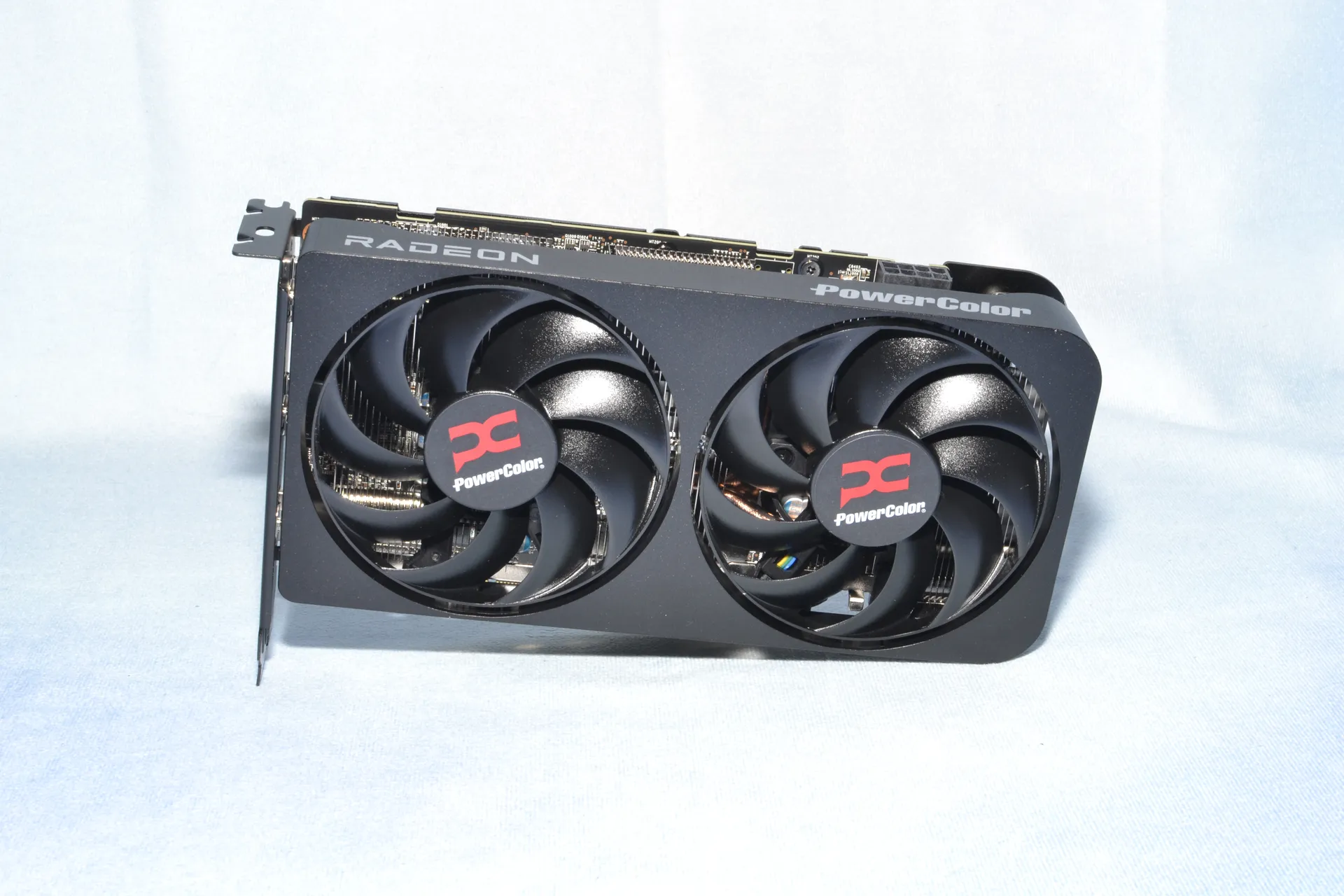
One major thing to note about the powercolor reaper: it's only 200mm x 39mm for a 16 gb version. That makes it one of the best cards for some smaller SFF builds out there for the money.