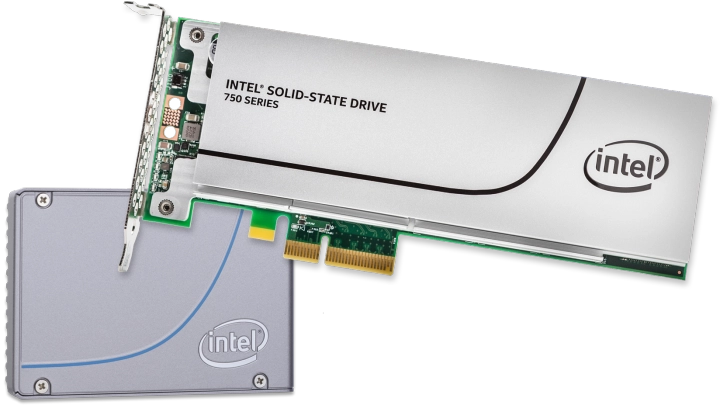
For workstation users, the Intel SSD 750 series is a perfect mix of performance, cost and features. This is a true enterprise part that is targeted at workstation users, but it's affordable enough for power users and enthusiasts. The 800GB model fills the gap between the small 400GB drive and the excessive 1.2TB model. This isn't the SSD for everyone but if you want a drive that will last for a decade without giving you trouble or making you feel that you need something better, this is your best option.
Pros
+
The SSD 750 800GB offers high performance and large-capacity storage that you can't get in another NVMe-based product (other than the 1.2TB model). This is the drive that we asked for from the start of this series, and it delivers just about everywhere.
Cons
-
It's difficult to attack Intel on the price, since this drive is so advanced and requires so many components. It does sell for $1 per gigabyte, and that can be hard to swallow for some.
Why you can trust Tom's Hardware
Our expert reviewers spend hours testing and comparing products and services so you can choose the best for you. Find out more about how we test.
Specifications, Pricing, Warranty And Accessories
Intel launched its SSD 750 in two capacities: 400GB and 1.2TB. Right from the start, we thought the gap between those sizes was too wide, and that an 800GB model should fill the space. The company heard our cries for something in the middle, and now has an 800GB version.
The 800GB model actual debuted back in August of last year, just four months after the 400GB and 1.2TB drives were released. Now, all three capacities are available in two different form factors. The first is what we have on-hand today, an add-in card with a traditional PCI Express 3.0 four-lane edge connector. The second one is new to the desktop space, and comes from the enterprise market. The U.2 model has a 2.5-inch drive footprint, but is 15 millimeters tall like high-performance SAS storage products. The edge connector passes four lanes of PCI Express over a reworked SAS HD cable. One cable supports one drive.
Intel's SSD 750 family consists of the most advanced consumer SSDs ever released. They feature an advanced NVMe interface and a controller taken from the enterprise. That processor is paired with lots of DRAM that acts as a map table buffer and 36 NAND packages that work together to deliver very high throughput.
The SSD 750s were the first desktop drives to utilize NVMe, which reduces latency, allowing for more transactions per second and thus increasing application performance under heavy loads. Most enthusiasts rarely push their storage subsystems hard enough to trip up an SSD, but the reduction in latency yields a more satisfying user experience. NVMe also imposes less CPU overhead than AHCI, the specification that NVMe may replace in time. That frees up cycles for other activities that benefit from increased compute horsepower.
Like the two existing models we've already reviewed (the Intel 750 Series 1.2TB and Intel 750 Series 400GB), the 800GB model uses Intel's 20nm-node MLC flash. In order to hit this capacity point, the company uses two different flash densities. In the simplest terms possible, half of the drive comes from Intel's 400GB model and the other half comes from the 1.2TB flagship.
A third-generation SSD processor that has been enhanced for NVMe ties all of the NAND together. This controller first appeared in a line of advanced enterprise-oriented drives and then trickled down to the desktop space. It carries over some of those professional-grade goodies too, enabling power loss and end-to-end data protection.
Stay On the Cutting Edge: Get the Tom's Hardware Newsletter
Get Tom's Hardware's best news and in-depth reviews, straight to your inbox.
At peak performance, the 800GB SSD 750 is technically slower than the other two models. Normally, though, it's hard to push these drives to their limits.
Pricing, Warranty And Accessories
When the 400GB and 1.2TB models launched, they were separated not only by lots of flash, but also big price differences. Currently, the smaller SSD 750 sells for around $340, while the big one costs around $1,000 (though these prices do fluctuate). With some PC games breaking the 100GB barrier, gamers increasingly find themselves needing more than 400GB, but balk at the idea of a $1000+ SSD. That's where the 800GB model starts looking good. Available between $759 to $799, it expands the line-up with a more palatable price.
All three SSD 750s include five-year warranties and are rated for 70GB of writes per day.
Intel supports its drives with the Solid-State Drive Toolbox software (the company's Data Migration Software does not currently support PCIe-based SSDs). The Toolbox utility is one of the best suites out there, improving your experience by simplifying optimizations that might otherwise be considered complicated.
Intel also offers a paid add-on for workstation users. If you'd like to try out its Cache Acceleration Software (CAS), you can download a 120-day trial here.
The SSD 750 ships with a half-height end bracket for 2U and small form-factor cases.
We've purchased SSD 750s in OEM and retail packaging. The picture above is the retail package with a printed box and software installation disc. The OEM model doesn't include the disc and instead ships in a brown box. Usually, you can save a few bucks by opting for the OEM drive.
Intel has guidelines for cooling the SSD 750s. Its 2.5-inch models require more airflow than the add-in cards. We didn't find a linear feet per minute rating for the 800GB version, but the existing drives range between 100 and 300 LFM. Don't let those numbers scare you. I don't know what my own cooling system is capable of, but I haven't had any throttling issues with Intel's NVMe-capable SSDs and that's with a single 120mm fan blowing over the expansion slots on my motherboard.
With the heat sink removed, we can see that this isn't an ordinary SSD. Although paying $1 per gigabyte is certainly rough, we're surprised Intel can even hit that price. When we test SATA-based SSDs, we see manufacturers adding a dash of DRAM. Intel piles on 2GB in addition to its flash. One-terabyte SSDs normally employ eight or 16 NAND packages, but the 800GB SSD 750 uses 36. This series also uses a well-engineered power-fail protection system. With all of the on-board components, the drive needs more power than a typical SSD to flush data from the buffer to flash in case of an emergency. There's no point in comparing Intel's SSD 750 to any SATA-based product because it's in an entirely different league.
Having owned the Samsung 950 Pro 512GB for a month now, I can say I'm consistently impressed and considering the price difference (I bought it for 167GBP / ~$240USD on an amazing sale) I can't justify the jump in price to the Intel 750 - even if random IOPS are nearly 2x higher. It'd probably be the difference of a blink of an eye. Still, as the 950 Pro is replacing an Intel 730, I can tell you that I've also been consistently impressed with Intel. If and when they go on sale, I usually end up convincing myself to buy them too.
there is problem in the mismatch of motherboards and PCI-E SSDs. The Xeon E3 motherboards may have 2 x8 slots, and the E5 boards might be 5x8 per socket, but more likely there is a combination of fewer slots, some x16, whereas all the affordable SSDs are x4, note that the P3608 is much more expensive. Could Intel put 2 750's on one x8 card, one connected to the lower x4 and the second to the upper x4? Alternatively, it would be nice if we could get an adapter for 2 M.2 to PCI-E x8.
So the Samsung 950 pro bets the intel 750 in low queue depths ie normal desktop workload (application starts and the like) and 750 beats 950 in higher qd's, both have their uses. Whats i like about my 950 pro over my 750 is its price/performance for desktop workloads.