









Integrated Graphics Performance: It's all in the chips
Weaknesses Of Integrated Graphics
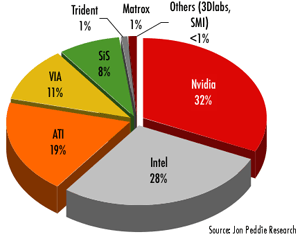
Total graphics market share numbers in Q4 2002 by Jon Peddie Research. Today Intel is leading the pack - thanks to its integrated chipsets.
Integrated graphics are very attractive from a cost perspective, since motherboards require only minor modifications to accommodate these chips. OEMs that build low-cost PCs love these all-in-one solutions, as it saves them the extra PCB, memory and cooling solution that a discrete graphics card would need.
At the same time, it is their low cost that has thus far prevented integrated solutions from being more successful. At $41, Intel charges only $5 more for its i865G with integrated graphics than for the graphics-less i865PE. At the store, an i865G board should sell for roughly $10-$15 more than the PE version. But what can you expect for $5?
Computers are sold with numbers - the bigger the better. "DirectX 9 graphics" sounds better than DirectX 8, and 256 MB of video memory are obviously better than 128 MB. Many less well-informed customers rely too heavily on the bigger the better number philosophy. In its nForce 2 IGP, NVIDIA uses the NV17/18 core of its GeForce 4 MX 440, which consists of about 27 million transistors. Judging from its performance and its feature set, it's safe to assume that Intel's i865G uses far fewer transistors. The trouble is that DirectX 9 support in hardware requires very complex GPUs with a very high transistor count. Even NVIDIA's entry-level GPU, the NV34 (a.k.a. FX 5200), counts a full 47 million transistors, while its bigger siblings NV31 (FX 5600) and NV35 (FX 5900) weigh in at 80 million and 130 million, respectively.
So if more power also means more transistors and consequently higher (manufacturing) cost, then integrating a low-cost GPU that at the same time incorporates features that will help sell the complete system seems impossible at this point. The issue represents an interesting paradox.
But even if, by some feat of engineering or ingenuity, such a combination became possible, the chips potential would be limited by the memory bandwidth available to it. Dual channel DDR 400, for example, offers a peak bandwidth of 6,4 GB/s. While this may seem pretty respectable compared to the 8 GB/s of a GeForce 4 MX 440 add-in card, the trouble is that the integrated GPU has to share this bandwidth with the rest of the system. So an integrated graphics chip can actually be detrimental to system performance, at least when bandwidth-hungry 3D applications are used. And let's not forget that the video memory is subtracted from system memory, taking up resources.
In light of these limitations, the integrated graphics solutions found on motherboards today appear to be one big compromise and seem to exist only on the fringe of the market, away from the mainstream. For our performance comparison, we assembled a group of three boards based on Intel's i865G, NVIDIA's nForce 2 IGP and SIS' 651 chipsets, respectively.
Get Tom's Hardware's best news and in-depth reviews, straight to your inbox.
Before we get to the actual comparison, we take a look at each of our contender's features and peculiarities.
Current page: Weaknesses Of Integrated Graphics
Prev Page Introduction Next Page Intel I865G - Extreme Graphics 2