









Why you can trust Tom's Hardware Our expert reviewers spend hours testing and comparing products and services so you can choose the best for you. Find out more about how we test.
To compare the AW3425DW’s performance, I’ve rounded up a speedy group of 34-inch 21:9 OLEDs. At 175 Hz is AOC’s AG346UCD. At 240 Hz are Corsair’s 34WQHD240-C, Acer’s X34, Gigabyte’s MO34WQC2, and Asus’ PG34WCDM.
Pixel Response and Input Lag
Click here to read up on our pixel response and input lag testing procedures.

View Original
View Original
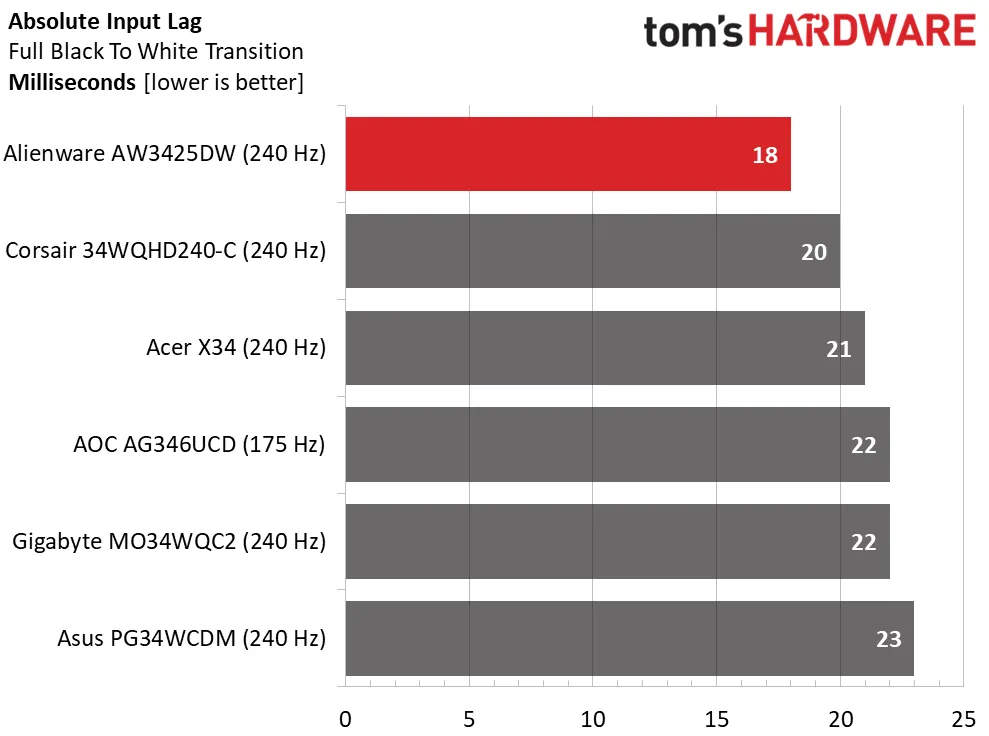
If you’re going for an OLED, it should be 240 Hz. Though the 175 Hz AOC isn’t that far behind the others in performance, it’s only $50 less than the AW3425DW, so you might as well get the fastest monitor in the field, which is, coincidentally, the Alienware. It refreshes in 4ms like the other 240 Hz screens, but manages 2ms less input lag with an 18ms total score. It’s faster than many 27-inch 16:9 monitors, and it is the fastest 34-inch ultra-wide in my test database. Motion processing is visually perfect with no blur observed in moving test patterns. Objects maintain full resolution no matter how fast they go by. Background graphics also stay sharp during rapid camera pans.
Test Takeaway: Nearly any OLED will deliver perfect motion resolution and low input lag, but the AW3425DW is the quickest 34-inch 21:9 screen I’ve tested to date. It delivers a premium feel with no compromises.
Viewing Angles

Some Quantum Dot OLEDs show a subtle tint at 45 degrees to the sides, but the AW3425DW remains consistent in color, brightness and gamma. You can easily share the screen without sacrifice. The top view has reduced gamma, but its color and brightness are barely affected.
Screen Uniformity
To learn how we measure screen uniformity, click here.
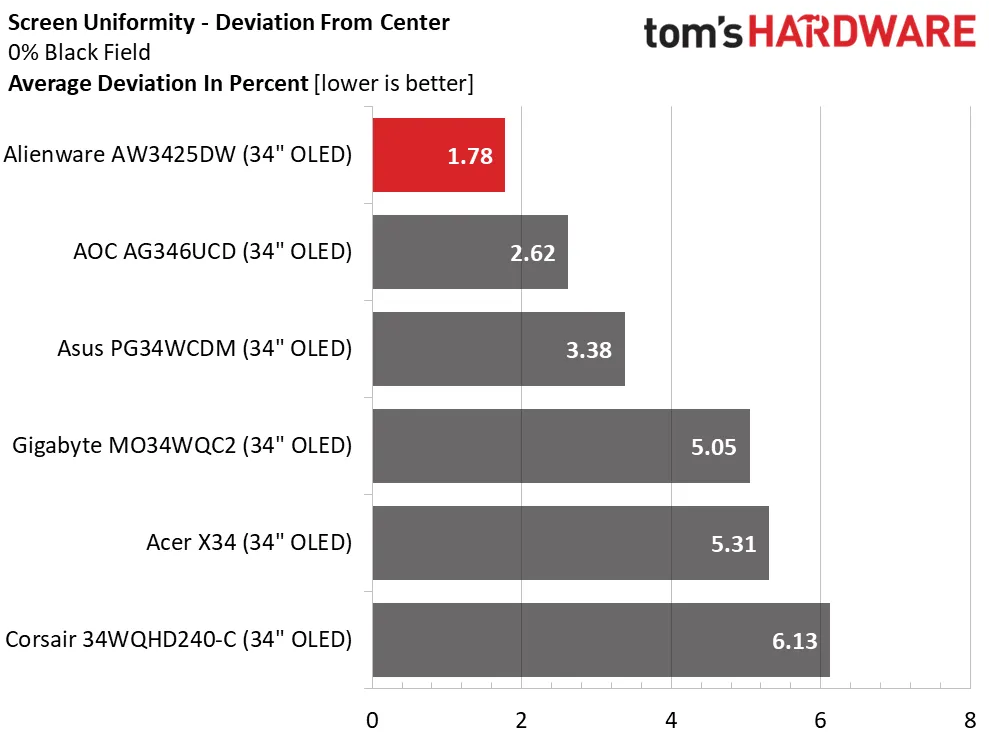
The AW3425DW includes screen uniformity in its factory calibration data, and my sample aced the test with one of the lowest scores I’ve ever recorded. 1.78% is about as good as it gets with no visible issues in any field pattern, color or gray. This is excellent performance.
Get Tom's Hardware's best news and in-depth reviews, straight to your inbox.
MORE: Best Gaming Monitors
MORE: How We Test PC Monitors
MORE: How to Buy a PC Monitor
Current page: Response, Input Lag, Viewing Angles and Uniformity
Prev Page Features and Specifications Next Page Brightness and Contrast
Christian Eberle is a Contributing Editor for Tom's Hardware US. He's a veteran reviewer of A/V equipment, specializing in monitors. Christian began his obsession with tech when he built his first PC in 1991, a 286 running DOS 3.0 at a blazing 12MHz. In 2006, he undertook training from the Imaging Science Foundation in video calibration and testing and thus started a passion for precise imaging that persists to this day. He is also a professional musician with a degree from the New England Conservatory as a classical bassoonist which he used to good effect as a performer with the West Point Army Band from 1987 to 2013. He enjoys watching movies and listening to high-end audio in his custom-built home theater and can be seen riding trails near his home on a race-ready ICE VTX recumbent trike. Christian enjoys the endless summer in Florida where he lives with his wife and Chihuahua and plays with orchestras around the state.
-
Morgan xXx ReplyAdmin said:Alienware delivers on all counts with its AW3425DW. It’s a 34-inch curved ultra-wide QD-OLED panel with WQHD resolution, 240 Hz, Adaptive-Sync, HDR10 and wide gamut color. It couples near-perfect color accuracy with premium gaming performance.
Alienware AW3425DW WQHD QD-OLED review: Near-perfect color and premium performance : Read more
Are there any issues with Auto Dimming? I'm still with an LG C2 OLED (may go to C4) because it is thus far, the only OLED that allows you to turn off Auto Dimming, or ASBL, using the service menu in SDR. When gaming in HDR ASBL is on, but PC work is in SDR and it's great to have it off.
I'd like to go with an OLED monitor for Display Port and usually a KVM, but inability to turn off ASBL is a deal breaker for me. -
Elrabin Reply
I have its predecessor, the AW3423DWF and if you set it to the TrueBlack400 setting, there is no auto dimming enabled.Morgan xXx said:Are there any issues with Auto Dimming? I'm still with an LG C2 OLED (may go to C4) because it is thus far, the only OLED that allows you to turn off Auto Dimming, or ASBL, using the service menu in SDR. When gaming in HDR ASBL is on, but PC work is in SDR and it's great to have it off.
I'd like to go with an OLED monitor for Display Port and usually a KVM, but inability to turn off ASBL is a deal breaker for me.
I'd be really surprised if this one isn't set up similarly. -
thestryker Reply
I have it and haven't used it outside of TrueBlack, but can confirm I've noticed no such thing there. I've only noticed panel refresh when the display turns off (either via PC or manually) and this process can be interrupted if you're resuming usage.Morgan xXx said:Are there any issues with Auto Dimming?
Keep in mind using DP with 240Hz refresh requires DSC which has its own set of downsides which may or may not be important for your use case.Morgan xXx said:I'd like to go with an OLED monitor for Display Port and usually a KVM, but inability to turn off ASBL is a deal breaker for me. -
Makaveli Great for gaming no doubt but how is this monitor for rendering text?Reply
Can this be used 8 hours a day for work also? -
Elrabin Reply
I've had the Alienware 3423DWF(this monitor's predecessor) for over 2 years so far and it's on 8 hours a day for work and at least a couple hours a night for gaming/watching streaming.Makaveli said:Great for gaming no doubt but how is this monitor for rendering text?
Can this be used 8 hours a day for work also?
I do the pixel refresh every 4 or so hours of use when it reminds me to do so. I just finish what i'm doing when i get the popup, lock my PC and go take a walk or change out laundry or some other 5 minute chore and by the time I get back, it's done
Text looks no different than my high end IPS monitors -
thestryker Reply
I think it depends on what you're doing and how sensitive you are. The subpixel layout is the same as the Gen 1 QD-OLED panels despite being a Gen 2 panel. My secondary display is slightly better text wise, but not to the degree that I'm bothered by the AW display.Makaveli said:Great for gaming no doubt but how is this monitor for rendering text? -
JMarvelous I have the 32in 4k version and it was expensive as heck but the most beautiful picture ive ever laid eyes on. Gaming is amazing.Reply
I've never had any issues with it. I run the refresher (6 mins long) every 4 to 5 hours if Im on for long periods. I mainly do design so color was important to me.
Text looks absolutely amazing, no fringing. The 1440p monitor may have text issues idk. -
Mr Majestyk Hard to fathom how the low pixel density isn't con. If this review is prioritising colour accuracy, it's surely implying it'sReply
also productivity focused monitor, not just a one trick gaming monitor. Colour gamut and accuracy mean almost nothing to gamers. -
Makaveli Reply
Valid points.Mr Majestyk said:Hard to fathom how the low pixel density isn't con. If this review is prioritising colour accuracy, it's surely implying it's
also productivity focused monitor, not just a one trick gaming monitor. Colour gamut and accuracy mean almost nothing to gamers. -
thestryker Reply
It might be more of a con if there was anything viable in the same format with better pixel density (assuming 120Hz or higher refresh).Mr Majestyk said:Hard to fathom how the low pixel density isn't con.
LG is going to have some "5k2k" 34" UW displays coming, but those are 800R. You have to move up to 40/45" to increase pixel density without high curve in UW format (former is IPS, latter is OLED but the adjustable one is $2500, non is 800R).
This is their standard review format so I'm not exactly sure what your problem is. Should the reviewer ignore the color gamut and accuracy because it's a gaming focused display?Mr Majestyk said:If this review is prioritising colour accuracy, it's surely implying it's
also productivity focused monitor, not just a one trick gaming monitor. Colour gamut and accuracy mean almost nothing to gamers.