Fortron FSP300-60GNF: Soundless With High Efficiency

Only candidate with passive cooling for noiseless operation: the high efficiency and acceptably priced Fortron FSP300-60GNF.
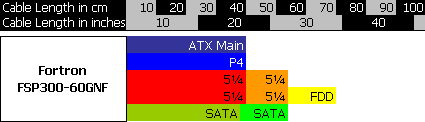
The graphic above shows the power supply connections and their length in centimeters. Small power supply with few connections: the Fortron FSP300-60GNF.
Features

The THG laboratory engineers fastened the 300 watt power supply unit from FSP (Fortron) onto the test platform with apprehension. In previous comparative tests passive power supply units gave an unsatisfactory performance: all of them prematurely gave out after a few hours under maximum load. The Fortron power supply unit is an exception: the unit held up under maximum load without a problem just shy of 24 hours.

The overvoltage protector, which guards the power supply unit and thus the computer from voltage peaks from the supply network.

Since the user can't hear the passive power supply unit working when it is on, the manufacturer has installed an on-switch with a blue light that matches the computer casing. The power supply unit can master 115 as well as 230 volt current, which is indicated by the label "Full Range". The power supply unit can thus be used anywhere in the world.

Since the power supply unit has to work without a ventilator, the heat sinks have correspondingly larger dimensions compared to the normal version. The three large aluminum cooling fins scorch the heat loss from the 60 watt fixed voltage controller. The temperature of the heat generated by the device is well over 149 °F (65 °C).

The power supply unit is stuffed with heat sinks in every nook and cranny, but nonetheless, when put on the scales, weighs only an astonishing 5 lb (2.3 kg).

Glued and screwed on, so that even under the worst stress and vibrations the component parts remain in place.
Due to the cooling concept of no ventilator, very high temperatures of more than 150.8 °F (66 °C) are produced on the blue lacquered outer surface of the power supply unit.
Test Results
The measurements of the device produced satisfying values, which were all within the specifications:
Input: 358 watts (214 volts, 2.33 amperes, cosphi 0.77)
Output: 300 watts (18.2 amperes/3.3 volts, 12 amperes/5 volts and two times 7.5 amperes at 12 volts)
Electrical efficiency under maximum load: 83.5 percent (59 watts of dissipation warms the air by just under 27°F (15 °C))
Noise measurement under maximum load: none, since no ventilator
At the first 12 volt line 11.82 volts were measured, at the second 12 volt current (CPU) 11.79 volts were measured, at the 5 volt line 4.94 volts and at the 3.3 volt line 3.25 volts. The 5 volt standby line excelled with 4.96 volts.
The FSP300-60GNF indeed has a sensationally high efficiency rate of 83.5%, however the cosine phi measurement was an extremely low value of 0.77. This expresses the ratio between effective and reactive power. In some countries, for example France, the reactive power has to be paid for. Thus in this case no cost savings are possible.
A further announcement for our loyal readers: for safety reasons, no live tests will be carried out over the weekend.
| FSP Fortron FSP300-60GNF (300 watts) | |||
|---|---|---|---|
| Test Phase 1 | |||
| Test Description | Lower Limit | Upper Limit | Result |
| Increase load from 20% to 100% of nominal load limit | 60 watts | 300 watts | Passed |
| Test Phase 2 | |||
| Test Description | Row 4 - Cell 1 | Load | Result |
| Steady load at 100% nominal load | Row 5 - Cell 1 | 300 watts | Passed |
| Test Phase 3 | |||
| Voltage Stability | |||
| Power Rail | Measurement | Min/Max according to ATX Spec. | Result |
| + 3.3 V | + 3.25 V | +/- 5% (+3.14 to +3.46 V) | Passed |
| + 5 V | + 4.94 V | +/- 5% (+4.76 to +5.25 V) | Passed |
| + 12 V | + 11.82 V | +/- 5% (+11.4 to +12.6 V) | Passed |
| + 12 V CPU | + 11.79 V | +/- 5% (+11.4 to +12.6 V) | Passed |
| + 5 V Standby | + 4.96 V | +/- 5% (+4.76 to +5.25 V) | Passed |
| - 12 V | - 12.24 V | +/- 10% (-10.8 to -13.2 V) | Passed |
| Ripple | |||
| Power Rail | Measurement | Min/Max according to ATX Spec. | Result |
| +3.3 V | 30 mV | 50 mV (Peak-Peak) | Passed |
| +12 V CPU | 20 mV | 120 mV (Peak-Peak) | Passed |
| Further Data | |||
| Value | Measurement | Row 20 - Cell 2 | Row 20 - Cell 3 |
| Noise Level (max.) | 0 dB(A) | Row 21 - Cell 2 | Row 21 - Cell 3 |
| Voltage | 214 V | Row 22 - Cell 2 | Row 22 - Cell 3 |
| Current | 2.33 A | Row 23 - Cell 2 | Row 23 - Cell 3 |
| Cos Phi (Distorsion of Phase) | 0.77 | Row 24 - Cell 2 | Row 24 - Cell 3 |
| Efficiency | 83.5% | Row 25 - Cell 2 | Row 25 - Cell 3 |