The Monitors Articles
- 20" LCD Monitors: XXL Displays
- Asus PW191 LCD: Looks Can Deceive
- 19" LCD Monitors: The Spring 2006 Collection
- Is the Acer F20 the Ferrari of LCD Monitors?
- Do You Want a 16:9 LCD Monitor Now?
- ViewSonic VP930 LCD Monitor: The New Champion?
- The Secret Sauces of THG's LCD Tests
- Do The New 19" LCDs Pass Muster?
- A Revolution? The First Lumileds LCD Display
- LCD TV Set Fall Preview
Reviews
Forum
- THE PC vs. CONSOLE WAR: PC's are LOSING.
- Four Wide Screen 19" Monitors Compared
- Post-NDA Conroe Benchmarks
- 20
- Driver help for my monitor
- LCD monitors (screen ratios)
- Per Pixel Color Component Output / Bit Display Pipeline....
- LCD resolutions / aspect ratios
- Why is the video card industry driven by games but not the..
Spatial Uniformity
6:08 AM - July 3, 2006 by
Benoit Dupont
Source: Tom's Hardware US – Keywords: wide, format, lcd, monitors
Syndication:
Source: Tom's Hardware US – Keywords: wide, format, lcd, monitors
Syndication:
Table of Contents:
Spatial Uniformity
The results of our uniformity test on the 230WP7NS were extremely close to those for the Sony. The panel's uniformity was very good, with all measurement points grouped close together, within 15% of the overall range. And there were no discernible light leaks.
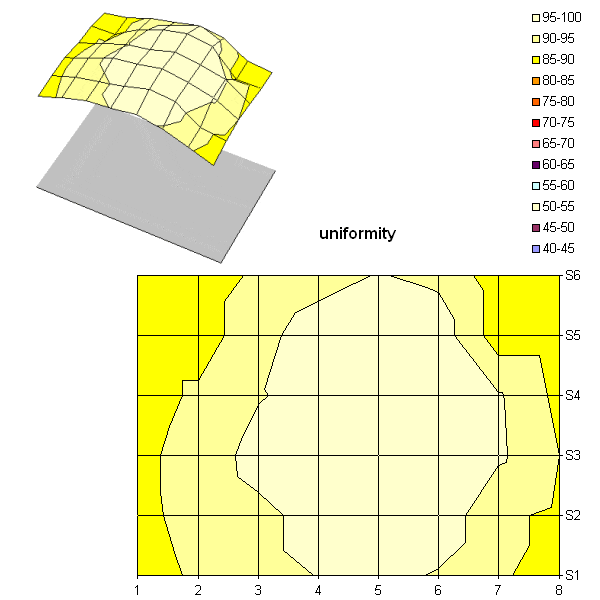
The monitor's static qualities are very respectable. The brightness is well calibrated, the display is very uniform and the default adjustments are not outlandish. As a static monitor, the Philips 230WP7NS is a serious model.
Low Reactivity

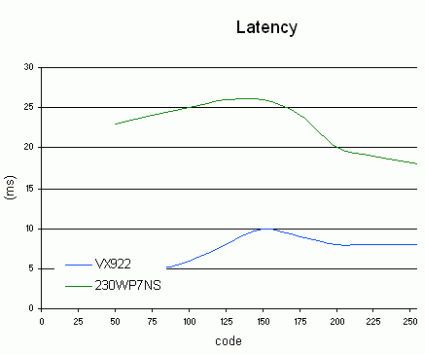
Unfortunately, displaying moving images was another story. The panel's latency readings are in line with older-generation panels, with a full 16 ms of latency at the ISO measurement point.
Overshoot
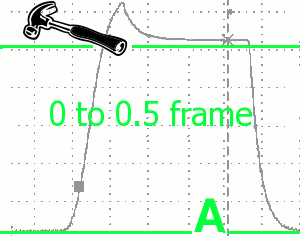
The monitor was very precise - we noted no overshoot.
- Previous page Ergonomics
- Next page In Use