- Migrating From Windows To Linux, Part 2: Installation
- Migrating from Windows to Linux, Part 1: Preparation
- VMware Workstation 4: More Virtual PCs, More Functionality
- On The Fly: Boot Knoppix Linux, Keep Windows Installation
- OS Comparison: On Which Operating System Do Games Run Best?
- Operating System: Microsoft's Windows Millennium
- High-End Workstation!
- THGC Needs You -Team 40051
- Barcelona/Shanghai Smackdown on Nehalem
- Nehalem goes mainstream in Q4 2009
- Is Phenom the worst CPU launch of all time?
- HOWTO: Overclock C2Q (Quads) and C2D (Duals) - Guide v1.6.1
- Worst PC Build Screw Ups
- Overclocking Rumor
- What would a Bugatti over-the-top PC look like?
- C2D E4300 GA965P-DS3 v3.3 F10 temps
-
part 2
-
Intel Skulltrail Part 1
-
part 3
-
build part 1
-
overclocking guide part 3
-
Overclocking Guide Part 2
-
AVIVO HD vs Purevideo HD Part
-
x38 comparison part 2
-
how to build a pc part
-
X38 Comparison Part
-
Graphics Beginners Guide Part 1
-
cpu cooler charts 2008 part 3
-
home server
-
server 2003
-
server board
-
2008 server
-
virtual server
-
server primer
Network Interface Configuration
Source: Tom's Hardware US – Keywords: server, part, 2
Syndication:
Network Interface Configuration

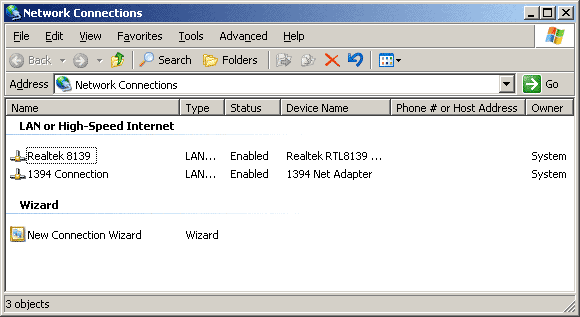
Multiple network cards are often used in server systems, which is why you should change the standard names assigned by Windows and select meaningful names. In our example, only one onboard network chip is available so that we can quite easily name the connection after it.

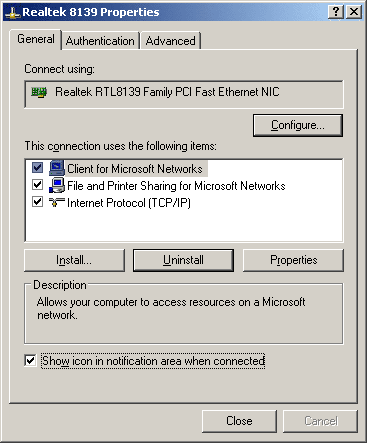
Under [Properties], after making a right-click on the desired network connection, you can get into the configuration menu. Windows likes to install the QoS service (quality of service), or alternatively network load compensation. However, in small networks, this really doesn't make sense. You should, however, select the option at the bottom of the dialog box so that the connection icon is always visible in the taskbar.
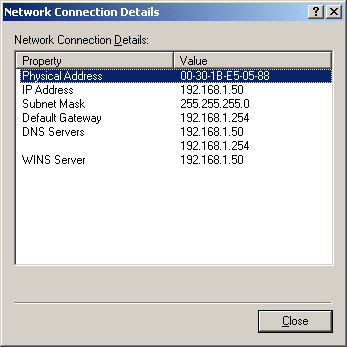
A right-click on this connection icon gives you a detailed overview of all the relevant interface data, among other things.

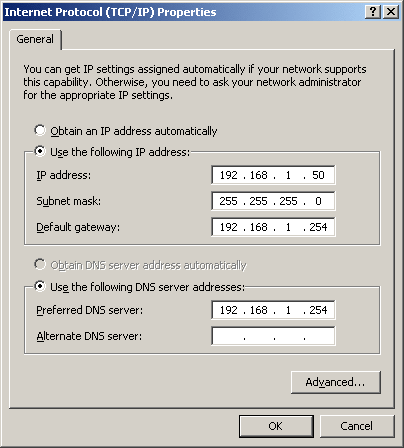
Since we are installing a server system here, it should of course always be reachable at the correct IP address. This is less important in a local network because you can also reach the computer by its name since the DNS service resolves names. However, as soon as services are to be reachable from the Internet (VPN, terminal services, FTP...) an IP address must be given for the router.
We give the IP address of our DSL router here as a gateway, because the server itself should ultimately also be given access to the Internet. At this time, we also enter the router as the DNS server.
- Previous page Internet Explorer Configuration
- Next page Active Directory Implementation