Join for quick access. Enter your email below and we'll send confirmation plus sign you up to our newsletter.
By submitting your information, you confirm you are aged 16 or over,
have read our
Privacy Policy
and agree to the
Terms & Conditions. Geographical rules apply.
Why you can trust Tom's Hardware
Our expert reviewers spend hours testing and comparing products and services so you can choose the best for you. Find out more about how we test.
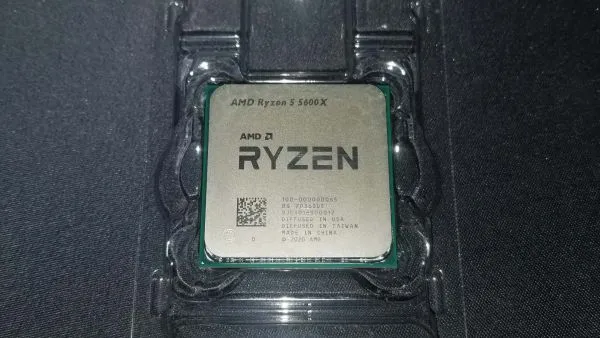
Here we'll take a closer look at the Ryzen 5 5600X's boost clock mechanisms. Our testing shows that the chips reach their advertised clock speeds within the power limits of the AM4 socket, but they generate quite a bit of heat in the process – especially if you use the bundled Wraith Stealth air cooler. The bundled air cooler doesn't impact performance in light tasks, but if you do a lot of intense threaded work, like rendering or game streaming, the bundled air cooler leads to slightly reduced performance.
As per our normal routine, we put AMD's boost clocks to the test in both single- and multi-threaded workloads (methodology here). The lightly-threaded test regimen is designed to extract the highest boost clock rates possible as we step through ten iterations of the LAME encoder, then single-threaded POV-Ray and Cinebench runs, PCMark 10, and GeekBench. To keep the charts 'clean,' we only plot the maximum and minimum frequency recorded on any one core during the test.
In the first slide in the album above, we chart out this series of tests at stock settings with the Corsair H115i 280mm air cooler. The chip peaked at 4.65 GHz, which is slightly above the advertised 4.6 GHz threshold. Temps topped out at 70C, which isn't concerning.
Unlike with the Ryzen 3000 series processors, the unused cores (plotted in black) dropped as low as 2.2 GHz during the test (previous-gen chips tended to bottom out at 3.8 GHz). This is a big improvement over the previous-gen chips: AMD added the ability for individual idle cores to drop into sleep states quickly, which reduces overall chip power consumption and heat generation. By reducing this wasted layer of power consumption, the active cores can boost to higher frequencies and they can boost more frequently and for longer durations.
The second slide shows the same series of tests, but with the bundled Wraith Stealth air cooler. The air cooler still allows the processor to boost freely in these lightly-threaded workloads and we reach the same peaks of 4.65 GHz, but we see a marked increase in peak chip temperature to 81C during the tests, which is surprising given the relatively light nature of the tests. However, that increased heat output doesn't appear to adversely impact boost frequencies or duration, but that changes when we stress the cores more fully in the tests below.
Ryzen 5 5600X Stress Test Frequency, Power, Thermals
The second series of tests plots our custom multi-threaded stress test that consists of multiple iterations of HandBrake, POV-Ray, Cinebench, v-ray, y-cruncher, and Blender renders. This is basically throwing the heaviest real-world workloads we have in our arsenal at the chip to see if we can push any active cores below the 5600X's 3.7 GHz base clock. It's important to note that all-core workloads that fully stress all the cores are represented in the areas where the red (maximum) and black (minimum) frequencies converge.
With the H115i AIO, the lowest all-core clock frequency we measured on fully active cores was 4.45 GHz, which is great considering the official 3.7 GHz base clock. Overall, all-core frequencies ranged from 4.65 GHz to 4.45 GHz. Temperatures were fine with the Corsair H115i cooler, peaking at 72C for short durations, albeit with the fans cranking away at high speed. AMD specs a maximum power draw (PPT - Package Power Tracking) of 88W for its 65W TDP processors. The 5600X peaked at 76W, meaning it has room to spare.
Stay On the Cutting Edge: Get the Tom's Hardware Newsletter
Get Tom's Hardware's best news and in-depth reviews, straight to your inbox.
Temperatures were much higher with the Wraith Stealth air cooler, though: We measured sustained periods of 92C, and a peak of 95C, during the most intense portions of the test (Blender, POV-Ray, y-cruncher). This matches AMD's 95C limit for 65W processors (105W processors have a 90C limit), but it does impact performance.
We can see that topping the 5600X with the Wraith Stealth cooler results in all-core frequencies that drop as low as 4.15 GHz, which is 300 MHz slower than the results with the H115i liquid cooler (but still well over the official 3.7 GHz base clock).
Naturally, that reduced frequency impacts performance. You'll notice that our test run required an additional 60 seconds with the air cooler - a ~3% reduction in performance. However, this reduction varies, especially if the task consists of a fixed amount of work over an extended period of time, like a rendering workload.
Overall, the bundled Wraith Spire is more than sufficient for matching AMD's spec'd clock rates in both single- and multi-threaded tasks, but the adaptive nature of Ryzen 5000's Precision Boost algorithms will reward you with higher performance if you invest in a better cooler, particularly in heavily-threaded workloads.
We recorded higher temperatures during our tests than we've seen with previous-gen Ryzen chips, but, long story short, don't get too excited about the higher stock temperatures. This is by design. AMD has tuned its boost algorithms to fully leverage every last bit of the thermal headroom available, resulting in higher chip temperatures – even during comparatively lighter workloads. This doesn't pose any danger to chip longevity and ultimately results in better performance.
To help align expectations, AMD issued the above guidelines for expected temperatures for various kinds of coolers and the expected voltage ranges for various workloads. Naturally, lesser coolers at more mundane settings will peak at higher temperatures.