









Why you can trust Tom's Hardware Our expert reviewers spend hours testing and comparing products and services so you can choose the best for you. Find out more about how we test.
Comparison Products and Testing
For comparison today we’re going to have a little bit of everything. We have the PCIe 3.0 WD Red SN700 and extend all the way to the PCIe 5.0 Crucial T700, with a collection of other SSDs in between. The Samsung 990 Pro 4TB rates as the top 4TB drive we've tested, and we have popular budget like the Lexar NM790 and Addlink A93. Older drives with DRAM include the Sabrent Rocket 4 Plus-G, the Seagate FireCuda 530, and the Netac NV7000. Lastly, we have a mid-range 4.0 drive with QLC flash in the Sabrent Rocket Q4, a drive that the SN5000 should fully supplant.
Trace Testing — 3DMark Storage Benchmark
Built for gamers, 3DMark’s Storage Benchmark focuses on real-world gaming performance. Each round in this benchmark stresses storage based on gaming activities including loading games, saving progress, installing game files, and recording gameplay video streams. Future gaming benchmarks will be DirectStorage-inclusive and we include details of that where possible.


The SN5000 performs surprisingly well in 3DMark, technically landing in the middle of the pack of 4TB drives on the chart, but it's not that far off drives like the 990 Pro. This is a good thing, as this drive is a potential candidate for a dedicated games drive, especially at 4TB. At lower capacities it should perform similarly, given that it’s essentially a cousin of the SN580 and SN770. For 4TB, it just needs to be priced right, as you can get TLC-based drives like the NM790 at often a surprisingly low price.
We may eventually see more QLC-based options like the HP FX700 that are more of a direct threat, but otherwise the SN5000 competes with the Crucial P3 Plus and Corsair MP600 Core XT. If you've been considering those drives for capacity on the cheap, the SN5000 potentially offers an alternative with a mature controller design.
Trace Testing — PCMark 10 Storage Benchmark
PCMark 10 is a trace-based benchmark that uses a wide-ranging set of real-world traces from popular applications and everyday tasks to measure the performance of storage devices.


The SN5000 does even better in PCMark 10, still falling behind the 990 Pro but coming out ahead of solid performers like the NM790 and A93. QLC flash has its downsides, but the typical user experience with this drive should be good. Problems arise when the drive gets fuller or after a prolonged workload. Looking at the ISSCC numbers for this flash, though, it’s comparable to early generations of 3D TLC flash, which when bolstered by a large pSLC cache means the SN5000 can feel fairly responsive in daily driving.
Console Testing — PlayStation 5 Transfers
The PlayStation 5 is capable of taking one additional PCIe 4.0 or faster SSD for extra game storage, with some requirements. The PS5 now supports up to 8TB drives, and while any 4.0 drive will work, Sony specifies drives that can deliver at least 5,500 MB/s of sequential read bandwidth are optimal. The PS5 does not support the host memory buffer (HMB) feature but DRAM-less drives still work. In our testing, PCIe 5.0 SSDs don't bring much to the table and generally should not be used in the PS5, especially as they may require additional cooling. Please see our Best PS5 SSDs article for more information.
Our testing utilizes the PS5’s internal storage test and manual read/write tests with over 192GB of data both from and to the internal storage. Throttling is prevented where possible using a Sabrent PS5 heatsink to see how each drive operates under ideal conditions.


The PlayStation 5 does not require anything special for an extra SSD, although ideally you should hit the 5.5 GB/s mark or higher. The 4TB SN5000 can do this and it provides essentially the same load time performance as faster drives. It’s a suitable alternative to drives like the A93 and NM790 if you want 4TB, but to make sense it needs to be less expensive.
Get Tom's Hardware's best news and in-depth reviews, straight to your inbox.
Transfer Rates — DiskBench
We use the DiskBench storage benchmarking tool to test file transfer performance with a custom, 50GB dataset. We write 31,227 files of various types, such as pictures, PDFs, and videos to the test drive, then make a copy of that data to a new folder, and follow up with a reading test of a newly-written 6.5GB zip file. This is a real world type workload that fits into the cache of most drives.


DiskBench gives a good picture of how real world file transfers fare on the SSDs. Copy performance is generally limited by the write speed, which will be lower than the read speed. For the most part, data will fit into the pSLC cache, so you can get good performance from most drives. This is the case here, with the SN5000 effectively matching “faster” drives, especially as copying is at a low queue depth.
Synthetic Testing — ATTO / CrystalDiskMark
ATTO and CrystalDiskMark (CDM) are free and easy-to-use storage benchmarking tools that SSD vendors commonly use to assign performance specifications to their products. Both of these tools give us insight into how each device handles different file sizes and at different queue depths. For ATTO, we show both linear and logarithmic scaling on the Y-axis, with the latter showing more differentiation at low queue depths.


View Original

View Original

View Original

View Original

View Original

View Original

View Original

View Original

View Original

View Original

View Original

View Original

View Original

View Original

The SN5000 performs as expected in ATTO, with an upward curve and a peak around 512KiB, more noticeable with reads. This matches our findings with the WD Blue SN580 quite well, though the drive is unable to reach the heights of SDDS that can push more bandwidth. Sequential performance is likewise limited in CDM, although QD1 reads are surprisingly good. To some extent this can translate to faster game and application load times, although generally any gaps there are small.
Random performance, in particular low queue depth random 4KB reads, is quite good. Random write latency is relatively low against even newer drives while the drive’s read latency is the best in the lineup. Data at rest will perform well on this drive, making it a good option for static data. If you’re looking for a game drive, this would fit the bill.
Sustained Write Performance and Cache Recovery
Official write specifications are only part of the performance picture. Most SSDs implement a write cache, which is a fast area of (usually) pseudo-SLC programmed flash that absorbs incoming data. Sustained write speeds can suffer tremendously once the workload spills outside of the cache and into the "native" TLC or QLC flash.
We use Iometer to hammer the SSD with sequential writes for over 15 minutes to measure both the size of the write cache and performance after the cache is saturated. We also monitor cache recovery via multiple idle rounds. This process shows the performance of the drive in various states as well as the steady state write performance.

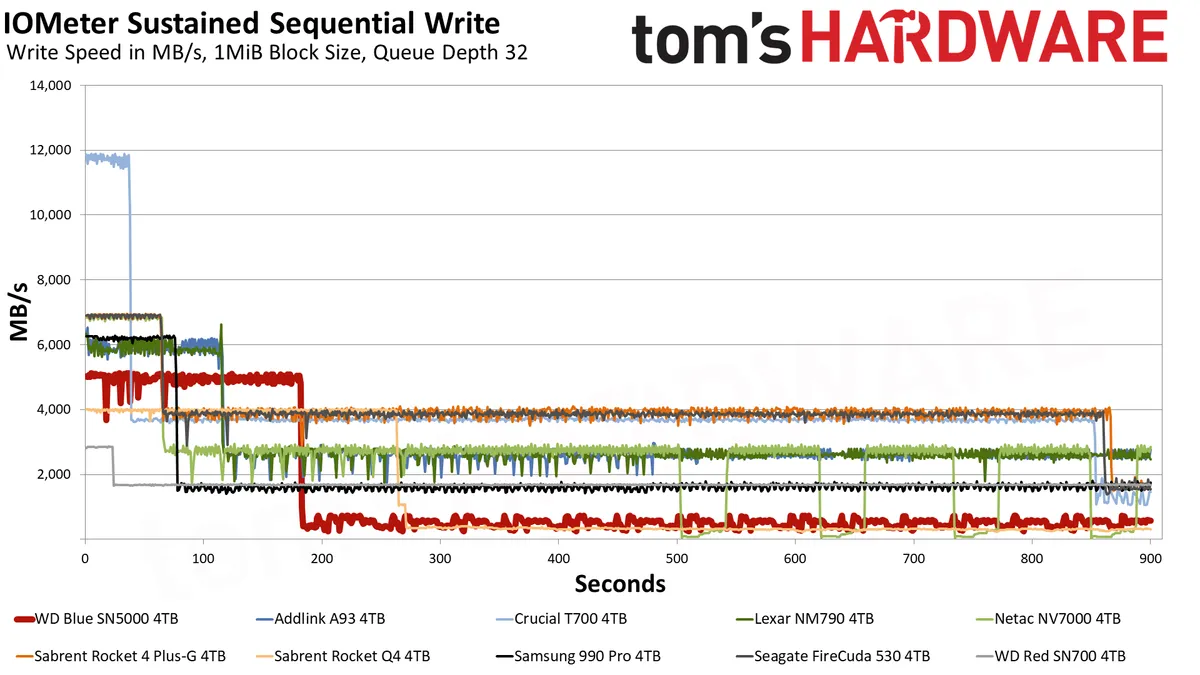


The SN5000 uses WD’s — or SanDisk’s if you prefer — nCache 4.0 technology, which is a hybrid cache that runs almost the full extent of the drive. This is similar to the Blue SN580, Black SN770M, and WD Black SN850X. Such a cache is part static and part dynamic, offering better consistency than one would otherwise expect. The result is that the SN5000 writes at almost 5 GB/s in pSLC mode before hitting a pseudo-folding state at around 544 MB/s. This is far superior to the post-cache performance of other QLC-based drives like the Crucial P3 Plus.
What’s most likely happening is that the SN5000 is alternating between direct-to-QLC and folding. If the drive is left idle, it goes back to the former performance state. Eventually it will recover pSLC, but the native QLC flash speed is good enough to pull up steady state performance. Above, we compared this QLC flash to early generation TLC flash, and this is where that becomes more apparent. According to the ISSCC documents, this flash could reach up to 60 MB/s per die. To put that into context, that’s more than twice as fast as Micron’s 176-Layer QLC flash used on the P3 Plus.
The caching scheme here, in comparison to Crucial’s full-drive dynamic, enables much higher steady state write performance. Considering that the cache is still fairly large, this is a good result and a good compromise, and certainly reminiscent of some older PCIe 3.0 TLC-based SSDs. Peak performance is higher than what was possible with 3.0, but also falls behind the faster PCIe 4.0 drives. While this doesn’t seem exciting on the surface, it means you can potentially get a robust gaming drive at up to 4TB without breaking the bank or having to suffer the P3 Plus’s questionable full-drive performance. It also means that QLC flash has, in a way, caught up to baseline TLC flash performance.
Power Consumption and Temperature
We use the Quarch HD Programmable Power Module to gain a deeper understanding of power characteristics. Idle power consumption is an important aspect to consider, especially if you're looking for a laptop upgrade as even the best ultrabooks can have mediocre stock storage. Desktops may be more performance-oriented with less support for power-saving features, so we show the worst-case.
Some SSDs can consume watts of power at idle while better-suited ones sip just milliwatts. Average workload power consumption and max consumption are two other aspects of power consumption but performance-per-watt, or efficiency, is more important. A drive might consume more power during any given workload, but accomplishing a task faster allows the drive to drop into an idle state more quickly, ultimately saving energy.
For temperature recording we currently poll the drive’s primary composite sensor during testing with a 21-22°C ambient. Our testing is rigorous enough to heat the drive to a realistic ceiling temperature for a well-ventilated case. Systems without a heatsink or sufficient airflow will see higher temperatures that what we show.


View Original

View Original

View Original

View Original

In order for the SN5000 to be a slam dunk, it needs to be power-efficient and cool-running so that it can compete as a laptop option. It does this quite admirably, being efficient though not quite topping the charts. It’s pretty close to the Corsair MP600 Elite, which uses Phison’s E27T controller with TLC flash, and is ahead of the Crucial T500 that has DRAM. It would certainly work well in any laptop. The drive only pulled a maximum of 4.73W for us, although it is rated by SMART for up to 6.3W. This is a good result.
The SN5000 hit a maximum temperature of 73°C, which isn’t bad considering how long it can write at maximum speed. The first throttling state, as given by SMART, is at 90°C, giving a decent amount of headroom. This drive should not require additional cooling in normal use but would not be difficult to cool if that’s an option.
Test Bench and Testing Notes
| CPU | Intel Core i9-12900K |
| Motherboard | Asus ROG Maximus Z790 Hero |
| Memory | 2x16GB G.Skill DDR5-5600 CL28 |
| Graphics | Intel Iris Xe UHD Graphics 770 |
| CPU Cooling | Enermax Aquafusion 240 |
| Case | Cooler Master TD500 Mesh V2 |
| Power Supply | Cooler Master V850 i Gold |
| OS Storage | Sabrent Rocket 4 Plus 2TB |
| Operating System | Windows 11 Pro |
We use an Alder Lake platform with most background applications such as indexing, Windows updates, and anti-virus disabled in the OS to reduce run-to-run variability. Each SSD is prefilled to 50% capacity and tested as a secondary device. Unless noted, we use active cooling for all SSDs.
WD Blue SN5000 Bottom Line
The WD Blue SN5000 SSD punches above its weight. Its QLC flash is the best we've ever seen, and its pSLC performance, buoyed by WD’s hybrid cache design, is quite good. Performance ends up being solid and consistent everywhere it matters. The drive is also single-sided, power-efficient, and relatively cool-running. WD also backs it with useful software and a reasonable warranty. Our primary complaint ends up being cost: Will this 4TB become competitively priced, and how long before that happens?
Another thing worth mentioning is that our review sample is 4TB and it’s not surprising WD sent out 4TB drives to reviewers without too much fanfare. It’s the only SKU to offer something new. At lower capacities, you’d be forgiven for thinking this is an SN770 in a blue package, because that’s basically the reality. That older hardware remains quite capable, but increased competition means those smaller capacity drives have to be priced aggressively. The 4TB capacity point is more interesting, even if the SN5000 doesn’t quite push the limits of its PCIe 4.0 interface.
The 4TB Blue SN5000’s primary competition consists of a variety of options. The Crucial P3 and P3 Plus, Corsair MP600 Core XT, Silicon Power UD90, and other drives that reach 4TB with QLC flash at 5 GB/s or so all land in the same general ballpark. Against these the SN5000 seems like an easy choice. Its flash is faster, it’s single-sided and efficient, and the controller technology is proven. It also stands up well to older PCIe 3.0 designs, like the now-vanished Team MP34 4TB, as it runs cooler and should be more reliable. It also gives the newer Samsung 990 EVO a run for its money. All it really has to do is come down in price.
Against faster PCIe 4.0 SSDs, the SN5000 falls behind. It won’t match the TLC-based NM790, A93, Team MP44, or Patriot Viper VP4300 Lite, and it’s also technically no match for older DRAM-equipped drives like the Adata Legend 960 Max, Silicon Power XS70, or Sabrent Rocket 4 Plus/Plus-G. However, the SN5000 is more efficient than the latter pack and could be a good alternative to the former SSDs if it’s priced competitively.
The Silicon Power US75 4TB, which has the same Maxio MAP1602 controller and YMTC 232-layer TLC NAND as the A93 and NM790, currently costs $219 by way of comparison. Considering that overall performance tends to favor those drives as well as the Netac NV7000, the WD Blue SN5000 4TB needs to at least match those on pricing if it's to be viable.
Overall, the SN5000 4TB is plenty fast for a laptop or PS5, or as a secondary drive for an enthusiast desktop build, and for the most part it punches above its weight. Even when it doesn’t, it beats other QLC-based drives on the market. So it really comes down to value. WD has to price the 4TB WD Blue SN5000 accordingly. It currently costs $349 on Amazon, though direct from WD you can get it for $279. A bit lower and it will become a much more reasonable upgrade option. Hopefully that happens sooner than later.
MORE: Best SSDs
MORE: How We Test HDDs And SSDs
MORE: All SSD Content
- 1
- 2
Current page: WD Blue SN5000 4TB Performance Results
Prev Page Intro, Features, and Specifications
Shane Downing is a Contributing Writer for Tom’s Hardware, covering consumer storage, PC hardware, and AI.
- Jarred Walton Senior Editor
-
1_rick Reply
Sounds like gibberish to me. (Actually I found a Reddit post that purported to explain it, but "Folding as used in this sense is the combining of three separate SLC blocks into a single TLC block." requires some thought. I guess it means "clearing the pSLC cache by writing to the NAND in TLC/QLC mode." Which is probably going to be slow.baboma said:Please explain "folding" and "pseudo-folding" state.
The mention of QLC flash probably elicits sighs of its own. It’s best not to be too hasty, as the performance specifications of this flash rival those of earlier 3D TLC flash generations.
And the sighs are because, as expected, once you exhaust the pSLC cache, the performance drops drastically.
The drive's probably fine until you do something like "copy Diablo IV to a different PC rather than download 90GB again" and you have to decide which one is actually going to be slower. -
Notton That's so weird. Why did they use 2x QLC for the 4TB model, when the 2TB model only used 1x TLC chip?Reply
There was plenty of space on the PCB for a second 2TB TLC chip. -
Maxxify Reply
A lot of Reddit threads and posts on this topic are by me, so I can quickly summarize here as briefly as possible. There's different granularities or units of storage depending on what you're doing with flash, the most important being the smallest read/write unit (pages) and the smallest erase (blocks). The latter is what we're talking about with folding since you're "folding" multiple blocks into one with garbage collection working at the block level as well. The smaller blocks are pseudo-SLC which means the native flash (in this case, QLC) acting in single-bit mode like SLC, so four blocks of SLC/pSLC "folds" into one block of QLC. This is required to free up space since the SLC/pSLC is only one-fourth the "real" QLC capacity.1_rick said:Sounds like gibberish to me. (Actually I found a Reddit post that purported to explain it, but "Folding as used in this sense is the combining of three separate SLC blocks into a single TLC block." requires some thought. I guess it means "clearing the pSLC cache by writing to the NAND in TLC/QLC mode." Which is probably going to be slow. -
Maxxify Replybaboma said:I did at least learn something useful from my searches. I had always wondered how empty space on SSD can be used as cache, when writing to such "cache" would be same as direct-writes. Per the reddit post below, apparently a dynamic cache of TLC/QLC can be used in SLC mode (and speed) at the penalty of requiring 3x or 4x space.
https://reddit.com/r/hardware/comments/kn7can/how_does_slc_cache_work_in_ssds
Check my reply just above as it applies here (and I did have some posts in that Reddit thread). In any case, direct writes means writing straight to the native flash. This can happen when the cache is full but doesn't take up all of the free capacity of the drive. That is, the cache is not using all of the drive's flash for the SLC mode. You usually want to avoid direct writes by using a pseudo-SLC mode because the impact of random writes is higher, but for sequential writes going to native is fine. Also, by writing first to SLC and then folding/copying to native you reduce write amplification since SLC writes out sequentially.
Regardless, if you outrun capacity you are forced into a "folding" state which is slower because you're writing to SLC first, reading from it, rewriting to TLC, confirming write before SLC erasure (to free up space), while already-written data also needs to be copied (not counting towards new writes). However, background copying can occur in any mode by taking some of the die time, so it's possible to get back SLC (or QLC vs folding) which causes a jump in performance. This can make for inconsistent speeds after the cache. -
Maxxify Reply
2TB one is probably the same as the 2TB SN770, which uses 1Tb dies (versus 512Gb at lower capacities). You can get that in one 16DP. Normally you'd do that for a drive that has to accommodate M.2 2230 (SN740/SN770M), maybe they are just repurposing. The QLC on the 4TB is 1Tb as well and so needs two packages though.Notton said:That's so weird. Why did they use 2x QLC for the 4TB model, when the 2TB model only used 1x TLC chip?
There was plenty of space on the PCB for a second 2TB TLC chip. -
Maxxify Reply
Check my replies above, since someone linked a Reddit thread I was in and I was summoned as if by magic. However, to be quick: folding is when the drive has to copy over already-written data from SLC to QLC in order to free up space/capacity. In some cases, the drive forces writes to SLC first as this can reduce write amplification/wear, in other cases it will go to writing directly to the QLC or can be forced to fold. As space is freed up, including in the background, this can lead to spikes/fluctuations in write speed.baboma said:>The result is that the SN5000 writes at almost 5 GB/s in pSLC mode before hitting a pseudo-folding state at around 544 MB/s.
>What’s most likely happening is that the SN5000 is alternating between direct-to-QLC and folding.
Please explain "folding" and "pseudo-folding" state. -
Maxxify Reply
The term "folding" comes from SanDisk and later their "nCache" technology. You can find articles on this from 10+ years ago, I think. In any case the diagram/graphic they used to explain it at the time was basically showing a DMA-like (direct memory access) operation where 3 blocks of SLC/pSLC compacted into 1 block of TLC. It's more complex than this today as there are different ways to merge blocks but essentially that is the idea. One advantage that was noted is that this can be done on-die without controller interaction, which means you don't have the overhead that killed host (incoming) I/O. You're still limited by simultaneous die operations, though.baboma said:@Maxxify, I appreciate your shedding some light on the subject. I get now where the term "folding" comes from. Some more questions if you don't mind:
. How do DRAM and DRAM-less compare in performance? Do DRAM NVMe's generally draw more power, and thus generate more heat?
. Does DRAM act as a tier 1 cache before data overflows into a SLC cache (if any) as a tier 2, and to pSLC as a tier 3?
. How has SSD performance improved over succeeding generations, and how has that improvement filter down from premium SSDs to mainstream to value offerings? (This last question is a bit expansive, so you can just summarize the highlights.)
DRAM-less drives are more often 4-channel so pull less power as a result, but if you're comparing like-for-like (and this did happen more in the past, e.g. SM2263 v SM2263XT) then DRAM-less technically pulls less power as it does away with external DRAM (which pulls some power) and reliance on a DRAM memory controller for it. However, performance could be worse in some cases, which could make it less efficient in some workloads/scenarios.
DRAM can but usually does not act as a write cache (or if it does, not in the way a HDD's DRAM cache does) but rather as a metadata cache for mapping, wear management, etc. FYI I explain this on my subreddit with my SSD Basics, which although outdated covers some of this. SSDs do use a volatile write cache but you don't need a lot of memory for that when you're accessing at a superpage level (e.g. 16KiB x 4 planes/die x 4 dies/channel x 4 channels). It makes more sense to take advantage of DRAM's latency for logical page (4KiB) mapping and other things. There can be multi-tier non-volatile caching though. Static SLC -> Dynamic SLC -> native is very common (e.g. static is FIFO, since it has different wear than dynamic) and it's possible to do pSLC -> pMLC/pTLC -> TLC/QLC and other things, but not at all common.
SSD performance has improved at the controller level and at the flash level (and for DRAM too, but mostly power efficiency). Controllers are more efficient, have way higher IOPS (and queues), better error correction (necessary for denser flash over time), more intelligent algorithms, etc. Flash has also improved a lot but people often say it hasn't. They cite that 4KiB random still feels the same, but in reality at the flash level there's been significant improvements in latency as well as power efficiency, throughput, etc. Today's DRAM-less NVMe SSDs are insanely fast and efficient as a result.
Not to advertise but I only post here from time to time (and mostly just Memory/Storage forum), you can find resources at my subreddit incl Discord. Not to derail the thread: the SN5000 is a good example of the above, since the QLC on the 4TB has specifications that would've been pretty good with Gen3 TLC drives. So people saying "flash hasn't improved" should surely take no issue with this drive, but then they want those juicy sustained graphs. It looks otherwise to be an SN770 which was a great drive borne from WD's experience with the hardware. -
SirStephenH $350!? What the hell are they thinking?Reply
You can get a 4TB 990 Pro for under $300, which beats the SN5000 in every way. -
JarredWaltonGPU Reply
I think this is just the initial MSRP, because you don't want to set a price that's "too low." It's relatively easy to come down on price, and harder to go up on price. Plus, there are places that will now be able to say, "Was $349.99, now only $249.99!" for semi-permanent sales.SirStephenH said:$350!? What the hell are they thinking?
You can get a 4TB 990 Pro for under $300, which beats the SN5000 in every way.
In fact, even WD itself now shows the base price of the 4TB as $289.99, with a "sale" to $279.99:
https://www.westerndigital.com/products/internal-drives/wd-blue-sn5000-nvme-ssd?sku=WDS400T4B0E
I expect over time the SN5000 drives will trend downward to compete with similar performance drives from other companies, and from WD itself. The SN580 2TB costs $119.99 now, while the 2TB Black SN770 and Blue SN5000 are $139.99. Note that the 2TB SN5000 uses TLC and really is the same basic hardware as the SN770, if I've got my facts right, so it makes sense for them to be priced the same. -
Avro Arrow Holy hell! The predictions of SSD storage skyrocketing in price were no joke. A 4TB NVMe costs $300CAD at the least expensive. I bought both of my 2TB NVMe drives for only $90CAD each a little over a year ago. Now the 2TB drives start at $135CAD and go up from there. That's literally a 50% increase in price from a year ago.Reply
Things were so much better a year ago that when I went into Memory Express to buy a 256MB WD Black SN770 PCIe4 NVMe to use as my new system drive. It cost $40CAD at the time but the salesperson used some "sales wizardry" to get me to spend $45CAD on a 512MB version (that was somehow faster than the 256MB model) instead. :giggle:
The prices today are just guano-insane.