Platinum Edition 2GB PC3-10666...
Shop at Price Stock Seller Rating
$169.99 yes 4.35/5.00
$165.74 yes 4.65/5.00
$149.99 yes 3.38/5.00
$139.87 yes 4.16/5.00
$89.99 yes 4.77/5.00

See More Products...

OCZ PC3-10666 Platinum Edition

Like Kingston, OCZ wants to appeal to the largest group of DDR3-1333 buyers by offering multiple models. Unlike Kingston, the "lesser" kit supplied by OCZ actually represents the company's midrange parts, with the same CAS 7 timings as its competitor's high-end parts.

That's right, price shoppers will find an even cheaper Gold kit from OCZ, but the firm's midrange Platinum Edition provides timings of 7-7-7-20. These are not just rated timings that require messing with BIOS to achieve, but are also found in the SPD values of this part number OCZ3P13332GK dual-channel 2 x1 GB kit.
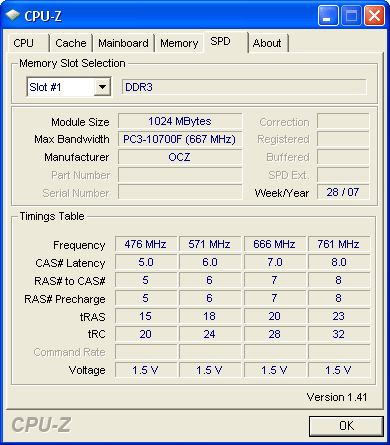
But this is where things get a little strange; OCZ's Platinum Series is actually rated to run its full performance values at 1.70 volts, yet its SPD table allows these timings to be set at 1.50 volts. OCZ is one of the companies that historically have provided modules that simply weren't bootable on some systems because its SPD values were too tight to operate at a motherboard's default voltage (1.50 volts for DDR3).

The great news is that our modules were able to operate stably at full-rated timings without manually increasing the voltage from motherboard default 1.50 to OCZ's recommended 1.70 volts. This was true for both our Gigabyte and Asus motherboards.

An SPD value of 761 MHz (DDR3-1522) at 8-8-8-23 timings provides extra room for new overclockers who are not yet familiar with manual changes, while SPD values for 571 MHz and 476 MHz translate downward to DDR3-1066 and DDR3-800 for lower FSB processors.


Talkback

dv8silencer 05/07/2008 2:45 AM
Hide
-0+
dv8silencer
I have a question: on your page 3 where you discuss the memory myth you do some calculations:


"Because cycle time is the inverse of clock speed (1/2 of DDR data rates), the DDR-333 reference clock cycled every six nanoseconds, DDR2-667 every three nanoseconds and DDR3-1333 every 1.5 nanoseconds. Latency is measured in clock cycles, and two 6ns cycles occur in the same time as four 3ns cycles or eight 1.5ns cycles. If you still have your doubts, do the math!"

Based off of the cycle-based latencies of the DDR-333 (CAS 2), DDR2-667 (CAS 4), and DDR3-1333 (CAS8), and their frequences, you come to the conclusion that each of the memory types will retrieve memory in the same amount of time. The higher CAS's are offset by the frequences of the higher technologies so that even though the DDR2 and DDR3 take more cycles, they also go through more cycles per unit time than DDR. How is it then, that DDR2 and DDR3 technologies are "better" and provide more bandwidth if they provide data in the same amount of time? I do not know much about the technical details of how RAM works, and I have always had this question in mind.
Thanks
Deleted profile 06/27/2008 2:08 AM
Hide
-0+
Latency = How fast you can get to the "goodies"
Bandwidth = Rate at which you can get the "goodies"
Deleted profile 06/27/2008 11:23 AM
Hide
-0+
So, I have OCZ memory I can run stable at
7-7-6-24-2t at 1333Mhz or
9-9-9-24-2t at 1600Mhz
This is FSB at 1600Mhz unlinked. Is there a method to calculate the best setting without running hours of benchmarks?

Note You are going to post a comment as anonymous.