Spatial Uniformity
We measured the uniformity of the panel's lighting. We set the panel at 50% brightness and 50% contrast and measure the uniformity of the lighting on a white image separated into 64 areas of equal size. The brightest point is considered to be 100%, and the previously measured black value is considered 0%, with the other values obtained distributed between them.
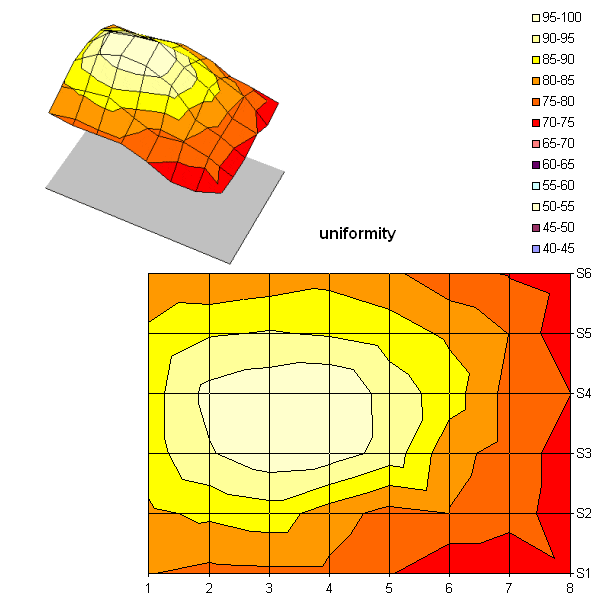
Frankly, it wasn't great. The panel wasn't very uniform. The right side was significantly less bright than the left side. On the other hand there was no upper/lower asymmetry and few light leaks.
Naturally, color fidelity is one. Black depth and the suitability of the brightness to the device's function are also taken into consideration. For example, a PC monitor that's too bright will lose points, as will a TV set that's really too dark.
12 Years In The Bottle
We measured the panel's actual latency.
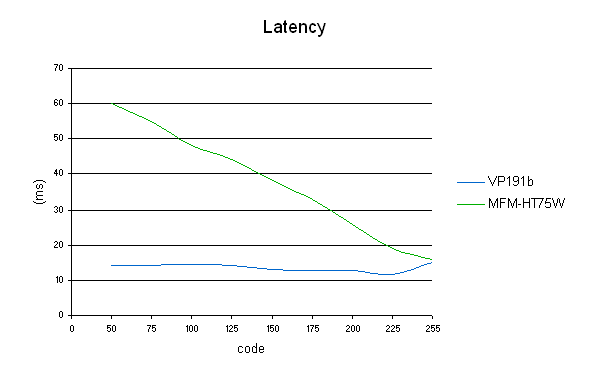
In case you are unfamiliar with our test methods, the curve shows the latency values for different levels of gray. A black-white alternation is shown on the curve by a point at X-axis 255, a black-gray alternation produces a point at X-axis 125, a black-gray alternation has a value of 50, etc.
The official ISO latency rating specified by the manufacturer is only for black/white transitions (0/255). While the value we measured may agree with the manufacturer on this point, it's not of much value in judging the panel's actual responsiveness in practice.
Despite some very serious efforts on Sony's part to do better, the latency is still unacceptable for video games. In the worst case, we logged 60 ms of latency. The preceding generations of Sony panels went beyond 130 ms. So the MFM-HT75W is twice as fast as its predecessors! But it's still five years behind the competition.